
Tabelog 100 #59
Our verdict
Honkaku Sanuki Udon Honoka places Sanuki udon in Amagasaki’s everyday dining register: low-priced, counter-friendly, self-service in parts, and serious enough to appear in Tabelog’s Udon WEST 100 for 2024. The format is compact rather than ceremonial, with udon and tempura carrying the weight of a regional noodle tradition built on speed, texture, and repetition.

Pearl is the En Primeur Club membership app, where members save venues, book tables and use the concierge.
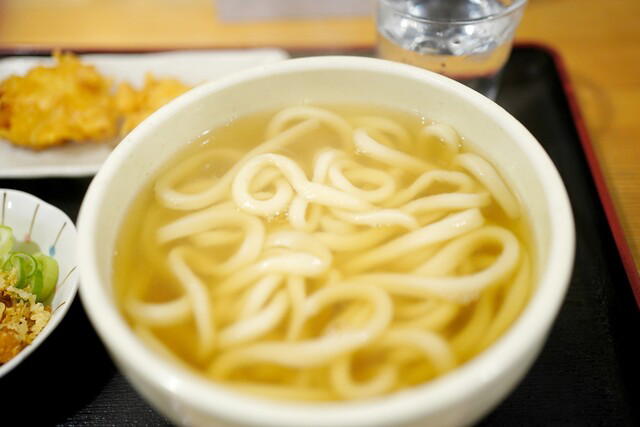
The approach to Amagasaki puts udon back where it belongs: not in a hushed tasting room, but in the rhythm of a working Kansai city. Sanuki udon, rooted in Japan’s wheat-noodle culture, travels well because its grammar is simple and unforgiving. The noodle must carry chew, the broth or dipping style must stay disciplined, and the meal has to move at a pace that suits lunch breaks, solo diners, families, and regulars who know the system before they reach the counter.
That is the useful lens for Honkaku Sanuki Udon Honoka. Its inclusion in Tabelog’s Udon WEST 100 for 2024 places it inside a regional conversation rather than a tourist checklist: western Japan has deep udon loyalties, and recognition in that category signals that a humble format can earn serious attention without abandoning its everyday price tier. In Amagasaki, where the dining map ranges from quick counters to higher-spend rooms, this is the kind of address that explains how local eating actually works.
Sanuki udon as daily food, not ceremony
Sanuki udon’s cultural force comes from repetition. The style is associated with firm wheat noodles, fast service, and a democratic relationship with toppings, condiments, and tempura. Kansai adds its own expectations around value and accessibility, so the appeal is not theatre; it is the precision of a staple done with enough consistency to become a habit.
At Honkaku Sanuki Udon Honoka, the category is stated plainly: udon and tempura. That pairing matters. Tempura in this context is not a luxury flourish but part of the everyday architecture of the meal, adding contrast and choice without shifting the experience into formal dining. The practical details also belong to the genre. The room is best understood through the pace of a specialist noodle shop, where attention stays on the bowl rather than service choreography.
The price band sharpens the point. A meal here sits at the sub-¥1,000 level, which puts it close to Amagasaki’s everyday counters rather than destination dining by spend. Read alongside Butanohoshi or Miraku En as part of a broader local map, the draw is not escalation. It is the rare alignment of low cost, specialist focus, and external recognition in a category where small differences in noodle texture and kitchen tempo decide repeat business.
A compact Amagasaki room with serious noodle credentials
The setting reinforces the format: a practical noodle shop in Amagasaki rather than a room built around ceremony. That matters in a city where dining is often practical before it is performative. The appeal suits quick meals, everyday lunches, and repeat visits. Udon’s role is all-ages and habitual rather than special-occasion cuisine.
Recognition gives the address its sharper editorial weight. Tabelog selected it for the Udon WEST 100 list in 2024, with a listed score of 3.77. Those are not luxury signals; they are consistency signals. For a noodle shop, that is the more relevant credential. Udon does not need a long narrative to justify itself. It needs a short feedback loop between kitchen, queue, counter, and returning customers.
Amagasaki’s broader dining scene rewards that kind of clarity. The city is not trying to mimic the polished dining images of larger nearby destinations. It has a tougher, more local register: everyday meals, casual specialist cooking, and prices that keep regular use possible. Within that frame, Honkaku Sanuki Udon Honoka reads as a specialist rather than a splurge.
For readers mapping the city, nearby editorial context helps. Butanohoshi shows another side of Amagasaki’s noodle culture, while other Amagasaki dining rooms widen the local restaurant map beyond udon. For the larger city view, use Our full Amagasaki restaurants guide, with parallel guides for Amagasaki hotels, Amagasaki bars, Amagasaki wineries, and Amagasaki experiences.
How to read the value proposition
The useful comparison is not with formal Japanese dining, but with other specialist, low-friction food formats. Udon at this level asks for a different kind of judgment: not luxury ingredients, not ceremony, not a chef-driven manifesto, but whether the shop can make a basic meal feel exact. A sub-¥1,000 price can hide carelessness; it can also reveal discipline because there is nowhere for excess to cover weak fundamentals.
That is why the Tabelog Udon WEST 100 selection matters. It puts a small Amagasaki shop into a broader western Japan category where the benchmark is specialist performance rather than décor. The listed budget is Dinner: - JPY 999; Lunch: - JPY 999, keeping the experience in the realm of practical everyday dining. It is better understood as an efficient noodle stop with credentials than as a soft-focus destination restaurant.
For travellers building a Kansai food itinerary, this kind of address adds a counterweight to the usual high-demand bookings. It also connects neatly to Japan’s broader casual dining vocabulary, from curry counters to onigiri shops and sake bars. EP Club’s wider Japan and diaspora map includes a range of unnamed casual dining examples across Japan and abroad. Read together, they show how casual Japanese formats travel, specialize, and survive on repeat use rather than ceremony.
Frequently asked questions
Is Honkaku Sanuki Udon Honoka okay for a casual meal?
Yes. Honkaku Sanuki Udon Honoka is best read as a casual udon and tempura specialist in Amagasaki, suited to an everyday noodle meal rather than formal dining.
What kind of setting is Honkaku Sanuki Udon Honoka?
It is an udon and tempura shop in Amagasaki. The format is low-friction and practical, with the focus on a specialist bowl rather than a long, ceremonial meal.
What price level is Honkaku Sanuki Udon Honoka?
Pricing at Honkaku Sanuki Udon Honoka is listed as - JPY 999 - JPY 999, with budget listed as Dinner: - JPY 999; Lunch: - JPY 999.
What recognition does Honkaku Sanuki Udon Honoka have?
Honkaku Sanuki Udon Honoka is listed in Tabelog’s Udon WEST 100 for 2024, with a score of 3.77.
Budget and Context
Nearby venues at a similar price tier for orientation.
| Venue | Cuisine | Price | Awards | Notes |
|---|---|---|---|---|
| Honkaku Sanuki Udon HonokaThis venue (the venue you are viewing) | Traditional Sanuki udon | $1–10 | Tabelog 100 #59 | Not listed |
| Udon Kobo Yuuyu | Udon and Tempura Shop | $10–20 | Tabelog 100 #21 | Tsukaguchi, Udon and Tempura Shop |
| Rock 'n' Billy Super 1 (ロックンビリーS1) | Award-Winning Ramen | Not listed | Not listed | Minamitsukaguchicho, Award-Winning Ramen |
| Angle | Japanese Stew & Curry House | $10–20 | Tabelog 100 #100 | /Tsukaguchi, Japanese Stew & Curry House |
| Ramen Senmon Nagomi | Specialty Ramen | $10–20 | Tabelog 100 #26 | Mukogawa, Ramen |
| Sanuki Udon Harushin | Sanuki-style Udon & Tempura | $10–20 | Tabelog 100 #92 | /潮江 (Shioe), Sanuki-style Udon & Tempura |
Recognition history
Dated appearances from independent guides and award organizations, with the underlying list record or original source where available.
Tabelog 100 #59 · No. 59
Tabelog · Tabelog 100 - Udon - WEST - 2024
Continue exploring
More in Amagasaki
Restaurants in Amagasaki
All restaurants in Amagasaki →


Bars in Amagasaki
Browse all →



Hotels in Amagasaki
Browse all →



Wineries in Amagasaki
Browse all →
Details
- Cozy
- Lively
- Classic
- Solo
- Casual Hangout
- Family
- Group Dining
- After Work
- Standalone
- A La Carte
- Counter Dining
Current opening hours
- Monday
- Closed
- Tuesday
- 10 AM–4 PM
- Wednesday
- 10 AM–4 PM
- Thursday
- 10 AM–4 PM
- Friday
- 10 AM–4 PM
- Saturday
- 10 AM–4 PM
- Sunday
- 10 AM–4 PM
Hours can change for holidays and private events. Hours as of .
Casual and bustling canteen-style udon shop with counter seating, bright daylight, and a relaxed neighborhood feel where guests watch noodles being prepared and quickly enjoy simple, comforting bowls.