
Tabelog 100 #93
Our verdict
Butanohoshi gives Amagasaki a serious ramen address in the Kansai conversation: a counter-led shop selected for Tabelog Ramen WEST “Tabelog 100” across multiple years, including 2025. The appeal is not luxury theater but concentration, sourcing logic, and a format that keeps attention on broth, noodles, and the discipline of a ramen room built for regulars as much as destination diners.

Pearl is the En Primeur Club membership app, where members save venues, book tables and use the concierge.
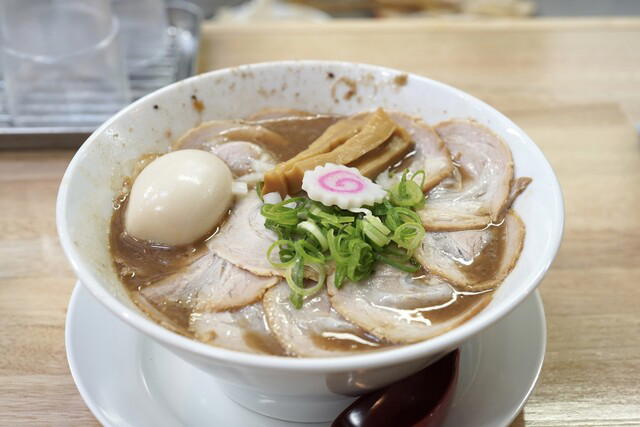
The menu
What to order
- Tonkotsu ramen
- Tonkotsu tamago ramen
- Tonkotsu char siu ramen
- Tonkotsu special
- KAKE
Approaching a serious ramen shop in Hyogo rarely feels ceremonial. The signal is usually smaller: a tight frontage, a counter rhythm, the steam-and-turnover tempo of a lunch room that has no interest in stretching a bowl into an occasion. In Amagasaki, that grammar matters. This is a city between Osaka and Kobe, close enough to both to absorb their appetites, but local enough to judge ramen on repeatability rather than spectacle.
Butanohoshi sits inside that regional conversation. Its selection for Tabelog Ramen WEST “Tabelog 100” in 2025, with earlier selections in 2019 and from 2021 through 2024, places it among western Japan’s better-documented ramen addresses. That kind of recognition is useful because ramen rankings in Japan tend to expose consistency: a shop can draw curiosity for a season, but it needs sustained local traction to remain in the conversation across years.
Amagasaki ramen is judged by broth discipline, not dining-room theatre
Ramen in Kansai has always had a different pressure than ramen in Tokyo. Tokyo’s scene often rewards narrow specialization and queue culture; Kansai diners tend to be less patient with preciousness when a bowl does not deliver immediate depth. In Amagasaki, the benchmark is even more direct. A ramen counter has to work for commuters, families, solo diners, and people comparing it against other low-friction meals nearby.
That is where ingredient sourcing becomes more than a backstory. In ramen, the sourcing question is not only what animal bones, seafood, aromatics, wheat, or fat go into the kitchen; it is whether those inputs are pushed into a broth with enough clarity to survive a compact format. A counter meal offers no long menu arc to hide behind. The bowl has to carry structure from the first spoonful, and the noodles have to sit inside that structure rather than behave as a separate starch.
Butanohoshi’s appeal should be read through that lens. The room is counter-led, and the category is ramen, so the experience is built around proximity and pace rather than extended service. An 18-seat, counter-only setup puts the cooking process and the bowl in direct relationship with the diner. In this style of restaurant, small variations in broth concentration, noodle texture, and seasoning balance are not background details; they are the entire critical field.
The surrounding Amagasaki casual-food tier reinforces the point. Teuchi Udon Yoshino and Sanuki Udon Harushin operate in a similar everyday-price band, while Honkaku Sanuki Udon Honoka sits in the city’s udon conversation at an even leaner bracket. Ramen has to justify itself differently from udon: not through wheat purity alone, but through broth extraction, fat management, tare, and the way all of that lands in a single bowl.
A counter format that rewards focused ordering
The strongest ramen shops in Japan often resist the Western habit of treating a meal as a survey. The better approach is to read the format and order with restraint. A ramen counter is designed for concentration: one bowl, a few decisions, and an understanding that the kitchen’s sourcing and preparation choices are compressed into a narrow set of variables. That is why recognition from a category-specific list such as Tabelog’s Ramen WEST matters more here than a broad lifestyle accolade would.
Butanohoshi also reflects a broader shift in how destination diners use smaller Japanese cities. Amagasaki is not usually framed as a luxury dining stop, yet its position on the rail corridor between Osaka and Kobe makes it a useful detour for food travelers who care about specialist formats. The city’s dining map mixes ramen, udon, Chinese cooking, casual Korean heat, and neighborhood drinking rooms rather than tasting-menu pageantry. For that wider context, Our full Amagasaki restaurants guide is the natural starting point.
Within that map, nearby internal comparisons help define the city’s range. Angle, Dairen, Gyoraku Karakara, and majide hamal point to a dining scene that is more granular than a single ramen pilgrimage. The useful traveler’s read is not “eat one famous bowl and leave,” but to understand how Amagasaki’s everyday restaurants compete on texture, heat, broth, and value.
Where Butanohoshi fits in a Kansai food itinerary
For travelers building a Kansai itinerary, this is not the same decision as booking a formal restaurant in central Osaka or Kyoto. It is a specialist stop, better suited to diners who appreciate compact meals and category rigor. The lack of reservation availability changes the psychology: the meal belongs to the rhythm of the shop, not to a pre-planned dining slot. That makes timing and tolerance for a counter format part of the experience, especially for visitors trying to fit Amagasaki between larger city commitments.
The price band also matters editorially. Japan’s ramen culture remains one of the few serious food categories where recognized shops can sit within everyday spending territory. That creates an unusual contrast with premium sushi, kaiseki, and tempura, where awards and access usually push the meal into a different financial register. Here, the value is not in ceremony but in the density of technique inside a short meal.
Amagasaki itself can support a broader day than the bowl. Visitors comparing food stops with overnight logistics can use Our full Amagasaki hotels guide, while drink-led planning sits better in Our full Amagasaki bars guide. The city is not a wine destination in the European sense, but Our full Amagasaki wineries guide and Our full Amagasaki experiences guide help round out the local planning frame.
Across Japan and beyond, EP Club’s broader restaurant coverage shows how different casual formats carry serious intent: -Grilled beef Sukiyaki- KAMAKURA TANUKIAN 鎌倉 たぬき庵 in Kamakura. 鮪と炭火焼き うお炭 秋葉原店 in Tokyo.cafe in Osaka.know in Kumamoto, (Shoku) Vietnam in Kawasaki, [Curry Senmon Ten] Maruyama Kyoju. in Sapporo, Jōdo Saké Bar in Los Angeles, and Onigiri Time in Pasadena. Butanohoshi belongs to that same critical category: modest in format, serious in execution, and clearer when judged through the food system behind the bowl rather than the volume of decoration around it.
Frequently asked questions
Is Butanohoshi suitable for children?
Yes. the public record lists Butanohoshi as children welcome and family friendly, with an 18-seat counter in Amagasaki. Check the venue's official channels for the latest details.
What kind of setting is Butanohoshi?
Butanohoshi is described as a house restaurant with counter seating and 18 seats total. It is non-smoking, and reservations are unavailable.
Is Butanohoshi expensive?
Pricing at Butanohoshi is listed as JPY 1,000 - JPY 1,999 JPY 1,000 - JPY 1,999.
What is Butanohoshi known for?
Butanohoshi is primarily known for its core concept and execution in Amagasaki.
At-a-Glance Comparison
Comparable venues by cuisine and price in the same metro.
| Venue | Cuisine | Price | Awards | Notes |
|---|---|---|---|---|
| ButanohoshiThis venue (the venue you are viewing) | Tonkotsu Ramen | $1–10 | Tabelog 100 #93 | Not listed |
| Sanuki Udon Harushin | Sanuki-style Udon & Tempura | $10–20 | Tabelog 100 #92 | /潮江 (Shioe) |
| Udon Kobo Yuuyu | Udon and Tempura Shop | $10–20 | Tabelog 100 #21 | Tsukaguchi |
| Ramen Senmon Nagomi | Specialty Ramen | $10–20 | Tabelog 100 #26 | Mukogawa |
| Nord | Okonomiyaki & Teppanyaki Izakaya | $10–20 | Tabelog 100 #66 | Tachibana |
| Miraku En | Yakiniku (Japanese BBQ) | Not listed | Tabelog 100 #52 | / Amagasaki Station area |
Recognition history
Dated appearances from independent guides and award organizations, with the underlying list record or original source where available.
Tabelog 100 #93 · No. 93
Tabelog · Tabelog 100 - Ramen - WEST - 2025
Continue exploring
More in Amagasaki
Restaurants in Amagasaki
All restaurants in Amagasaki →


Bars in Amagasaki
Browse all →
Hotels in Amagasaki
Browse all →



Wineries in Amagasaki
Browse all →
Details
- Cozy
- Classic
- Solo
- Casual Hangout
- Family
- Standalone
- A La Carte
- Counter Dining
Current opening hours
- Monday
- 11 AM–3 PM
- Tuesday
- Closed
- Wednesday
- 11 AM–3 PM
- Thursday
- 11 AM–3 PM
- Friday
- 11 AM–3 PM
- Saturday
- 11 AM–3 PM
- Sunday
- 11 AM–3 PM
Hours can change for holidays and private events. Hours as of .
Simple house-style ramen shop atmosphere focused on the food rather than formal dining; the setting is casual and non-smoking.