.png)
Among Osaka's mid-tier specialist counters, Tempura Urakami in Fukushima Ward takes a precise approach to the form: safflower oil, seasonal ingredient selection, and pairings that push tempura toward kaiseki territory. A 2025 Michelin Plate recognition places it in a documented peer set of serious single-subject restaurants across the city, holding a 4.6 Google rating across 115 reviews.

Tempura in a City That Takes Frying Seriously
Osaka's restaurant culture has always rewarded specialisation. The city's most respected dining rooms tend to do one thing and do it with a depth of focus that generalist menus rarely achieve. Within that framework, the tempura counter occupies a specific niche: not the theatrical omakase of high-end kaiseki, not the casual tendon bowl of a lunch-hour set menu, but a middle register where technique, ingredient sourcing, and the quiet discipline of oil management determine whether a counter earns a following or fades into the neighbourhood. Tempura Urakami, situated in Fukushima Ward at the SK Building on Fukushima 5-chome, operates in that register with a 2025 Michelin Plate recognition confirming its place in Osaka's documented dining tier.
Fukushima itself has developed into one of Osaka's more concentrated dining districts, sitting just west of the Umeda cluster and threading along a stretch where counter-led restaurants with serious single-subject formats have accumulated over the past decade. The ward rewards the kind of deliberate visit that tempura at this level requires — not a walk-in impulse, but a meal with a start time and an intention.
What Safflower Oil Signals About a Tempura Counter
The central technical decision at any serious tempura counter is the oil. Sesame oil, with its heavier aromatic register, has traditionally dominated Tokyo-style tempura. Osaka counters, operating within a broader culinary culture that prizes ingredient clarity over richness, have often leaned toward lighter frying mediums. At Tempura Urakami, the choice of safflower oil is not incidental. Safflower carries a neutral flavour profile and a high smoke point, which means the oil functions as a transparent conductor for the ingredient rather than a contributing flavour. The result, in practical terms, is that a piece of abalone or tiger prawn arrives tasting primarily of itself — the coating present as texture and temperature rather than competing flavour. This is a philosophically distinct position from counters that use the oil as part of the taste architecture, and it places Tempura Urakami in a category of lighter-register tempura practitioners that runs counter to the richer, more aromatic Tokyo model.
For visitors arriving from Tokyo's established tempura counters or from a city like Taipei where Japanese tempura formats are being reinterpreted (see Mudan Tempura in Taipei), the stylistic difference is tangible. The comparable Tokyo reference point within this editorial network is Tempura Ginya in Tokyo, where the capital's tempura tradition offers a useful contrast to what Osaka-based practitioners like Urakami are doing.
The Structure of the Meal
The meal follows a sequenced format that reflects how tempura counters at this level handle pacing. Two tiger prawns open the meal , a structural choice that front-loads a recognisable flavour reference point before the menu moves into less familiar territory. The prawn legs, served afterward as a separate course, extend the ingredient rather than discarding it: the fragrant, crisp legs draw out the aromatic dimension that the prawn flesh itself carries more subtly. This is tempura deploying a nose-to-tail logic more commonly associated with kaiseki or offal-focused Western formats.
The more compositionally ambitious courses come with pairings that push the format toward kaiseki adjacency. Abalone, a high-status ingredient in Japanese fine dining and one that demands precise heat management to avoid toughening, appears alongside milt. Both are paired with vinegared rice containing sea urchin , a combination that functions as an internal acid-fat balance, with the rice's acidity cutting against the richness of the milt and the sweetness of the urchin amplifying the ocean register of the abalone. This kind of composed pairing is less common at tempura counters, which more typically serve individual pieces with salt, tentsuyu dipping broth, or grated daikon as the primary accompaniments. Urakami's approach moves the meal closer to the constructed dish logic of the kaiseki counters operating in the same price tier across Osaka, including Hiraishi and Gochiso nene.
Osaka's ¥¥¥ Tier: Where This Counter Sits
At the ¥¥¥ price point, Tempura Urakami competes with some of Osaka's most serious single-format restaurants. Numata, Shunsaiten Tsuchiya, and the kaiseki-anchored rooms in this tier set a high contextual benchmark. The tempura format, however, operates within its own competitive logic. At the same price bracket, OIMATSU Tempura Suzuki represents the closest direct comparison within Osaka's tempura category. The two counters share a price tier and a Michelin-recognised status, making them a natural pairing for visitors mapping the city's tempura offer. Above the ¥¥¥ tier, Osaka's ¥¥¥¥ restaurants , including HAJIME, La Cime, and Fujiya 1935 , operate in a different register entirely, one defined by tasting menus with elaborate mise en place rather than the focused repetition of a single cooking technique.
For broader context across the Kansai region, Gion Sasaki in Kyoto and akordu in Nara demonstrate how this mid-tier price bracket plays out across different culinary formats and cities within the same travel radius. Further afield, Harutaka in Tokyo, Goh in Fukuoka, 1000 in Yokohama, and 6 in Okinawa collectively map the range of Japan's serious counter-format dining across different cities and styles.
A Note on the Dining Room
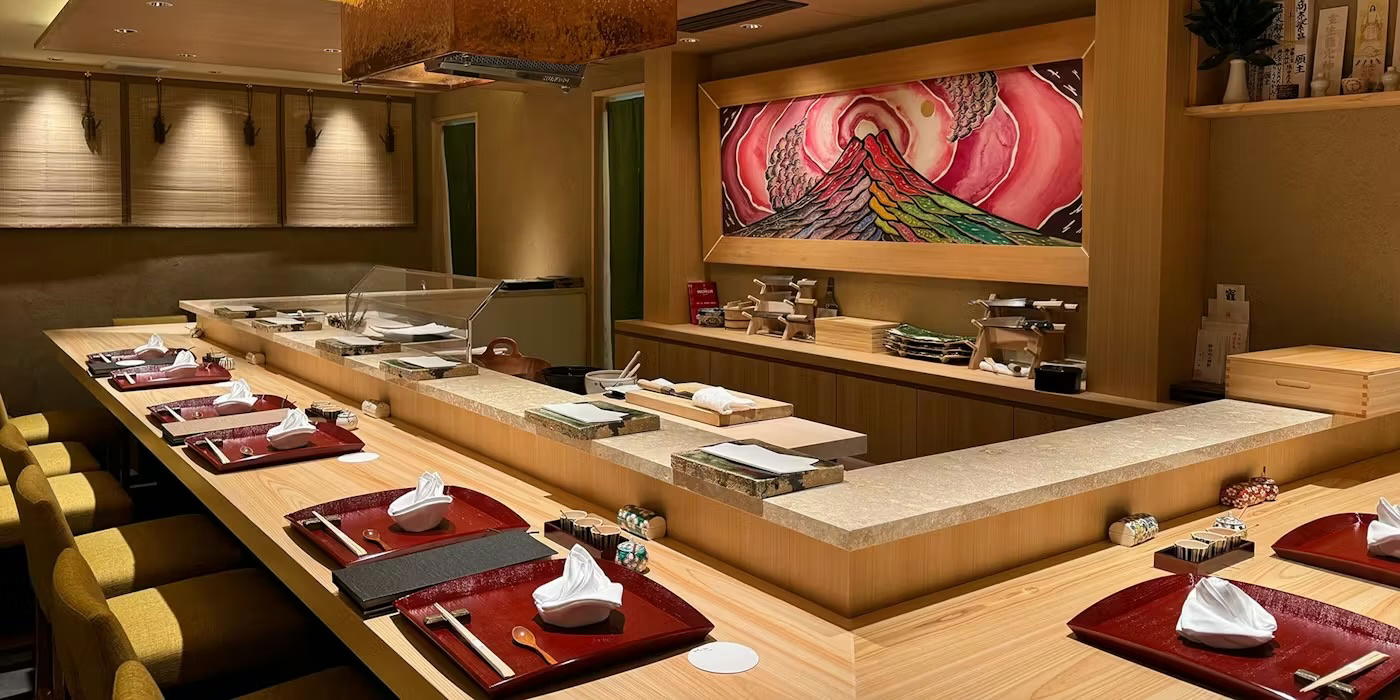
The Michelin recognition specifically notes a painting of Mount Fuji on the dining room wall, described in the context of a continuous aspiration toward higher standards. In Japan's fine-dining culture, the visual and material environment of a counter carries communicative weight , objects in the room are chosen deliberately, and the Fuji reference reads as a statement of ongoing ambition rather than arrived status. For diners familiar with how Japanese restaurant rooms signal their intentions, the detail is legible. For those arriving from contexts where dining room art is purely decorative, it functions as a subtle orienting cue about the seriousness of the format.
Planning Your Visit
Tempura Urakami is located at 5 Chome-6-3, Fukushima, Fukushima Ward, Osaka (SK Building, 1st floor). The counter holds a 4.6 Google rating from 115 reviews, which for a specialist Osaka counter at this price tier represents a stable positive consensus. Budget: ¥¥¥ tier, consistent with Michelin Plate-recognised counters in Osaka's mid-upper range. Reservations: No booking method is confirmed in available data; given the counter format and Michelin recognition, advance reservation through standard Japanese restaurant booking channels is the sensible approach. Walk-in availability cannot be confirmed. Getting there: Fukushima Ward is accessible from Osaka's central transport nodes, with Fukushima Station (JR Osaka Loop Line) and Noda Station (Osaka Metro Chuo Line) serving the area.
For a full picture of Osaka's dining, drinking, and accommodation options across all categories, see our full Osaka restaurants guide, our full Osaka hotels guide, our full Osaka bars guide, our full Osaka wineries guide, and our full Osaka experiences guide.
Frequently Asked Questions
What is the defining dish or idea at Tempura Urakami?
The structural centrepiece of the meal is the pairing of fried abalone and milt with vinegared rice filled with sea urchin , a combination that uses the rice's acidity to balance the fat in the milt and layers multiple high-status Japanese ingredients in a single composed course. This kind of constructed pairing is unusual for a tempura counter and signals that Urakami is working closer to kaiseki logic than the more direct sequential-piece format that defines most tempura restaurants at this price point. The 2025 Michelin Plate recognises the counter within Osaka's documented dining tier.
What is the signature dish at Tempura Urakami?
The meal opens with two tiger prawns followed by the fragrant fried legs served as a separate course , a technique that extends a single ingredient across two preparations to draw out both its sweetness and its aromatic complexity. Later, abalone and milt tempura paired with sea urchin rice represents the meal's most compositionally ambitious moment. Michelin's 2025 Plate recognition reflects the counter's standing within Osaka's serious tempura category, with a 4.6 Google rating from 115 reviews supporting that assessment.
Can I walk in to Tempura Urakami?
Walk-in availability is not confirmed in available data for this counter. Tempura Urakami holds a 2025 Michelin Plate recognition and a 4.6 Google rating across 115 reviews, which for a Fukushima Ward counter at the ¥¥¥ price level typically implies consistent demand. Osaka's serious counter-format restaurants at this tier , including comparable tempura operations like OIMATSU Tempura Suzuki , generally require advance reservation. Confirming availability through standard Japanese reservation channels before visiting is the practical approach.
A Lean Comparison
A quick look at comparable venues, using the data we have on file.
| Venue | Notes | Price |
|---|---|---|
| Tempura Urakami | This venue | ¥¥¥ |
| HAJIME | French, Innovative, ¥¥¥¥ | ¥¥¥¥ |
| La Cime | French, ¥¥¥¥ | ¥¥¥¥ |
| Kashiwaya Osaka Senriyama | Japanese, ¥¥¥ | ¥¥¥ |
| Taian | Kaiseki, Japanese, ¥¥¥ | ¥¥¥ |
| Fujiya 1935 | Innovative, ¥¥¥¥ | ¥¥¥¥ |
Need a table?
Our members enjoy priority alerts and concierge-led booking support for the world's most difficult tables.
Access the Concierge