taïm mediterranean kitchen
Taïm Mediterranean Kitchen on Waverly Place in the West Village has anchored New York's fast-casual falafel scene since the mid-2000s, when the format was still a novelty rather than a category. The counter offers Israeli-inflected mezze, falafel, and pita built for speed without the sacrifice of sourcing quality that defines the better end of the segment.
- Address
- 222 Waverly Pl, New York, NY 10014
- Phone
- +1 212 691 1287
- Website
- taimkitchen.com
- Directions
- Get directions
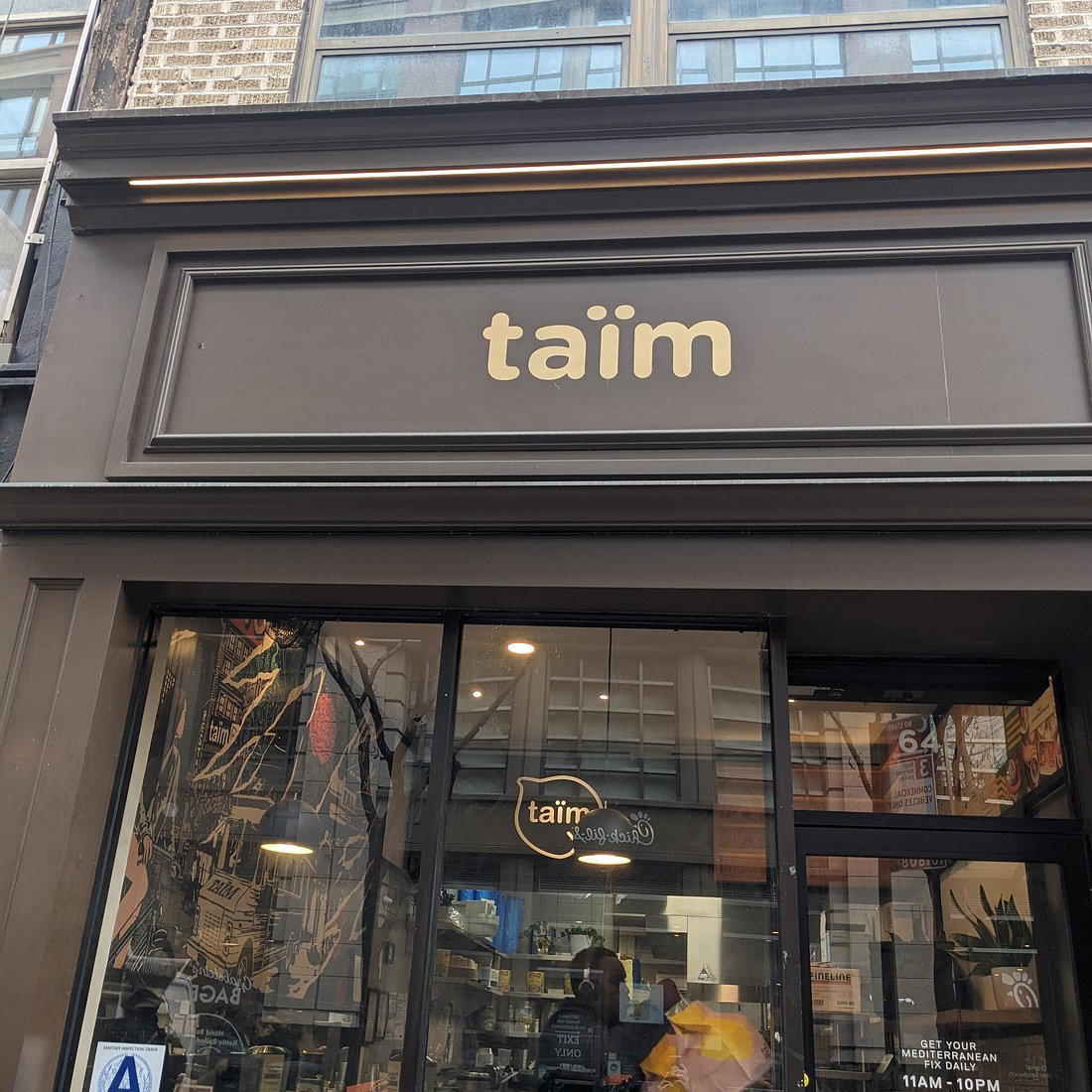
The West Village and the Rise of Serious Fast-Casual Mediterranean
New York's fast-casual dining segment has fractured sharply over the past two decades. At one end sit the chain-scaled operations optimized for throughput and price uniformity. At the other, a smaller cohort of counter-service spots has quietly developed a different playbook: tighter menus, better sourcing, and a kitchen discipline more associated with full-service restaurants than grab-and-go storefronts. Taïm Mediterranean Kitchen is a Mediterranean Street Food restaurant in New York City, with a casual dress code, a walk-in-friendly policy, and a price point around $20 per person. It sits in that second group, and its West Village address is not incidental. The neighbourhood has long supported a dining culture that expects more from a lunch counter than it does elsewhere in the city.
The West Village's food scene is built around a specific kind of diner: one who will pay for quality, knows the difference between dried and fresh herbs, and is not especially impressed by branding. That audience created the conditions for Taïm to operate as something more than a falafel stand with a tidy logo. In that sense, the address does as much editorial work as the menu itself.
Mediterranean Fast-Casual in Context: Where Taïm Sits in the New York Dining Spectrum
It is worth placing Taïm against the broader map of New York dining to understand what it is and what it is not. The city's haute Mediterranean and Middle Eastern table is served elsewhere: tasting-menu programs, wine-forward rooms, and prix-fixe formats that occupy the same price tier as Le Bernardin, Atomix, or Eleven Madison Park. Those rooms, like Masa and Per Se, command multi-hundred-dollar per-head spends and are organized around service choreography and long tasting sequences. Taïm operates in an entirely different register, one defined by speed, accessibility, and a specific Israeli-Mediterranean culinary vocabulary delivered without ceremony.
That vocabulary, however, draws from a serious tradition. Israeli food culture, particularly the street-food and mezze formats that inform Taïm's menu, has undergone significant critical reappraisal globally over the past fifteen years. What was once dismissed as simple or unremarkable has been recognized as technically precise and regionally layered, from the emulsification technique in a well-made hummus to the spice ratios that distinguish a Yemenite-inflected falafel from an Egyptian or Lebanese version. New York, with its large and culinarily literate Israeli and Jewish diaspora communities, was one of the first American cities to reflect that reappraisal at the counter-service level.
The Format: Counter Service as Editorial Discipline
The fast-casual Mediterranean format demands a kind of team discipline that does not always get credited. Without a front-of-house team in the traditional sense, without sommeliers or captains, the counter itself becomes the service interface, and the pressure on kitchen execution is correspondingly higher. When there is no tableside correction available, no wine pairing to shift a guest's attention, every component of a pita or a plate has to perform on its own terms.
This is the structural reality that shapes operations at counters like Taïm, and it separates the serious players in the segment from the casual ones. The coordination required between the team managing hot components, the team assembling cold elements, and whoever is running the counter determines whether a falafel arrives at peak temperature with the correct texture contrast, or whether it sits under a heat lamp until the crust softens. That operational precision is less visible than the choreography at full-service rooms like Blue Hill at Stone Barns or The French Laundry, but it is no less consequential for the product in the customer's hands.
The collaboration between kitchen and counter is also where Mediterranean fast-casual often fails at scale. Expansion tends to dilute the timing discipline that makes a small original location work. Taïm has navigated multi-location growth, which makes its continued presence in the West Village original a data point worth noting: the format has proven durable enough to survive the pressures of replication, even if execution can vary by site.
What the Menu Signals About the Culinary Tradition
Israeli-Mediterranean counter food in New York has evolved from a novelty category into a competitive one. The entry points, falafel, hummus, sabich, shawarma, are now offered widely, which means the differentiators are increasingly granular: the quality of the tahini, the freshness of the herbs, the structural integrity of the pita, the acid balance in a pickled component. These are not decorative details. They are the technical markers that separate a thoughtfully run counter from a high-volume commodity operation.
Taïm's menu has consistently emphasized falafel as its anchor item, which is a meaningful choice. Falafel is among the more technically demanding items in the format: the balance of soaked versus cooked chickpeas or fava beans, the hydration level of the mix, the oil temperature at fry time, and the window between service and degradation are all variables that a serious kitchen tracks carefully. Menus built around falafel as a headline are making an implicit claim about kitchen precision, in the same way that a seafood restaurant built around raw preparations is staking its credibility on sourcing and handling.
The broader Israeli-Mediterranean pantry, which also informs operations at comparable counters in other American cities, draws on a convergence of Levantine, North African, and Eastern European Jewish food traditions. The result is a culinary vocabulary that is simultaneously specific and flexible, capable of producing a tight menu with internal coherence. For New York diners accustomed to the broader range at full-service restaurants from Smyth in Chicago to Providence in Los Angeles, Taïm represents a deliberately narrow proposition executed with consistency.
Neighbourhood Position and the Waverly Place Original
The Waverly Place address has operated long enough to accumulate the kind of neighbourhood loyalty that is difficult to manufacture. West Village regulars who have been eating at the original location for years have a different relationship with it than a visitor consulting a list. That embedded local trust is one of the less quantifiable assets a counter-service operation can hold, and it tends to be the first thing that erodes when a brand scales aggressively or standardizes its supply chain.
West Village context also means that Taïm competes, however indirectly, with some of the city's most serious casual dining. The neighbourhood has a density of well-regarded independent operators across multiple formats and price points, which keeps the bar for quality perception relatively high. That competitive pressure has historically been a net positive for the original location. For visitors exploring New York's broader dining picture, our full New York City restaurants guide maps the city's full range across formats and price tiers.
Know Before You Go
Address: 222 Waverly Pl, New York, NY 10014
Neighbourhood: West Village, Manhattan
Format: Counter-service, fast-casual Mediterranean
Price tier: $20 per person
Reservations: Not applicable for counter-service format
Getting there: The West Village is well-served by the 1/2/3 lines at Christopher St and the A/C/E/B/D/F/M lines at West 4th St
Leading timing: Midweek lunch hours tend to move faster than weekend peak periods at this format
Peers in This Market
Comparable venues nearby, for context on price, style, and recognition.
| Venue | Cuisine | Price | Notes |
|---|---|---|---|
| taïm mediterranean kitchenThis venue — the venue you are viewing | Mediterranean Street Food | $$ | Not listed |
| 58-22 Myrtle Ave | Balkan & Mediterranean Specialty Market | $$ | Ridgewood |
| Olive Tree Cafe | Mediterranean & American | $$ | Greenwich Village |
| Queen | Mediterranean | $$ | Brooklyn Heights |
| Osteria Nando | Mediterranean French-Italian Bistro | $$$ | Upper East Side-Yorkville |
| Lokal Mediterranean Kitchen | Mediterranean Small Plates | $$ | Upper West Side (Central) |
Continue exploring
More in New York City
Restaurants in New York City
Browse all →
Bars in New York City
Browse all →
Hotels in New York City
Browse all →






At a Glance
- Trendy
- Modern
- Lively
- Casual Hangout
- Open Kitchen
- Local Sourcing
Current opening hours
- Monday
- 11 AM–10 PM
- Tuesday
- 11 AM–10 PM
- Wednesday
- 11 AM–10 PM
- Thursday
- 11 AM–10 PM
- Friday
- 11 AM–10 PM
- Saturday
- 11 AM–10 PM
- Sunday
- 11 AM–10 PM
Hours can change for holidays and private events. Last verified .
Lively and fresh fast-casual atmosphere focused on craveable street food.