
Tahei places Osaka yakiniku in a compact, practical register: Japanese BBQ and tripe, counter seating, sake and shochu, and repeat recognition in Tabelog’s Yakiniku WEST 100 selection. In Namba’s dense eating district, it reads less like ceremony and more like a disciplined grill house where offal culture, small-room service, and cash-minded local dining carry the argument.
Pearl is the En Primeur Club membership app — saves, bookings, and concierge access live there. Same editors, same standards.
- Address
- 大阪府大阪市浪速区難波中1-15-3
- Phone
- +81666326375
- Website
- tabelog.com
 Saves & bookings on Pearl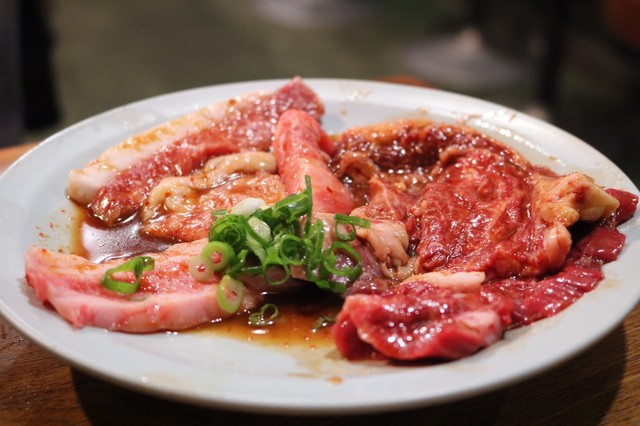
Approaching a small Namba grill room, the cues are not theatrical. Yakiniku in Osaka works through compression: table heat, disciplined smoke, close seating, and a menu that rewards groups who share cuts rather than over-order. Tahei belongs to that compact urban tradition, with Japanese BBQ and tripe at the center, not a broad hotel-style meat program.
That matters in a city where beef culture splits several ways. Osaka can do high-spend wagyu rooms, department-store dining, quick counters, and old neighbourhood grills within a few train stops. Tahei sits in the smaller, workmanlike lane: a 23-seat room with counter seating and four tables, intimate without becoming a tasting-menu performance. For travellers using Our full Osaka restaurants guide, read it as part of Namba’s dense casual dining fabric rather than a luxury detour.
Yakiniku with tripe at the center of the Osaka argument
Yakiniku’s environmental story is often told poorly because the conversation stops at premium beef. The more interesting version is older grill-house logic: use more cuts, make offal part of the meal, and let the table control quantity. Tripe is a defining category here, placing Tahei in a tradition where value and waste reduction are linked by habit, not slogan. Offal cookery has long been one of Japan’s practical answers to whole-animal eating, especially in grill formats where quick cooking and shared ordering make smaller portions viable.
Tahei’s inclusion in Tabelog 100 - Yakiniku - WEST - 2025 gives that modest format a clear trust signal. The selection places it among recognised yakiniku addresses across western Japan, and its Tabelog score of 3.68 matters on a platform where incremental differences can reflect sustained local approval. The point is not luxury theatre but consistency in a category where regulars judge heat, cut handling, sauce balance, and pace over decorative service.
Osaka’s Namba area also changes the room’s meaning. Visitors often default to famous snacks and queue-driven addresses, from pork buns at 551 Horai (551蓬莱) to bakeries such as 52CHO-ME BAKERY and coffee stops like .cafe. A small yakiniku house asks for a different tempo: order across beef and tripe, drink simply, and let the grill set the rhythm.
A small-room format in a city of big eating options
The dining room scale is part of the editorial case. A 23-seat yakiniku restaurant has different economics from a large chain grill room: fewer covers, less service choreography, and sharper dependence on repeat custom. Counter seating also changes how solo diners or pairs experience a format often associated with groups. It makes yakiniku feel less like a banquet and more like a neighbourhood meal, especially when sake and shochu are the drinks in focus.
Within the comparison set, Tahei occupies a middle lane. Daman Lumiere Takashimaya oosaka ten operates at a lower listed spend, while Sumiya sits in a higher dinner bracket. That contrast shows how Osaka’s casual-to-premium spectrum can mislead: price alone does not define seriousness. A grill house with Tabelog 100 recognition and focused category identity can carry more culinary weight than a broader, smoother restaurant with easier optics. Masachan, Comme Chinois Takashimaya oosaka ten, and Hokkyoku Nanba honten point to the same city truth: Namba’s eating culture is a stack of formats, from quick sweets to department-store French-inflected dining to smoke-led meat rooms.
For a broader itinerary, the surrounding city rewards contrast. Italian cooking at a canto (Italian) or Neapolitan-leaning pizza at 99 Pizza Napoletana Gourmet shows how international formats have been absorbed into Osaka dining. Yakiniku offers the counterpoint: heat, offal, rice, alcohol, and shared grilling’s social mechanics. Travellers building a wider route can pair the restaurant section with Our full Osaka hotels guide, Our full Osaka bars guide, Our full Osaka wineries guide, and Our full Osaka experiences guide.
How to read the meal: appetite, cuts, and cash culture
The right approach is not to chase a chef narrative. No named chef is central to the public identity here, and that suits the genre. In many serious yakiniku rooms, authority comes through procurement, preparation, grill management, and customer knowledge rather than a visible auteur. Tahei’s practical signals are old-school: cash payment, no private rooms, no private-use format, non-smoking seating, and a room small enough that planning affects the experience. Those details do not make the meal rustic; they make it specific to a local style prioritising throughput, repeatability, and direct exchange.
The sustainability angle is strongest when kept concrete. A tripe-forward yakiniku meal supports broader cut culture, and shared grilling naturally discourages the oversized main-course logic of Western steakhouse dining. That does not certify sourcing or environmental policy. It does show why Osaka grill houses deserve nuance: they can be indulgence-adjacent without being wasteful by design, especially when diners order across textures and portions rather than treating beef as a single prestige object.
For readers comparing Japanese meat formats beyond Osaka, the distinction is useful. Beef sukiyaki at -Grilled beef Sukiyaki- KAMAKURA TANUKIAN 鎌倉 たぬき庵 in Kamakura frames meat through simmered sweetness and set-piece comfort; charcoal cooking at. 鮪と炭火焼き うお炭 秋葉原店 in Tokyo moves toward fire and seafood; sake-led dining at Jōdo Saké Bar in Los Angeles treats pairing as the organising idea. Tahei is simpler and narrower, exactly its value. It asks whether a small Osaka grill room can say enough through category focus, tripe culture, and local recognition. Yes, if the diner wants the format rather than spectacle.
That lens also sorts other regional references without flattening them:.know in Kumamoto, (Shoku) Vietnam in Kawasaki, [Curry Senmon Ten] Maruyama Kyoju. in Sapporo, [ki:] in Kyoto, and Onigiri Time in Pasadena each depend on format clarity. Osaka’s version, at this address, is the compact yakiniku room where recognition, offal, and restraint in scale do the heavy lifting.
Comparable Options
Nearby venues at a similar price tier for orientation.
| Venue | Cuisine | Price | Notes |
|---|---|---|---|
| TaheiThis venue — the venue you are viewing | Traditional Yakiniku (Japanese BBQ) | $$ | Not listed |
| Ampere Coffee & Kitchen | Japanese-International All-Day Cafe | $$ | Chūō |
| Saru Shokudo Honmachi honten | Japanese Western (Yoshoku) | $$ | Chūō |
| Revo Honten | Japanese Yoshoku (Steak & Hamburger Steak) | $$ | Nishinari |
| Osake to Gohan Taku | Tuna-focused Japanese Izakaya | $$ | Kita |
| Man masa | Yakiniku (Japanese BBQ) | $$ | Ikuno |
Recognition history
Dated appearances from independent guides and award organizations, with the underlying list record or original source where available.
Tabelog 100 #88 · No. 88
Tabelog · Tabelog 100 - Yakiniku - WEST - 2025
Continue exploring
More in Osaka
Restaurants in Osaka
Browse all →




Bars in Osaka
Browse all →


Hotels in Osaka
Browse all →



Wineries in Osaka
Browse all →
At a Glance
- Lively
- Classic
- Cozy
- Energetic
- Rustic
- Casual Hangout
- Group Dining
- Family
- After Work
- Solo
- Celebration
- Standalone
- Sake Program
- Beer Program
- Street Scene
A compact, old-school yakiniku joint with counter and small tables, often packed and lively, where gas grills fill the room with smoke and the aroma of sizzling meat, creating a nostalgic Showa-era, no-frills atmosphere focused on casual eating and drinking.