Tacos Al Pastor Estilo Puebla
Our verdict
A Coliseum Way address puts this Puebla-style al pastor operation at the working edge of East Oakland, where the trompo tradition travels intact from central Mexico. The format is tight, the focus narrow, and the cooking anchored in the regional logic of Puebla's street taco culture rather than the generalist Mexican menus that dominate the corridor. Worth knowing before you make the trip to this part of the city.

Pearl is the En Primeur Club membership app, where members save venues, book tables and use the concierge.
The menu
What to order
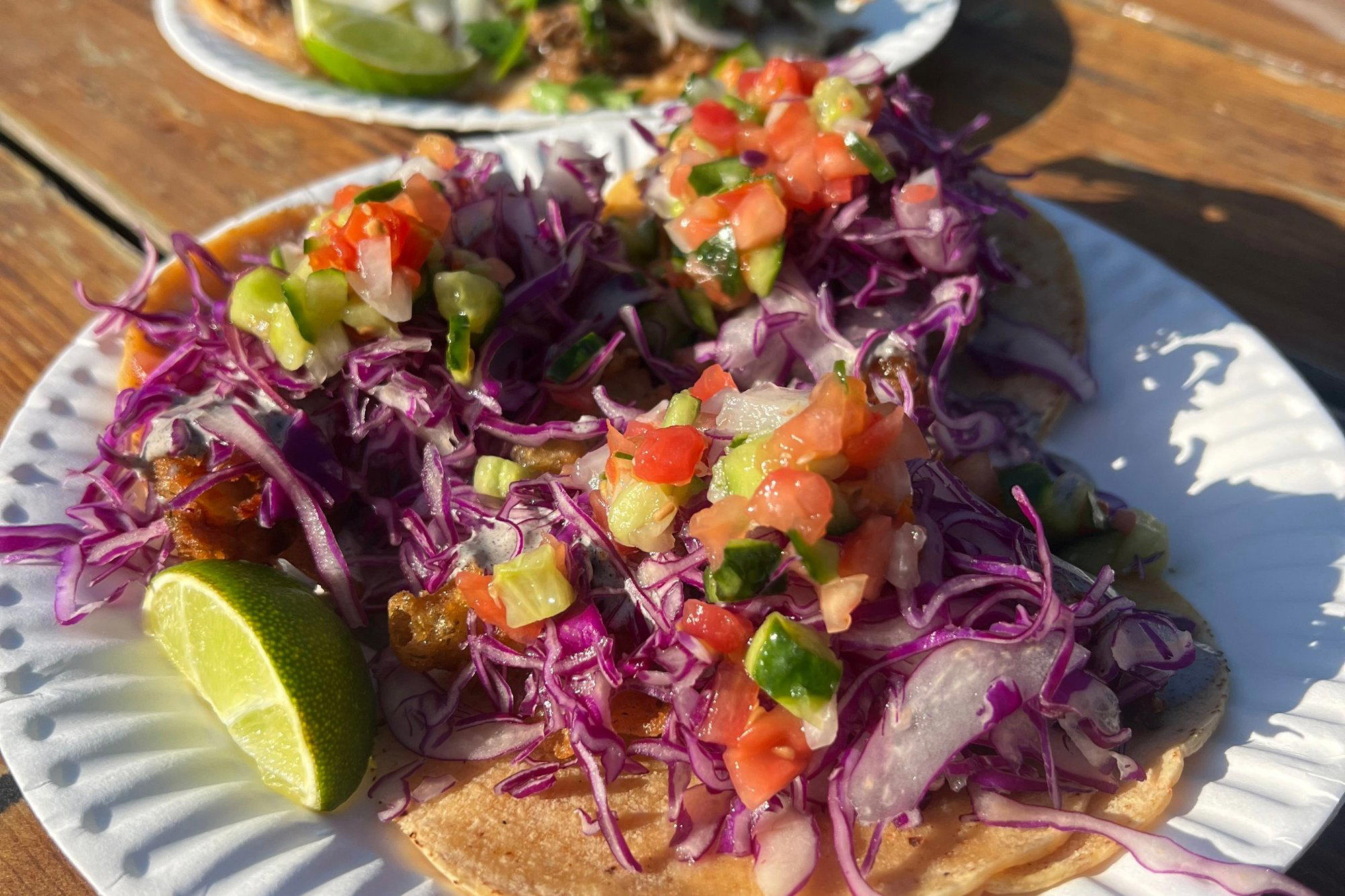
- Tacos al Pastor
- Gringas
East Oakland and the Trompo Tradition
The stretch of Coliseum Way that runs through the Elmhurst district is not where most Oakland dining coverage lands. The restaurant press tends to cluster in Temescal, Grand Lake, and Uptown, which means a place like Tacos Al Pastor Estilo Puebla operates almost entirely outside the critical conversation that shapes the city's food reputation. That is partly a function of geography and partly a function of format: al pastor at this level of specificity is street food first, and street food rarely earns column inches proportional to its actual cultural weight.
Al pastor as a tradition has deep roots in the collision between Lebanese shawarma culture and Mexican taco technique, a migration that moved through Puebla and Mexico City in the mid-twentieth century and produced one of the defining preparations in Mexican cooking. The vertical spit, the marinated pork, the pineapple counterpoint, these are not incidental details but structural elements of a regional grammar. Puebla's version sits slightly apart from Mexico City al pastor in its seasoning profile and achiote weight, and a venue that signals that regional specificity in its name is making a declaration about lineage, not just menu category.
What Sustainable Street Food Actually Looks Like
The sustainability conversation in American dining tends to orbit fine-dining formats: tasting menus with named farm partners, kombucha in-house fermentation programs, chefs photographed at farmers markets. That framing misses where the majority of the country's most resource-conscious cooking actually happens. Traditional taco operations running a trompo use whole-animal logic by structural necessity. Every part of the pork shoulder that goes onto the spit gets used; waste is not a philosophy but an economic reality baked into the format.
This is the kind of cooking that operations like Blue Hill at Stone Barns in Tarrytown articulate as a value system. At the street-taco level, the same logic runs without the institutional framing. The trompo itself is an inherently efficient cooking mechanism: the rotating vertical heat source produces consistent results with minimal energy overhead, and the format's reliance on simple corn tortillas, fresh cilantro and onion, and a protein carved directly at service keeps the supply chain short and the ingredient count low. That is not incidental to what Puebla-style al pastor is. It is the tradition.
Oakland's food corridor along the Coliseum Way and International Boulevard zones supports several operations working in this mode. Cenaduria Elvira nearby runs home-style Mexican including tacos dorados and tostada raspada in a similarly focused format, where the menu's narrowness signals competence rather than limitation. The East Oakland taco scene as a whole operates at a different register than the farm-to-table narrative that gets amplified in food media, and understanding that register means reading the signals differently.
Reading the Neighborhood
East Oakland's Elmhurst district has a predominantly Latino population and has historically supported a dense network of taquerias, panaderias, and family-run Mexican and Central American operations. For Puebla-style cooking specifically, this part of the East Bay has a meaningful residential population with roots in Puebla state, which creates both the demand and the informal standard of comparison that keeps regional specificity honest. A Puebla-style al pastor operation in this neighborhood is cooking for people who know what Puebla-style al pastor tastes like from primary experience, not from a trend cycle.
That community context functions as a quality signal that no award or publication endorsement can replicate. It is also why the Oakland taco scene in East Oakland remains meaningfully distinct from the polished Mexican restaurants that appear in Uptown or near the Grand Lake corridor, where venues like Agave Uptown operate in a different price tier and for a different primary audience. Both have their place in the city's food ecology; they are simply answering different questions.
For a broader orientation to where Oakland's dining sits across formats and neighborhoods, the full Oakland restaurants guide maps the city's range from operations like 3 Bottled Fish and alaMar Dominican Kitchen to the Hong Kong-style tea house format at 8th St Cafe and the Ethiopian coffee culture represented by Alem's Coffee. The city's food identity is substantially more distributed than the coverage suggests.
Where This Fits Against the Broader Scene
The fine-dining end of the California and national table is well-documented. The French Laundry in Napa, Single Thread Farm in Healdsburg, and Lazy Bear in San Francisco represent the formal, technique-heavy, award-structured tier of West Coast dining. Nationally, operations like Le Bernardin in New York City, Alinea in Chicago, and Atomix in New York City anchor the critical conversation. That conversation matters, but it accounts for a thin slice of where and how Americans actually eat.
The al pastor tradition sits at the opposite structural pole: low overhead, high craft, community-embedded, and evaluated by the people eating rather than by outside critics. That is not a consolation framing. It is a description of how a distinct kind of culinary authority actually works. The regional specificity in the name, Estilo Puebla, is the equivalent of a sourcing credit at a fine-dining table. It tells you where the knowledge comes from and invites you to hold the result to that standard.
Know Before You Go
- Address: 4930 Coliseum Way, Oakland, CA 94601
- Neighborhood: Elmhurst, East Oakland
- Format: Street-style taco operation, Puebla al pastor focus
- Reservations: Not applicable to this format; walk-in only
- Phone / Website: Not publicly listed at time of publication
- Price: Street taco pricing; cash recommended for this category of operation
- Getting There: Coliseum Way is accessible via I-880; street parking available in the corridor
- Ideal time to visit: Al pastor trompo operations typically run at peak from late morning through mid-afternoon when the spit is freshest; arrival timing matters
Frequently asked questions
Where do I go for Tacos Al Pastor Estilo Puebla?
Tacos Al Pastor Estilo Puebla is located at 4930 Coliseum Wy, Oakland, CA 94601, Oakland.
How does Tacos Al Pastor Estilo Puebla differ from other al pastor spots in the East Bay?
The Puebla designation refers to a regional preparation style from the Mexican state of Puebla, where Lebanese immigration in the mid-20th century shaped the original trompo technique, distinct from Mexico City or Jalisco variants. In the East Bay, al pastor is broadly available, but venues specifying Puebla-style preparation are fewer. This spot on Coliseum Way in Oakland makes that regional specificity its point of difference.
What should I eat at Tacos Al Pastor Estilo Puebla?
The name signals the focus: al pastor prepared in the Puebla tradition, which typically means achiote-marinated pork shaved from a vertical trompo spit. At a venue operating under this format on Coliseum Way in East Oakland, the al pastor taco is the throughline, order multiples rather than range across a broad menu.
Do I need a reservation for Tacos Al Pastor Estilo Puebla?
Taquerias operating in the street-food format at 4930 Coliseum Way do not typically take reservations. Walk-in is the standard approach, though peak lunch and dinner windows in East Oakland's Elmhurst district can draw a line, arriving early or off-peak is the practical move.
What makes Tacos Al Pastor Estilo Puebla worth seeking out?
Most Oakland taco coverage concentrates on the Fruitvale corridor. Tacos Al Pastor Estilo Puebla operates in the Elmhurst stretch of Coliseum Way, a part of East Oakland that sustains a dense taqueria and panaderia network largely outside the food press. The Puebla-specific preparation distinguishes it from generic al pastor found elsewhere in the East Bay.
Do they accommodate allergies at Tacos Al Pastor Estilo Puebla?
The al pastor format relies on marinated pork, flour or corn tortillas, and traditional garnishes, guests with specific dietary requirements should confirm directly when ordering at the counter on Coliseum Way.
Peers You’d Cross-Shop
Comparable venues nearby, for context on price, style, and recognition.
| Venue | Cuisine | Price | Notes |
|---|---|---|---|
| Tacos Al Pastor Estilo PueblaThis venue (the venue you are viewing) | Puebla-Style Al Pastor Tacos | $10–20 | Not listed |
| Peña’s Bakery | Traditional Mexican Bakery | $1–10 | St. Elizabeth |
| El Potrillo Birrieria | Authentic Mexican Birrieria | Not listed | South Kennedy Tract |
| Cholita Linda | Latin American Taqueria | $20–30 | Temescal |
| La Salsa | Fresh Mexican Grill | Not listed | Downtown Oakland |
| Mariscos La Costa | Mexican Mariscos & Ceviche | $10–20 | Fruitvale Station |