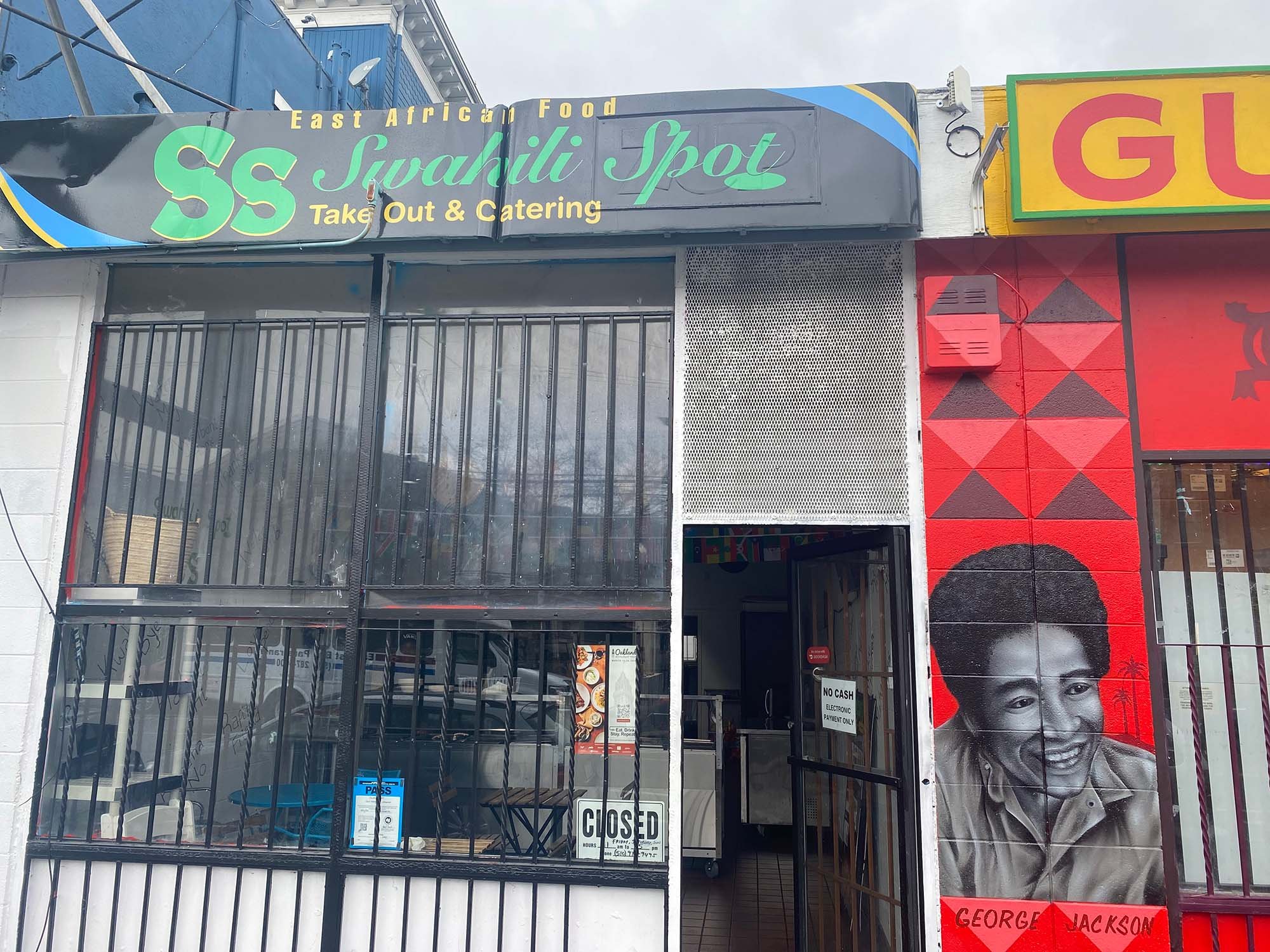
Swahili Spot
Our verdict
Swahili Spot serves authentic Tanzanian lunch from a standalone Oakland address, with quick-bite dishes including vitumbua, chicken curry rice bowl, and bongo beef rice bowl.

Pearl is the En Primeur Club membership app, where members save venues, book tables and use the concierge.
The menu
What to order
- Vitumbua
- Chicken curry rice bowl
- Bongo beef rice bowl
West Oakland's East African Table
West Oakland's Peralta Street corridor has long operated outside the city's better-documented dining circuits. The neighborhood draws less editorial attention than Uptown or Temescal, which means the restaurants that have taken root there tend to reflect community demand rather than trend pressure. Swahili Spot, at 1327 Peralta St, sits inside that context: an East African kitchen in a part of Oakland where the dining culture skews toward working-class authenticity over culinary theater.
East African cooking in the United States occupies a smaller, less codified niche than West African or Ethiopian traditions, which have established footholds in cities like Washington D.C. and the Bay Area's own East Bay Ethiopian corridor. Swahili cuisine, rooted in the coastal cultures of Kenya, Tanzania, and Zanzibar, carries the imprint of centuries of Indian Ocean trade: coconut milk, aromatic spice blends, and slow-braised proteins that reflect Arabic, South Asian, and indigenous African influences layered over each other. That history of exchange is not incidental to the food; it is the food's organizing logic.
Where the Indian Ocean Meets a West Oakland Block
The editorial angle that applies most precisely to Swahili cooking is the intersection of imported technique and indigenous product. The coastal Swahili kitchen developed as a trade-route cuisine, absorbing South Asian spice knowledge, Arabic slow-cooking methods, and African agricultural staples into a single coherent framework. In that sense, it predates the "local ingredients, global technique" framing that contemporary fine dining has adopted as a self-conscious design choice. For a Swahili kitchen, that integration is not a program; it is the inherited condition of the cuisine.
Oakland's food culture has shown a consistent appetite for this kind of layered immigrant cooking. Venues across the city draw on diaspora traditions to produce food that carries genuine regional authority rather than approximation. alaMar Dominican Kitchen works Caribbean coastal traditions into a West Oakland format; Alem's Coffee grounds an East African cafe culture in the neighborhood's daily rhythms. Swahili Spot extends that pattern into a less-represented culinary geography.
The contrast with the Bay Area's high-technique register is worth noting. Venues like Lazy Bear in San Francisco or Single Thread Farm in Healdsburg build their identity around explicit technique-as-theater, where provenance and method are narrated at the table. Swahili Spot operates in a different register entirely: the technique is embedded in the cuisine's history rather than foregrounded as innovation. For diners accustomed to tasting menus at The French Laundry in Napa or Providence in Los Angeles, the shift from performed precision to inherited craft is itself a form of education.
What the Cuisine Actually Represents
Swahili cooking's spice vocabulary draws heavily from the Zanzibar spice trade, one of the most consequential commodity networks in nineteenth-century Indian Ocean commerce. Cloves, cardamom, cumin, and coriander appear in both savory preparations and in the rice dishes (pilau, biriyani variants) that reflect South Asian influence on the coast. Coconut milk functions as both a cooking medium and a flavor bridge between African and South Asian elements. Grilled and braised meat preparations, often with acidic marinades, sit alongside fish and seafood dishes that reflect the coastal geography of the cuisine's origins.
This is not a cuisine that translates easily into a single signature register. It is broad enough to encompass street-food formats (mishkaki, maandazi) and more composed preparations, which means a Swahili restaurant in a diaspora context has real decisions to make about which register to emphasize and for which audience. How Swahili Spot navigates those choices is part of what defines its position in Oakland's dining scene.
For context on how diaspora kitchens in Oakland position themselves across format and price tiers, see 3 Bottled Fish, 8th St Cafe, and Agave Uptown, each of which handles a different origin tradition in a broadly analogous way.
Oakland's Underreported Dining Geography
West Oakland's Peralta Street address places Swahili Spot at some distance from the neighborhoods that attract most first-time visitors to Oakland's restaurant scene. That geographic remove is not a liability for a venue serving a community audience, but it does affect discoverability for travelers whose itineraries are organized around Uptown or Temescal. The tradeoff is a dining room that operates without the ambient performance pressure of a scene-adjacent location.
Within Oakland's broader immigrant kitchen tradition, Swahili Spot occupies a relatively rare position. Ethiopian restaurants in the East Bay have built genuine critical density, with multiple venues and a shared audience that understands the cuisine's conventions. East African coastal cooking has not reached that kind of market saturation in the Bay Area, which means Swahili Spot is working in a space where it must educate as well as serve. That is a different commercial and creative challenge than operating inside an established cuisine category.
Comparisons to venues working in analogous positions in other cities are instructive. Atomix in New York City has built a high-recognition platform for Korean cooking that required similar audience education in its early years. Blue Hill at Stone Barns in Tarrytown did comparable work for American farm-driven cuisine before that category had established conventions. The challenge of representing an underexposed tradition to a new audience is not specific to any one cuisine, but it is a challenge that shapes a venue's programming choices in ways that more established categories do not face.
Oakland's record with this kind of restaurant is generally positive. JUNE'S PIZZA and Joodooboo have both built audiences for formats that were not obvious fits for the market at the time of opening. The city's dining culture tends to reward specificity over generalism, which works in favor of a venue with a coherent regional identity.
For a broader map of how Oakland's restaurant scene is organized by neighborhood and cuisine tradition, see our full Oakland restaurants guide.
Know Before You Go
- Address: 1327 Peralta St, Oakland, CA 94607
- Neighborhood: West Oakland
- Cuisine: East African (Swahili / coastal tradition)
- Hours: Not confirmed; verify before visiting
- Booking: Not confirmed; walk-in availability unknown
- Phone / website:
- Can I walk in to Swahili Spot?
- What is the standout thing about Swahili Spot?
- The most editorially significant aspect of Swahili Spot is its representation of a cuisine tradition with very limited Bay Area presence. East African coastal cooking, shaped by Indian Ocean trade routes and the layering of African, Arab, and South Asian influences, is not well-documented in the region's restaurant coverage. That gap in the local landscape is itself part of the venue's value to diners interested in diaspora cooking traditions that have not yet reached critical market mass.
- How does Swahili Spot handle allergies?
- Is Swahili Spot the only East African coastal restaurant in Oakland?
Frequently asked questions
Where exactly is Swahili Spot?
Swahili Spot is located at 1327 Peralta St, Oakland, CA 94607, Oakland.
Is Swahili Spot one of the only East African coastal restaurants in the Bay Area?
East African restaurants in the Bay Area skew heavily toward Ethiopian cuisine, which has a well-established presence across Oakland and the broader region. Swahili coastal cooking, distinct from Ethiopian in its spice profile, its reliance on Indian Ocean trade-route ingredients, and its Bantu-Arab-South Asian synthesis, occupies a much narrower niche. Swahili Spot's Peralta Street location in Oakland represents one of the few dedicated venues for this tradition in Northern California.
What's the signature dish at Swahili Spot?
The kitchen draws on Swahili coastal traditions, which typically center on slow-cooked stews, rice dishes prepared with Indian Ocean spice blends, and grilled proteins built on the Zanzibar spice trade's flavor vocabulary. Contacting the restaurant directly at 1327 Peralta St, Oakland will give you the most accurate picture of what's on the current menu.
Can I walk in to Swahili Spot?
Walk-in availability at Swahili Spot has not been formally documented, and the restaurant does not currently list a reservations platform or phone number in public records. Given its West Oakland Peralta Street location outside the city's main dining corridors, demand patterns differ from higher-traffic neighborhoods, but arriving early or calling ahead is always the safer approach for a small independent spot.
What's the standout thing about Swahili Spot?
The address itself tells part of the story: 1327 Peralta St sits in a West Oakland corridor that receives little editorial coverage compared to Temescal or Rockridge, yet Swahili cooking, shaped by centuries of Arab, South Asian, and Bantu exchange along the East African coast, is among the most historically layered cuisines available anywhere in the Bay Area. That combination of location and cuisine makes Swahili Spot one of the few places in Oakland where you can engage seriously with this culinary tradition.
How does Swahili Spot handle allergies?
Swahili cooking traditionally relies on ingredients like coconut milk, various spice blends, and wheat-based preparations, so guests with specific dietary restrictions should check the venue's official channels before visiting. The address is 1327 Peralta St, Oakland, CA 94607.
Booking and Cost Snapshot
Comparable venues nearby, for context on price, style, and recognition.
| Venue | Cuisine | Price | Notes |
|---|---|---|---|
| Swahili SpotThis venue (the venue you are viewing) | Authentic Tanzanian | $10–20 | Not listed |
| Enssaro Ethiopian Restaurant | Authentic Ethiopian | $20–30 | Adams Point, Authentic Ethiopian |
| Cafe Colucci | Authentic Ethiopian | $20–30 | Paradise Park, Authentic Ethiopian |
| Kingston 11 Cuisine | Authentic Jamaican Caribbean | $20–30 | Northgate, Authentic Jamaican Caribbean |
| Sura Korean Cuisine | Korean Cuisine | $20–30 | Temescal, Korean Cuisine |
| lion dance cafe | Vegan Singaporean-Chinese California Italian Fusion | $30–50 | Downtown, Vegan Italo-Chinese-Singaporean |