Palace Hotel, a Luxury Collection Hotel, San Francisco



Michelin Selected · Forbes Recommended · Virtuoso Luxury Hotel Partner
San Francisco's oldest luxury hotel, the Palace has occupied its downtown block since 1875 and sits on California's historical landmark registry. Part of Marriott's Luxury Collection, the 556-room property pairs Gilded Age architecture — including the glass-domed Garden Court — with renovated rooms and two in-house restaurants.200 reviews reflects consistent delivery at scale.

Pearl is the En Primeur Club membership app — saves, bookings, and concierge access live there. Same editors, same standards.
- Address
- 2 New Montgomery St, San Francisco, CA 94105
- Phone
- (415) 512-1111
- Website
- marriott.com
- Directions
- Get directions
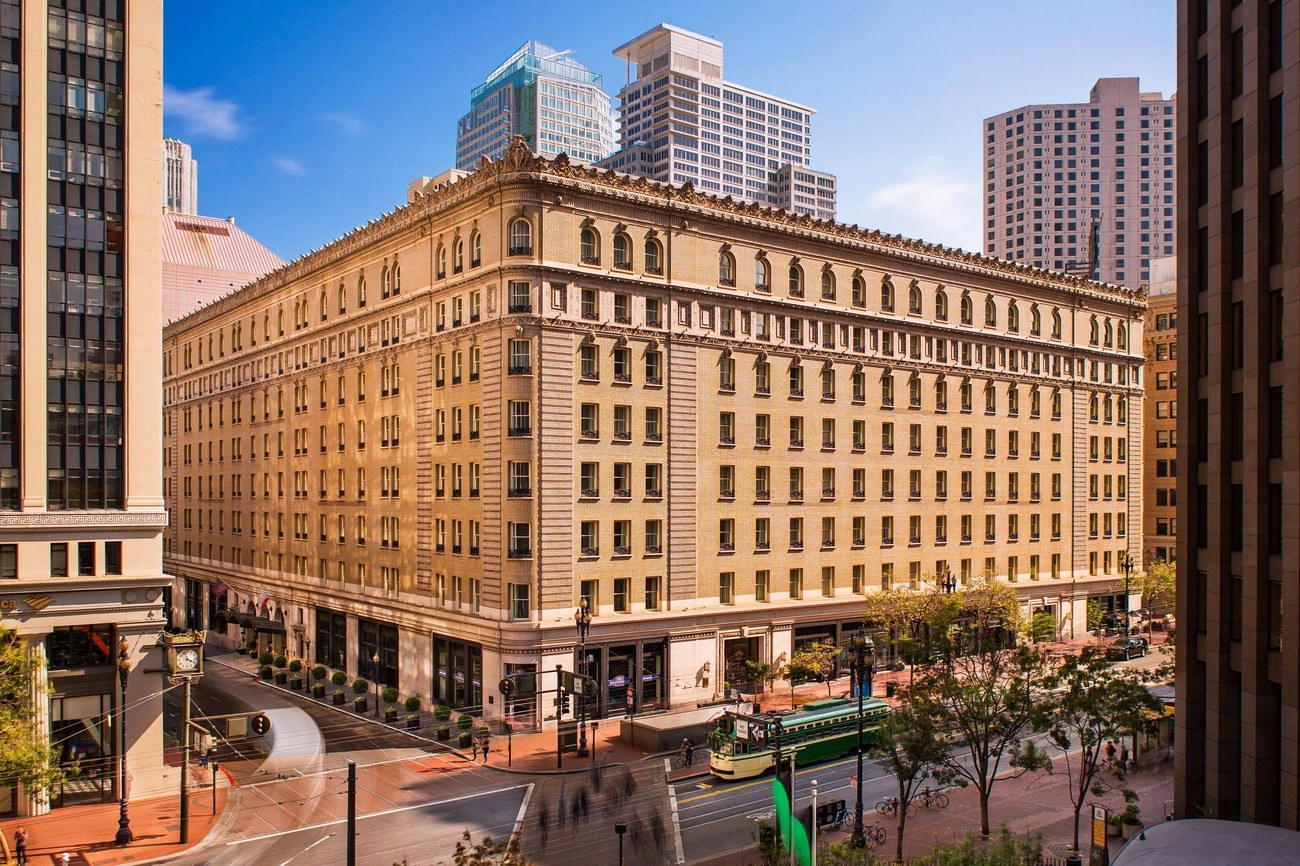
Where the Gilded Age Still Has a Dress Code
Approaching the Palace Hotel from New Montgomery Street, the wrought-iron entrance doors set the tone before you've reached reception: ornate hand-painted gold detail, cherub faces worked into the metalwork, the kind of craftsmanship that takes a building out of the hospitality category and places it in the civic one. San Francisco has no shortage of grand hotels, but the Palace occupies a different position in that conversation. Opened in 1875 on an entire city block bounded by New Montgomery, Market, Jessie, and Annie streets, it is the city's oldest luxury hotel and one of California's oldest standing buildings, listed on the state's historical landmark registry. That combination of documented age and physical survival — through the 1906 earthquake and the fires that followed — gives the property an authority that newer entrants to the downtown market cannot replicate.
Within San Francisco's current luxury hotel tier, the Palace sits alongside properties like the Fairmont San Francisco as one of the city's genuinely historic addresses, distinct from the design-led and lifestyle-oriented hotels that have reshaped the market in the past decade. Properties such as 1 Hotel San Francisco and The Battery have carved out their own positions with contemporary programming and tightly curated guest lists, while the Four Seasons Hotel San Francisco at Embarcadero and Four Seasons Hotel San Francisco compete at the top of the new-build luxury tier. The Palace's competitive argument rests on something none of those properties can offer: continuity with the city's founding hospitality culture, expressed through architecture that has actually survived rather than been reconstructed for effect.
The Architecture as First Course
In a hotel stay framed as a progression, the Palace front-loads its strongest material. The approach through the lobby functions as an orientation to what the building is: wide hallways that reflect the luggage norms of early twentieth-century travel, original crown molding running through rooms now renovated with contemporary fixtures, door knobs carrying the original Palace Hotel monogram on rooms that open with electronic key cards. These are not decorative gestures toward history, they are the surviving material record of a building that has been in continuous operation for approaching 150 years.
The 1906 earthquake destroyed much of San Francisco's interior city, but the Palace's shell largely held and several significant elements survived, including the chandeliers. That survival shapes the experience in ways that are structural rather than cosmetic. The building's proportions belong to a different era of hospitality, and those proportions remain. For guests whose reference point for grand hotels extends to properties like Badrutt's Palace Hotel in St. Moritz or Aman Venice, the Palace's physical scale reads as genuine rather than staged.
The Rooms: Renovation Within the Frame
All 556 rooms have been renovated, with extensive bathroom updates forming the core of the recent investment. The design approach throughout keeps the historic bones visible, original crown molding is highlighted rather than painted over, and the room proportions retain the residential character that comes from a building conceived for extended stays rather than transient occupancy. Glass coffee tables, plush white linen seating, and gray curtains give the spaces a contemporary surface while the architecture underneath remains period. Bathrooms in many rooms are fitted with Toto washlet technology, a specification more commonly associated with high-end Japanese properties and the kind of functional detail that signals investment beyond purely aesthetic renovation.
The residential quality noted consistently in guest feedback, the sense of arriving in an apartment rather than a room, reflects the building's original design logic. Early twentieth-century luxury hotels were conceived as extensions of domestic life for guests who traveled with household staff and stayed for weeks. That spatial DNA persists. Among comparable downtown properties, the Hotel Drisco in Pacific Heights offers a similarly residential feel at smaller scale, while the Hotel Adagio, Autograph Collection represents the Marriott portfolio's more design-led end of the spectrum.
Restaurants and the Indoor Pool
The hotel operates two in-house restaurants, providing options for guests who prefer not to leave the building for the main meal of the day, a practical consideration in a downtown location where dining out requires planning. The Garden Court, the hotel's glass-domed central space, is one of San Francisco's most photographed interiors and functions as an anchor for the on-site dining experience. Complimentary coffee is served in the lobby daily from 6 a.m. to 10 a.m. a logistical detail worth knowing for early departures or pre-meeting preparation.
Heated indoor pool operates under a sky-lit ceiling, a combination of natural light and year-round temperature control that addresses San Francisco's coastal climate directly. For guests used to outdoor pool-focused properties, whether the Auberge du Soleil in Napa or destination resorts like Amangiri in Canyon Point, the Palace's enclosed pool reflects its urban, all-season operating environment. A fitness center and in-room dining round out the amenity set alongside professional concierge services and valet parking.
Location and the Downtown Tier
Address at 2 New Montgomery Street places the hotel in the Financial District, within walking distance of Union Square, the cable car network, and Chinatown. For guests whose priority is access to the city's commercial and cultural core, the location is direct. The surrounding neighborhood operates at a different register than the waterfront positioning of the Four Seasons at Embarcadero or the residential calm of Pacific Heights, where Hotel Drisco operates. The Palace's downtown placement is inseparable from its identity: this is a hotel that has always been at the center of the city's commercial life, and that orientation shows in the amenities it prioritizes, business services, concierge infrastructure, event and meeting capacity.
For guests comparing the Palace against other grand American hotels with documented historical weight, references like The Fifth Avenue Hotel in New York City or Raffles Boston sit in the same general conversation about what inherited architecture and long institutional memory contribute to a hotel stay. The Palace's distinction within that peer group is its California specificity: the building's history is San Francisco's history, and the guest who understands that connection gets more from the stay than one treating it as a large luxury hotel that happens to be old.
Saturday historic tours run at 2 p.m. translation services are available for international guests, and the hotel operates within the Marriott Luxury Collection, which means points-eligible booking through the standard Marriott Bonvoy system. For further context on San Francisco's dining and hotel options, see our full San Francisco restaurants guide.
Planning Your Stay
Booking is available through the Marriott Bonvoy platform, which provides the most direct access to rate categories and elite member benefits. Given the hotel's size at 556 rooms, last-minute availability is more realistic here than at smaller properties like the The Battery, though peak conference periods and major San Francisco events compress inventory significantly. Guests whose travel patterns extend to other Luxury Collection or comparable grand-hotel properties, Aman New York, Hotel Bel-Air in Los Angeles, will find the Palace occupies a different register: larger, more publicly oriented, and rooted in civic rather than private-club hospitality culture.
Price and Positioning
Comparable venues nearby, for context on price, style, and recognition.
| Venue | Price | Awards | Notes |
|---|---|---|---|
| Palace Hotel, a Luxury Collection Hotel, San FranciscoThis venue — the venue you are viewing | Not listed | Michelin Selected · Forbes Recommended | Not listed |
| The Huntington Hotel | $300–500 | Michelin Guide New Hotels New Hotel · Michelin Selected | Nob Hill, Historic luxury property built in 1924 with timeless elegance. |
| The Westin St. Francis San Francisco on Union Square | $300–500 | Not listed | Tenderloin, Historic palace hotel combining early 1900s Beaux-Arts architecture with contemporary luxury and Art Deco design elements. |
| The St. Regis San Francisco | Not listed | Michelin Selected · La Liste Top Hotels | Financial District/South Beach, Luxury urban high-rise with modern art collection and signature St. Regis service |
| Taj Campton Place | $300–500 | Michelin Selected · Virtuoso Luxury Hotel Partner | Financial District/South Beach, Historic luxury landmark blending early 20th-century elegance with contemporary amenities in a prime Union Square location. |
| San Francisco Proper Hotel | $300–500 | Michelin Selected · Star Wine List | Mid-Market, luxury boutique in historic flatiron landmark |
Recognition history
Dated appearances from independent guides and award organizations, with the underlying list record or original source where available.
Michelin Selected
Michelin
Forbes Recommended
Forbes
Virtuoso Luxury Hotel Partner
Virtuoso
Full recognition history (4 entries)
Forbes Recommended
Forbes
Continue exploring
More in San Francisco
Hotels in San Francisco
Browse all →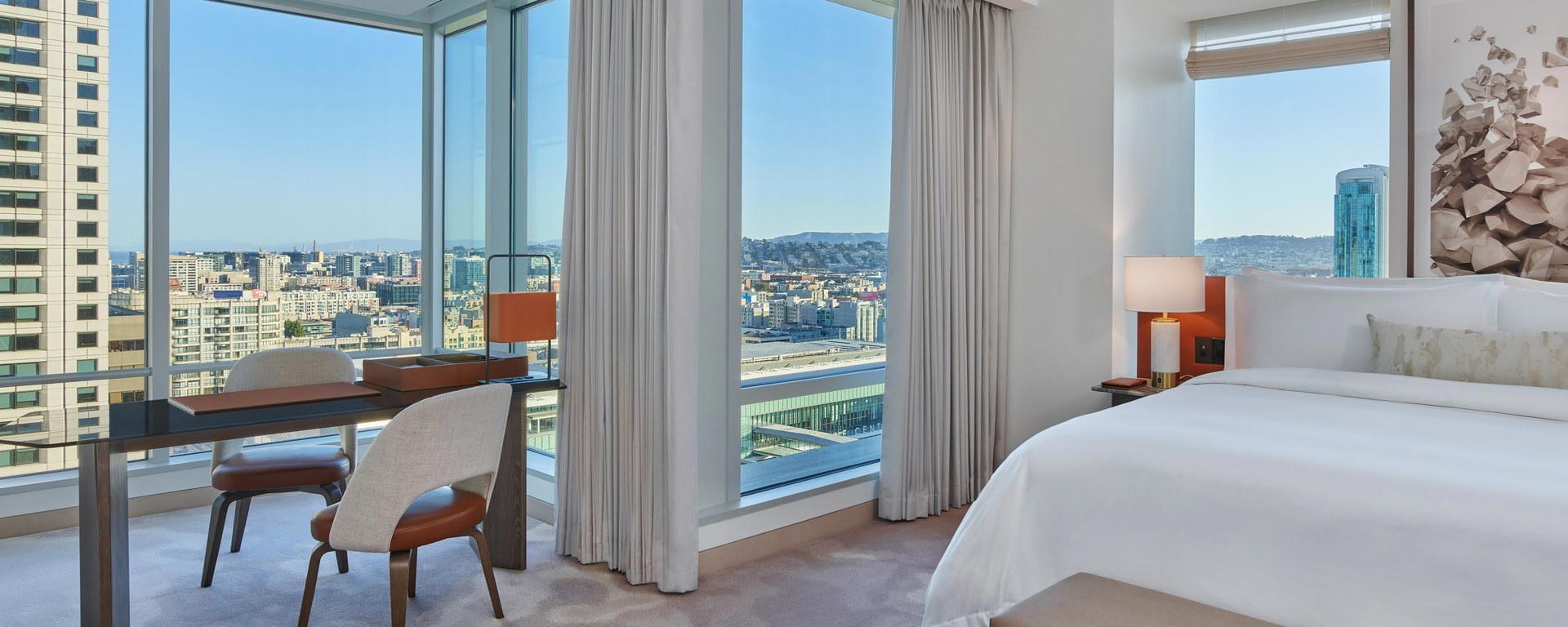
Bars in San Francisco
Browse all →
Restaurants in San Francisco
Browse all →


Details
- Elegant
- Classic
- Well Known
- Sophisticated
- Ornate
- Romantic Getaway
- Business Trip
- Anniversary
- Celebration
- Historic Building
- Wi Fi
- Pool
- Spa
- Fitness Center
- Room Service
- Concierge
- Business Center
- Valet Parking
- EV Charging
- Wheelchair Accessible
- Elevator
- Step Free Entrance
- Accessible Restroom
Timeless elegance with historic grandeur, skylit spaces, and sophisticated atmosphere praised in guest reviews.