On Filellinon Street in the shadow of the Acropolis, Souvlaki Kostas is one of Athens' most enduring souvlaki addresses, a counter-service institution where the ritual of charcoal-grilled pork in warm pita has been repeated for decades. The setting is compact and unadorned, the queue often extends onto the pavement, and the price point sits firmly in the city's everyday register — which is precisely the point.
Pearl is the En Primeur Club membership app — saves, bookings, and concierge access live there. Same editors, same standards.
- Address
- Filellinon 7, Athina 105 57, Greece
- Phone
- +30 21 0322 8502
- Website
- facebook.com
- Directions
- Get directions
 Saves & bookings on Pearl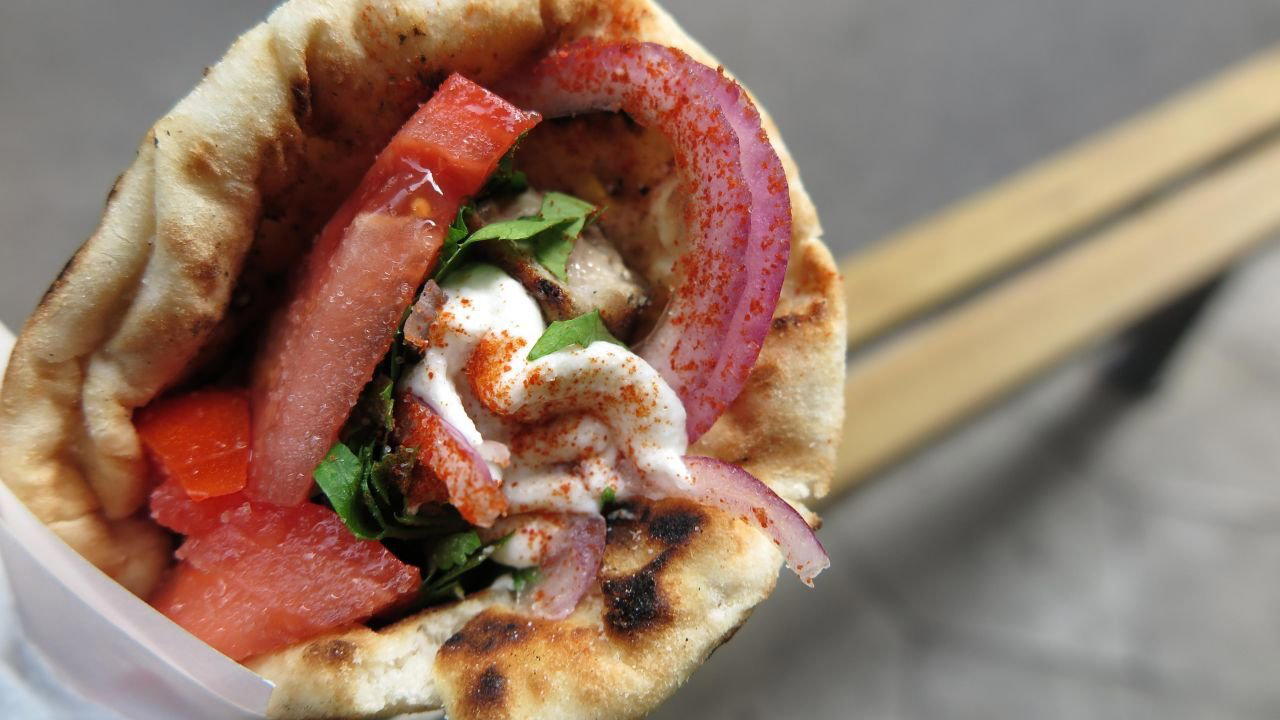
Where the Smoke Meets the Street
Stand at the corner of Filellinon in central Athens on any given afternoon and you'll catch the smell before you see the place. Charcoal smoke, rendered pork fat, and the faint sweetness of grilled onion cut through the diesel and hot pavement that characterise this stretch of the city between Syntagma Square and the Plaka. Souvlaki Kostas occupies a narrow slip of a shop at number 7, barely wide enough for the grill and the person working it. The pavement outside does most of the heavy lifting as a dining room.
This is not an accident of design. Across Greek cities, the souvlaki shop — or souvlatzidiko — has always operated as architecture of necessity rather than aspiration. The counter is close to the street, the grill faces the customer, and the transaction is rapid: wrap, paper, maybe a paper cup of something cold. Kostas fits this tradition precisely, and its position on Filellinon, one of the main pedestrian corridors connecting the city's tourist core to the Acropolis slope, means the foot traffic is constant across most of the day.
The Souvlaki Canon and Where Kostas Sits Within It
Athenian souvlaki has its own internal hierarchy, and understanding it helps locate Kostas accurately. At the most casual end sit the late-night gyros counters operating on volume and speed. A tier above, neighbourhood psistaries (grill houses) offer table service and a broader menu. Kostas belongs to a third category: the specialist souvlaki address, focused almost entirely on one format, in this case the pita wrap, and sustained over decades by a local reputation that outlasts tourism cycles.
The souvlaki itself, in Athenian convention, means small cubes or pieces of pork threaded onto a skewer and cooked over charcoal. The pita here is the thick, soft Athens-style wrap rather than the thinner island version. Standard accompaniments include tomato, onion, and tzatziki. What distinguishes addresses like Kostas from generic competitors is charcoal discipline and pork quality: underpowered coals produce steamed meat rather than seared, and the difference is immediately apparent in texture and flavour. Athens regulars tend to have strong opinions about which shops execute the balance correctly, and Kostas has maintained a loyal following in the immediate Syntagma district for long enough that it appears on most informed city eating lists.
For context, this is the same city where modern Greek cuisine has been reinterpreted at length by kitchens like Hytra, Botrini's, and Delta, and where the tasting menu format has been applied with considerable seriousness at addresses including Hervé and Makris Athens. Kostas operates in a completely different register, one that predates the contemporary Greek fine dining conversation and has no interest in joining it. The two tiers coexist without tension in this city, and both are worth understanding on their own terms.
The Physical Reality of the Place
The sensory experience at Kostas is immediate and uncomplicated. The grill is the centrepiece, visible from the street, and the sound of fat hitting hot coals is the ambient noise that replaces music or conversation. The space inside is functional: a counter, a person assembling wraps at speed, a small queue that extends outward depending on the hour. There is no design intention at work beyond the practical. The paper wrapping that holds the pita together is both serving vessel and plate, and most customers eat standing on the pavement or moving.
Lunchtime on weekdays, particularly in the warmer months from April through October when Athenian street life intensifies, produces the longest queues. The area around Filellinon and the adjacent Plaka district fills early as the day heats up, and the turn-over at the counter is fast enough that waiting times rarely extend beyond a few minutes even when the line appears long. If you want a more immediate experience, mid-morning or the shoulder hours between 3pm and 5pm tend to be quieter, though the grill may not be at full pace.
Reading Athens Through Its Grills
One way to understand a city's food culture is to pay attention to which quick-service formats sustain over decades and which do not. In Athens, the souvlaki shop is one of the more durable institutions, resistant to the café-isation and brunch culture that has reshaped other European capitals. The format survives because it is genuinely functional: fast, affordable, and calibrated to the rhythm of Greek daily life, where a midday meal is not a desk lunch but a proper, if brief, break. Kostas is a useful reference point for this pattern, operating in a part of the city that sees enormous tourist volume without orienting itself primarily toward tourists.
Visitors who have spent time at higher-register Greek dining elsewhere, whether at Selene in Santorini, Etrusco in Corfu, or Aktaion in Firostefani, sometimes treat the souvlaki stop as a footnote. It is better understood as a different chapter: the part of Greek food culture that is not performing for anyone, that has not been adjusted for export, and that has remained largely unchanged because it does not need to change. For a full picture of what eating in Greece actually involves, the street grill is as relevant as the white-tablecloth taverna or the contemporary tasting menu.
The same principle applies across the islands. Eating well in Greece involves moving across registers and formats: the beachside catch at To Psaraki, the resort dining at Myconian Utopia or Old Mill in Elounda, and the neighbourhood grill counter all belong to the same food culture, even when they share almost no formal characteristics. See our full Athens restaurants guide for a broader map of how these formats distribute across the city.
Planning Your Visit
Kostas sits on Filellinon 7, a short walk from Syntagma Metro station and within comfortable distance of the Acropolis Museum. No booking is required or possible; the format is counter-service only. The price point sits at the low end of Athens eating, consistent with the souvlaki category across the city. Bringing cash is advisable, as many counter-service grills in this part of Athens operate on a cash-only basis, though this should be confirmed on arrival. The experience takes as long as it takes to eat a pita wrap standing up, which is to say roughly five minutes, and that brevity is part of the point.
How Souvlaki Kostas Athens: Hours & Dress Code compares with similar nearby venues.
| Venue | Cuisine | Price |
|---|---|---|
| Ovio | Italian Contemporary | €€ |
| Aneton | Mediterranean Cuisine | €€ |
| Nolan | Fusion | € |
Continue exploring
More in Athens
Restaurants in Athens
Browse all →
Bars in Athens
Browse all →
Hotels in Athens
Browse all →

At a Glance
- Classic
- Well Known
- Rustic
- Casual Hangout
- Historic Building
- Standalone
- Street Scene
Current opening hours
- Monday
- 10:25 AM–3:45 PM
- Tuesday
- 10:25 AM–3:45 PM
- Wednesday
- 10:25 AM–3:45 PM
- Thursday
- 10:25 AM–3:45 PM
- Friday
- 10:25 AM–3:45 PM
- Saturday
- 10:25 AM–3:45 PM
- Sunday
- Closed
Hours can change for holidays and private events. Last verified .
No-frills hole-in-the-wall street food stand with busy queues and simple, unpretentious atmosphere.