
Tokyo’s curry culture is broad enough to hold old-school roux counters, spice-forward cafés, and Hokkaido-style soup curry under the same citywide appetite. Soup Curry Ya Oodori Chiyoda kandasurugadai ten belongs to the soup-curry lane near Jimbocho, with Tabelog Curry TOKYO 100 recognition in 2024 and a price band that keeps it in everyday-lunch territory rather than special-occasion dining.
Pearl is the En Primeur Club membership app — saves, bookings, and concierge access live there. Same editors, same standards.
- Address
- 東京都千代田区神田小川町3-10-18
- Phone
- +81352808228
- Website
- tabelog.com
 Saves & bookings on Pearl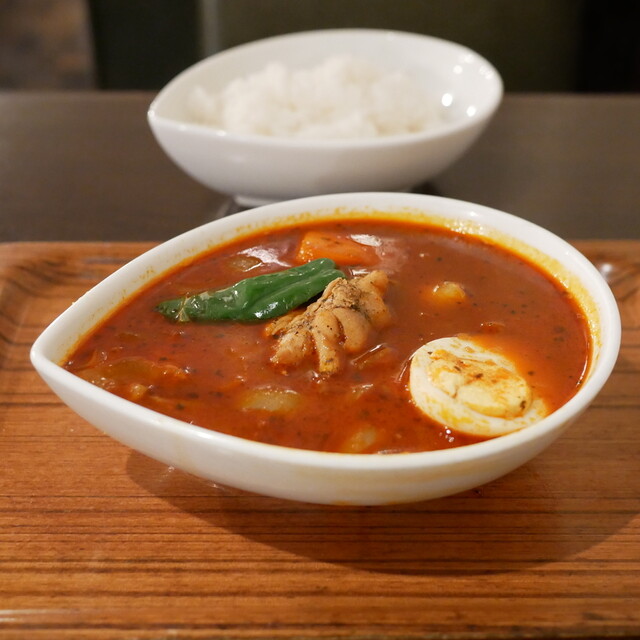
Approaching the Jimbocho-Ochanomizu edge of Kanda, the rhythm shifts from university streets and bookshop browsing to compact lunch counters built for decisive ordering. This part of Tokyo has long rewarded practical eating: curry rice before a meeting, coffee between errands, noodles after class. Soup curry fits that pattern differently. Instead of a thick roux over rice, the format separates broth, spice, vegetables, protein, and rice into a modular plate-and-bowl structure, so the meal reads less like a single sauce and more like a calibrated set of choices.
That architecture is the reason Soup Curry Ya Oodori Chiyoda kandasurugadai ten matters in a city already crowded with curry. Tokyo’s curry category is not one cuisine but several competing habits: Japanese curry rice, South Asian canteen cooking, spice-curry hybrids, café curry, and Hokkaido-derived soup curry. The restaurant’s selection for Tabelog Curry TOKYO 100 in 2024 places it inside a narrow, publicly recognized slice of that field. The Tabelog score of 3.78 reinforces the point without turning the meal into trophy dining: this is still a JPY 1,000 to JPY 1,999 proposition, which is exactly where much of Tokyo’s serious curry culture lives.
Soup curry as a menu system, not just a bowl
Soup curry succeeds when the ordering logic is clear. The diner is not only choosing curry; the decision usually involves broth intensity, spice level, rice, and add-ons. That makes the format closer to ramen in its customization than to a fixed curry-rice plate. At this address, the category listing is explicit: curry and soup curry. That distinction matters for travelers who arrive expecting the sweeter, thicker Japanese curry served across train-station counters. Soup curry is looser, lighter in body, and built to let ingredients remain distinct rather than disappear into roux.
In Tokyo, soup curry has never had the same mainstream saturation as standard curry rice, which gives the category a sharper identity. It attracts diners who want spice and structure without the formality of a tasting menu or the price escalation of reservation-led dining. Nearby comparison venues show how broad this bracket is: Curry Rice Senmon Ten Ethiopia Honten and Curry Ya Banbi sit in the same JPY 1,000 to JPY 1,999 range, while HINATA-YA and Koseto Coffee Ten occupy similarly accessible curry territory. The difference is not price so much as grammar. Curry rice asks whether the roux and rice cohere; soup curry asks whether broth, heat, toppings, and rice stay in balance.
The room’s 38 seats, split across the first floor and mezzanine, also explain the restaurant’s usefulness. Counter seating gives solo diners a natural place to land, while the larger seat count makes it less precious than the tiny curry shops that define parts of central Tokyo. The no-smoking policy and children-welcome note broaden the audience. This is not the hush of a chef’s counter; it is a functional urban curry room where the menu structure does the serious work.
Jimbocho's curry habit and the Kanda lunch circuit
Jimbocho is one of Tokyo’s natural curry districts because its daily population has always needed food that is quick, filling, and repeatable. Students, publishers, office workers, and secondhand-book hunters create a demand pattern that favors low-friction restaurants with clear specialties. Soup Curry Ya Oodori Chiyoda kandasurugadai ten sits within that circuit near Jimbocho Station, with Ochanomizu and Shin-Ochanomizu also within walking range. For visitors, the location is useful because it can be folded into a day that moves from Kanda bookshops to Akihabara, or from university-side cafés toward central Tokyo.
The competitive set around Kanda and Jimbocho is unusually dense. A traveler using curry as a lens on Tokyo could compare this meal with 3 Chome no Curry Ya San, then widen the day with nearby restaurant options such as . 鮪と炭火焼き うお炭 秋葉原店, 12/10 Shinjuku ten, 124. KAGURAZAKA (Yakitori), and 2D Cafe. The point is not to rank them against one another; it is to see how Tokyo’s casual dining strength comes from specialization at modest price levels.
Payment is another part of the experience architecture. Credit cards, electronic money, and QR code payments are not accepted, so cash planning matters. Reservations are available, but lunch is listed as walk-in only, which matches the neighborhood’s daytime rhythm. Operating hours are listed from 10:30 AM to 8:00 PM daily, and the practical move is to treat lunch peaks with caution rather than assume a frictionless seat. The restaurant has no parking, so rail access is the sensible default.
Where it fits in a Tokyo food itinerary
For a premium traveler, the value here is not luxury coding. It is category clarity. Tokyo rewards visitors who understand that the city’s strongest meals are not always expensive or ceremonial. A Tabelog Curry TOKYO 100 selection at this price band says something specific: curry is judged here as a competitive craft category, not as a fallback lunch. That makes Soup Curry Ya Oodori Chiyoda kandasurugadai ten a useful counterweight to sushi counters, kappo rooms, hotel bars, and tasting menus across the city.
Readers planning more than one Tokyo meal can use Our full Tokyo restaurants guide for the wider dining map, then pair it with Our full Tokyo hotels guide, Our full Tokyo bars guide, Our full Tokyo wineries guide, and Our full Tokyo experiences guide. For broader Japan context, compare casual-specialist formats with -Grilled beef Sukiyaki- KAMAKURA TANUKIAN 鎌倉 たぬき庵 in Kamakura.cafe in Osaka.know in Kumamoto, (Shoku) Vietnam in Kawasaki, [Curry Senmon Ten] Maruyama Kyoju. in Sapporo, and [ki:] in Kyoto. Even overseas links such as Jōdo Saké Bar in Los Angeles and Onigiri Time in Pasadena underline the same editorial lesson: Japanese dining culture travels well when the format is disciplined.
The recommendation is simple: treat this as a category meal. Go for the soup-curry structure, the Jimbocho setting, and the evidence of repeat recognition, not for ceremony. In a city where high-end reservations often dominate travel planning, a focused curry lunch can teach just as much about how Tokyo actually eats.
At-a-Glance Comparison
Comparable venues at a glance for context.
| Venue | Cuisine | Price | Notes |
|---|---|---|---|
| Soup Curry Ya Oodori Chiyoda kandasurugadai ten | Soup curry & Japanese curry house | $ | Chiyoda |
| Buta Daigaku (豚大学) | Grilled Pork Bowl (Butadon) | $ | Shimbashi |
| Fukuo Shoten | Traditional Japanese sweets and agar jelly shop | $ | Chiyoda |
| Nihonbashi Nishikihorin Karintou senmonten | Traditional Japanese Karintou Specialty Shop | $ | Chiyoda |
| Oniyanma Ningyouchou ten | Standing Udon Noodle Bar | $ | Chūō |
| Imojin | Traditional Japanese sweets & ice cream café | $ | Bunkyō |
Recognition history
Dated appearances from independent guides and award organizations, with the underlying list record or original source where available.
Tabelog 100 #92 · No. 92
Tabelog · Tabelog 100 - Curry - TOKYO - 2024







At a Glance
- Cozy
- Lively
- Casual
- Casual Hangout
- Solo
- Family
- After Work
- Group Dining
- Standalone
Casual, compact curry house with counter and simple table seating across a ground floor and mezzanine, non‑smoking and relaxed enough for solo diners, friends, and families.