
Sora Tsuruhashi souhonten puts Osaka’s Tsuruhashi yakiniku culture in a direct, ingredient-led frame: beef, tripe, smoke, sake and shochu, with recognition from Tabelog 100 Yakiniku WEST 2025. The draw is not ceremony but access to a serious grill house in one of the city’s Korean-Japanese barbecue districts, with counter and table seating and a price tier that remains grounded for Osaka.
Pearl is the En Primeur Club membership app — saves, bookings, and concierge access live there. Same editors, same standards.
- Address
- 大阪府大阪市天王寺区下味原町1-10
- Phone
- +81667731300
- Website
- yakinikusora.jp
 Saves & bookings on Pearl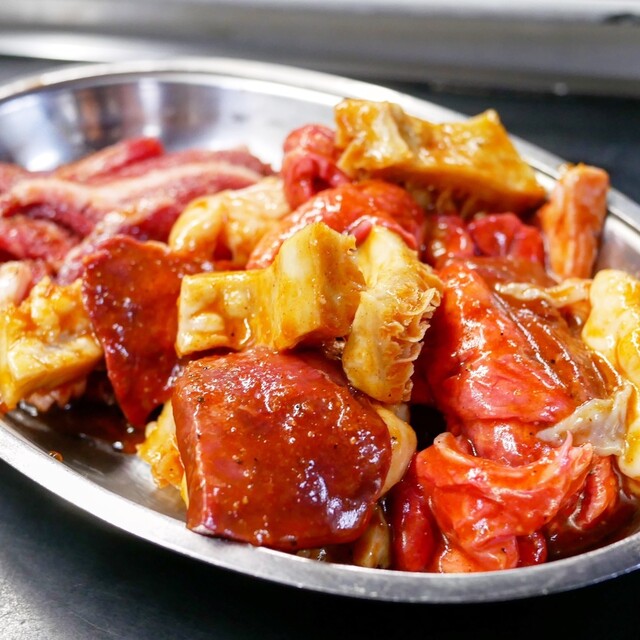
Approaching Tsuruhashi, smoke arrives before signage. This part of Osaka is built for grilled meat: station-side alleys, quick turnover, group tables, and the rhythm of yakiniku, where sourcing and cut selection matter as much as technique. Sora Tsuruhashi souhonten belongs to that older Osaka grammar: a house-style restaurant, not a polished tasting-menu stage, with attention fixed on beef, tripe and the grill rather than chef performance.
That matters in Osaka, where dining often rewards speed, appetite and specialization over grand presentation. Tsuruhashi has long been a reference point for Korean-influenced barbecue, and stronger local addresses are judged by consistency: offal handling, grill discipline, sauce balance, ventilation, and whether the meal works for both a small counter stop and a family table. Sora Tsuruhashi souhonten’s inclusion in Tabelog 100 Yakiniku WEST 2025 places it within the region’s recognized yakiniku tier, not the casual snack bracket around the station.
Beef and tripe define the Tsuruhashi equation
Osaka yakiniku is not one luxury category. It runs from train-platform-adjacent meat-and-rice meals to beef-focused rooms competing on cut quality and repeat recognition. Read Sora Tsuruhashi souhonten through its category mix: tripe, yakiniku and beef dishes. Tripe is not a side note here. In Kansai barbecue culture, offal cookery measures procurement and preparation, because texture, trimming and freshness leave little room for disguise.
That ingredient angle gives the address more editorial weight than a generic grill stop. A beef-only restaurant can lean on marbling; a yakiniku house with a serious tripe identity must manage more cuts, cooking times and diner expectations. That breadth suits Tsuruhashi, where meals are communal and modular. Diners build the table by category rather than surrendering to a fixed sequence: a different luxury from omakase, with less choreography and more control.
The listed drinks, sake and shochu, keep the experience in a Japanese grill-house register. Wine-pairing theatrics are not the point. The beverage logic is direct: rice, grain or sweet-potato spirits against fat, char and salt. For travelers mapping Osaka beyond sushi and kaiseki, this is the city in a lower, smokier register.
A recognized grill house rather than a reservation trophy
Recognition in Japan’s restaurant culture is fragmented by design. Michelin dominates international shorthand, but Tabelog’s Hyakumeiten lists often capture category specialists that matter to domestic diners. Selection for Tabelog 100 Yakiniku WEST 2025 is therefore a useful trust signal, placing the restaurant among western Japan’s named yakiniku addresses for that year. Earlier selections for yakiniku and grill categories add continuity, making the listing more than a single-year spike.
The Tsuruhashi competitive set clarifies that recognition. Men to Niku Daitsuru Tsuruhashi ten and Ramen Shuki sit in a cheaper noodle-and-meat orbit, while Okonomiyaki Ajikuraya represents another Osaka staple at a lower spend. The restaurant is a different dinner decision: still informal by international luxury standards, but priced and recognized as a specialist yakiniku meal rather than a quick station bite. That is the sweet spot for travelers seeking a serious local category without a white-tablecloth event.
Scale shapes the mood. With 120 seats plus counter and table options, this is not a tiny counter turning scarcity into prestige. The advantage is practical and cultural: yakiniku is better when the room absorbs groups, families and friends without pretending barbecue should be hushed. Children are welcome, private rooms are not part of the format, and the energy is closer to an Osaka dining room expecting people to eat, talk and order another round.
For a broader Osaka food map, the restaurant pairs naturally with less obvious category stops. Compare its barbecue focus with the bakery precision at 52CHO-ME BAKERY, the casual city rhythm of 551 Horai (551蓬莱), the Italian register at a canto (Italian), or the contemporary pizza lane at 99 Pizza Napoletana Gourmet. For coffee and daytime pacing, .cafe fills another slot. Together, these addresses show why Osaka works better as a sequence of specialties than as a single dining thesis.
How to read the room before planning the meal
Location is part of the value. Tsuruhashi Station puts the restaurant inside one of Osaka’s easiest food districts to fold into a day, especially between Namba, Tennoji and the eastern side of the city. The practical profile is plain: counter seating, table seating, no private rooms, no on-site parking, and a no-smoking policy. Payment matters: credit cards, electronic money and QR code payments are not accepted. In Japan, that is not nostalgia; it is operational reality. Bring yen.
The listed budgets keep the address grounded for recognized yakiniku: lunch at JPY 2,000 to JPY 2,999 and dinner at JPY 4,000 to JPY 4,999. That makes it strong for travelers wanting Tabelog-recognized barbecue without a high-ticket wagyu counter. Reservations are unavailable, so timing is the planning tool. The official schedule lists service on Monday, Thursday, Friday, Saturday and Sunday, with Tuesday and Wednesday closed; holiday changes can alter that rhythm.
Osaka rewards targeted planning. Use Our full Osaka restaurants guide for the wider dining map, then split the trip by mood through Our full Osaka hotels guide, Our full Osaka bars guide, Our full Osaka wineries guide and Our full Osaka experiences guide. For readers comparing Japanese dining formats beyond Osaka, related reference points include -Grilled beef Sukiyaki- KAMAKURA TANUKIAN 鎌倉 たぬき庵 in Kamakura. 鮪と炭火焼き うお炭 秋葉原店 in Tokyo.know in Kumamoto, (Shoku) Vietnam in Kawasaki, [Curry Senmon Ten] Maruyama Kyoju. in Sapporo, [ki:] in Kyoto, Jōdo Saké Bar in Los Angeles and Onigiri Time in Pasadena.
A Pricing-First Comparison
Comparable venues in the metro at similar price points.
| Venue | Cuisine | Price | Notes |
|---|---|---|---|
| Sora Tsuruhashi souhontenThis venue — the venue you are viewing | Not listed | $$ | Not listed |
| Okonomiyaki Ajikuraya | Tennōji, Osaka okonomiyaki & teppanyaki | $$ | Not listed |
| Grill Baranoki | Not listed | $$ | Chūō, Japanese-style Western (Yoshoku) |
| Odashi to Spice Ganso Electroni Curry | Not listed | $$ | Miyakojima, Dashi-based Japanese Spice Curry |
| Chitose (千とせ) | Minami Horie, Osaka-style Okonomiyaki | $$ | Not listed |
| Junkissa American | Not listed | $$ | Chūō, Traditional Japanese Kissaten / Cafe |
Recognition history
Dated appearances from independent guides and award organizations, with the underlying list record or original source where available.
Tabelog 100 #97 · No. 97
Tabelog · Tabelog 100 - Yakiniku - WEST - 2025
Continue exploring
More in Osaka
Restaurants in Osaka
Browse all →




Bars in Osaka
Browse all →


Hotels in Osaka
Browse all →



Wineries in Osaka
Browse all →
At a Glance
- Lively
- Energetic
- Classic
- Cozy
- Group Dining
- Casual Hangout
- Family
- After Work
- Late Night
- Standalone
- Sake Program
Busy, no-frills yakiniku house with tightly packed counter and table seating, smoky grills, and an energetic, casual atmosphere typical of Tsuruhashi’s old-school BBQ district.