Soon's Kal Bi Drive In
Our verdict
Drive-In Culture and Korean Barbecue in Honolulu Ala Lilikoi Street, a quiet residential corridor in the Aliamanu and Salt Lake district northwest of downtown Honolulu, does not read like a dining destination. The streetscape is functional, the...

Pearl is the En Primeur Club membership app, where members save venues, book tables and use the concierge.
The menu
What to order
- Meat jhun
- Kal bi
- Oversized plate lunches
- BBQ chicken
Drive-In Culture and Korean Barbecue in Honolulu
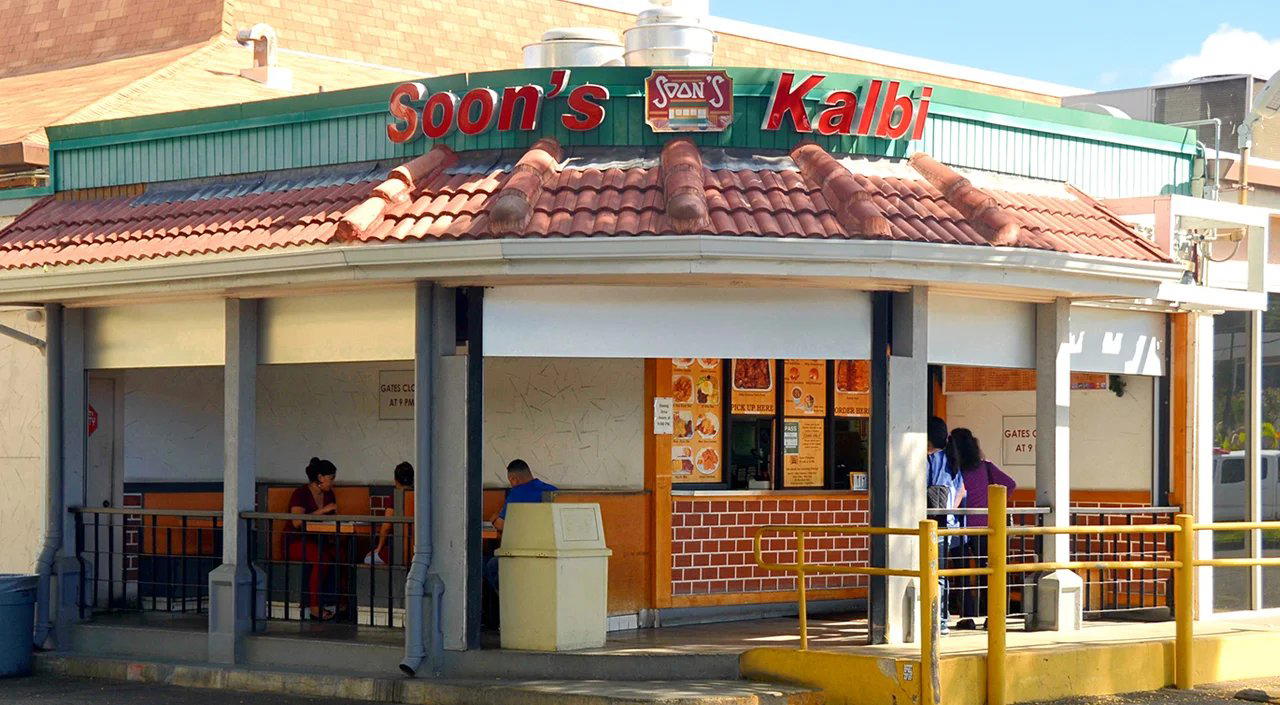
Ala Lilikoi Street, a quiet residential corridor in the Aliamanu and Salt Lake district northwest of downtown Honolulu, does not read like a dining destination. The streetscape is functional, the signage modest, and the setup unmistakably old Hawaii: a drive-in window, a parking lot, and a menu that has been feeding the surrounding neighbourhood for decades. Soon's Kal Bi Drive In operates in a format that was once the backbone of local eating across Oahu, a counter-service model built for working families and shift workers who needed fast, filling food rooted in the flavours they grew up with. That format has mostly disappeared from Honolulu's dining conversation as attention has shifted to chef-driven rooms in Kakaako and Waikiki, but Soon's persists, and its persistence is the editorial point.
The Ingredient Logic Behind Korean-Hawaiian Drive-In Food
Korean barbecue in Hawaii is not the same conversation as Korean barbecue in Los Angeles or New York. In Hawaii, the tradition was shaped by the Korean plantation workers who arrived in the early twentieth century and adapted their food to available ingredients and communal eating patterns. The result was a regional hybrid: kalbi short ribs marinated in soy, sesame, garlic, and sugar, cooked over open flame or on flat-leading grills, and served alongside rice and pickled banchan that had themselves been adjusted to local palates. The marinade ratios, the cut of the rib, and the degree of char became signatures specific to individual kitchens.
Drive-in restaurants were the primary vehicle for this tradition through much of the mid-twentieth century. They operated as affordable, accessible points of entry into a cuisine that was technically direct to scale but flavour-dependent on the quality of the marinade and the consistency of the grill. The sourcing logic was local by necessity: fresh produce from island farms, proteins from suppliers familiar with the specific cuts required for Korean preparation, and pantry staples that could be sourced reliably in quantity. This was not farm-to-table as a marketing concept but as a structural reality of island geography, where importing food at scale was expensive and local supply chains were more economical.
That ingredient logic still applies in a different way today. Hawaii's food economy is heavily import-dependent for proteins, with a significant portion of beef arriving from the mainland United States and Australia. Locally raised beef exists, primarily from Big Island ranches like those operating under the Parker Ranch umbrella, but it commands a premium that drive-in formats rarely absorb. What distinguishes a Korean barbecue drive-in in this context is therefore less about sourcing provenance and more about the consistency and depth of the marinade program and the skill of the grill operation. These are the quality signals that matter at this price tier and format.
Where Soon's Sits in the Honolulu Dining Pattern
Honolulu's dining scene in 2024 runs a wide range. At the upper end, restaurants like 53 By The Sea and Fête (New American) operate tasting-menu and refined-casual formats aimed at visitors and special-occasion diners. Institutions like 3660 On the Rise occupy the mid-range with polished Hawaiian Regional Cuisine. Cultural programming like the Ahaaina Luau serves a visitor-facing function. And at the neighbourhood level, drive-ins and plate lunch counters serve the people who actually live and work across Oahu's residential districts.
Soon's Kal Bi Drive In belongs to that last tier, and it is worth being precise about what that means. It is not competing with 855-ALOHA for cocktail-friendly dinner trade, nor is it positioned as a novelty for food tourists. Its competitive set is the other Korean and local-style drive-ins and plate lunch spots distributed across the island, where the measure of quality is repeat local custom, not critical recognition. In this tier, longevity is the credential. A drive-in that has operated for years in the same neighbourhood with the same regulars is making an argument by volume and consistency that no award system adequately captures.
For context on what this kind of neighbourhood-anchored persistence means in a broader American dining framework, consider that even celebrated destination restaurants like Lazy Bear in San Francisco, The French Laundry in Napa, or Blue Hill at Stone Barns in Tarrytown depend on a stable local food culture beneath them. Drive-ins like Soon's are part of that substrate. The same is true for the Korean-American fine dining conversation: Atomix in New York City is possible partly because Korean food has a deep grassroots infrastructure in American cities, and in Hawaii that infrastructure includes exactly this kind of counter-service institution.
The Drive-In Format as a Document of Local Eating
The physical setup of a drive-in window is itself an editorial statement about who the food is for. There is no ambient music calibrated to a target demographic, no reservation system filtering the room, no dress expectation managing the social contract at the door. You drive up, you order, you eat. The format compresses the social distance between the kitchen and the customer in a way that chef-driven restaurants actively work to reconstruct through open kitchens and counter seating. At a drive-in, that compression is simply the operating model.
For Honolulu specifically, this matters because the city's food identity has always been more complex than its tourism infrastructure suggests. The shave ice and poke bars visible to visitors are real, but they sit on top of a deeper layer of Korean, Japanese, Filipino, Chinese, Portuguese, and Native Hawaiian food traditions that play out daily in neighbourhoods visitors rarely reach. The Salt Lake and Aliamanu area, where Soon's operates, is a residential district with a mixed local population and proximity to Joint Base Pearl Harbor-Hickam. It is not a food tourism corridor. A restaurant operating here for years is, by definition, serving the people who live and work nearby, and that function has its own integrity.
For readers building a fuller picture of Honolulu's dining range, the full Honolulu restaurants guide maps the city across price tiers, neighbourhoods, and cuisine types. Destination-format restaurants elsewhere in the United States, from Le Bernardin in New York City to Providence in Los Angeles to Addison in San Diego and Alinea in Chicago, represent one end of the American dining spectrum. Soon's Kal Bi Drive In represents another, and understanding the range is what makes either end legible.
Know Before You Go
- Address: 898 Ala Lilikoi St, Honolulu, HI 96818
- Format: Drive-in counter service
- Neighbourhood: Salt Lake / Aliamanu, northwest of downtown Honolulu
- Booking: No reservation system; walk-in and drive-up format
Pricing, Compared
Comparable venues nearby, for context on price, style, and recognition.
| Venue | Cuisine | Price | Awards | Notes |
|---|---|---|---|---|
| Soon's Kal Bi Drive InThis venue (the venue you are viewing) | Korean BBQ | $10–20 | Not listed | Not listed |
| Sura Hawaii | All-You-Can-Eat Korean BBQ | $30–50 | Not listed | Ala Moana, All-You-Can-Eat Korean BBQ |
| Palace Saimin | Hawaiian-Style Saimin | $10–20 | Not listed | Kalihi-Palama, Hawaiian-Style Saimin |
| O'Kims | Modern Korean Fusion | $20–30 | James Beard Award Semi Finalist | Chinatown, Modern Korean Fusion |
| Alicia's Market | Hawaiian Poke & Plate Lunches | $10–20 | Not listed | Kalihi Kai, Hawaiian Poke & Plate Lunches |
| Mama Guava | Modern Filipino-American Fusion | $20–30 | Not listed | Chinatown, Modern Filipino-American Fusion |
Continue exploring
More in Honolulu
Restaurants in Honolulu
All restaurants in Honolulu →
Bars in Honolulu
All bars in Honolulu →
Details
- Classic
- Casual
- Casual Hangout
- Family
- Solo
- Group Dining
- Standalone
- Counter Dining
- A La Carte
Current opening hours
- Monday
- 10 AM–8 PM
- Tuesday
- 10 AM–8 PM
- Wednesday
- 10 AM–8 PM
- Thursday
- 10 AM–8 PM
- Friday
- 10 AM–8 PM
- Saturday
- 10 AM–8 PM
- Sunday
- 10 AM–8 PM
Hours can change for holidays and private events. Hours as of .
Casual, no-frills, and busy drive-in counter service with a takeout-focused feel and limited outdoor seating.