
Shinfuji Honten puts Osaka’s everyday yoshoku tradition in a small Nishinari room rather than a polished dining district. Its Tabelog 100 Yoshoku WEST 2025 selection, compact 20-seat format, take-out option, and low-key house-restaurant setting make it a useful counterpoint to the city’s higher-priced reservations.
Pearl is the En Primeur Club membership app — saves, bookings, and concierge access live there. Same editors, same standards.
- Address
- 2 Chome-3-5 Senbonminami, Nishinari Ward, Osaka, 557-0055, Japan
- Phone
- +81 6-6657-2121
- Website
- tabelog.com
 Saves & bookings on Pearl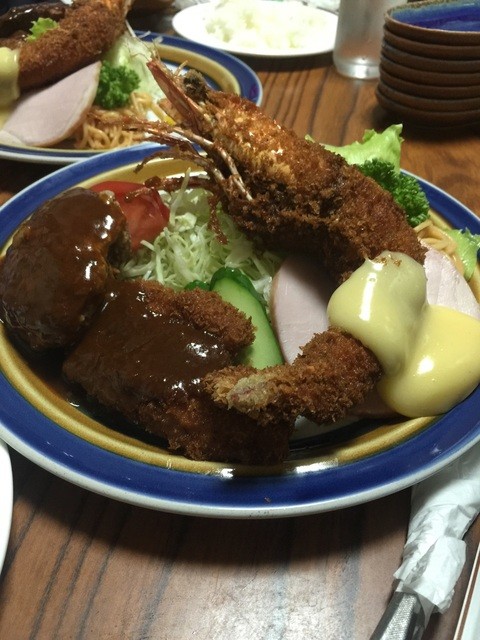
Approach this corner of Nishinari and the signal is domestic, not theatrical: house-restaurant scale, counter seats, tables, tatami rooms, and a short service window that makes hesitation costly. Osaka is often read through neon, queues, and station food, but its yoshoku culture sits quieter: cutlets, pork dishes, Japanese-Western plates, and practical cooking built for repeat local use rather than ceremony.
Shinfuji Honten belongs to that register. Its recognition is category-coded, not luxury-coded: selection for Tabelog 100 Yoshoku WEST 2025, with earlier Yoshoku 100 selections in 2023, 2022, and 2020. That pattern places it in a narrower conversation than general Osaka dining. It is not competing with kaiseki rooms, sushi counters, or hotel restaurants, but with the small group of yoshoku addresses preserving the city’s appetite for Western-derived Japanese comfort food at modest scale.
Yoshoku in Nishinari: value, restraint, and the anti-spectacle meal
Yoshoku asks for a different attention than fine dining. It came through Japan’s adaptation of Western dishes into local habits: rice with cutlets, familiar sauces, frying as craft rather than novelty, and pork dishes as everyday food. In Osaka, where dining swings from standing bars to high-end counters within a few train stops, yoshoku holds a useful middle ground: structured, cooked to order, comforting, and free of reverence.
The sustainability story is not manifesto language or farm-name performance. Here, environmental sense appears through scale and discipline: a small room, limited seating, short operating sessions, take-out as a kitchen extension, and a menu identity concentrated by category rather than sprawl. A 20-seat operation with counter seating, two four-seat tables, and tatami rooms works with less excess than a large-format venue chasing breadth. The food listing also notes attention to fish, relevant in a city where casual restaurants can lean heavily on meat, frying oil, and volume.
That restraint makes the address read differently from a destination restaurant. The appeal is persistence, not novelty: an older Osaka logic of cooking within a tight lane, serving families and friends, keeping the room compact, and letting reputation build through repeat selection rather than spectacle. Within the comparison set, Kamaage Udon Raku and Zouya occupy a similar everyday-value band, while Revo Honten moves higher at dinner and Etchuya sits in a much more expensive register. Shinfuji Honten’s signal is narrower: yoshoku, tonkatsu, pork dishes, and an award trail inside that category.
A compact room where congestion is part of the planning
The room format says more than glossy interior copy would. Five counter seats create a direct, functional rhythm; tables and tatami rooms broaden use for small groups and families. Private-room availability for six gives the address flexibility many compact restaurants lack, though the overall scale stays limited. This is a house-restaurant format, not a large dining room built to absorb late decisions.
Plan accordingly. Reservations are accepted by phone until opening hours, and congestion can block entry even during business hours. Wednesday is the regular closing day, with service split into brief lunch and early-evening periods. Payment is old-school: credit cards, electronic money, and QR code payments are not accepted. Free parking is limited to one vehicle, first-come, with paid coin parking nearby. The nearest station is Kishinosato Tamade, and the address sits in Senbonminami rather than the restaurant-heavy zones first-time visitors usually map.
That geography matters. Nishinari complicates the polished image of Osaka dining. The ward’s food culture is practical, residential, and less mediated by hotel concierges than Umeda, Namba, or Kitashinchi. A yoshoku meal here offers a clearer read on everyday Osaka than another premium counter reservation. The trade-off is friction: shorter hours, smaller room, cash-style planning, and a higher chance that casual arrival fails.
How to place it within an Osaka itinerary
For food-focused Osaka travel, this is a daytime or early-evening anchor, not a late-night plan. It pairs better with neighborhood exploration than a packed tasting-menu day. The family-friendly designation, non-smoking policy, and take-out service widen its usefulness, but compact seating keeps the experience closer to a local dining room than a flexible tourist stop.
Use it as a lens on Osaka’s non-luxury excellence. The city’s dining reputation is often compressed into takoyaki, okonomiyaki, sushi, and high-end counters, yet the richer story is how many formats developed rigorous standards at modest spend. Yoshoku is central because it absorbs Western technique into Japanese dining habits without imported glamour. Tabelog’s Yoshoku 100 list gives external confirmation, but durability is the stronger point: repeated category recognition across multiple years shows this is not a passing online spike.
Readers mapping the wider city can place this meal alongside other Osaka entries such as .cafe, 52CHO-ME BAKERY, 551 Horai (551蓬莱), 99 Pizza Napoletana Gourmet, and a canto (Italian). For broader planning, use Our full Osaka restaurants guide, then cross-check the city through Our full Osaka hotels guide, Our full Osaka bars guide, Our full Osaka wineries guide, and Our full Osaka experiences guide.
For wider Japan and overseas comparison of casual formats, see -Grilled beef Sukiyaki- KAMAKURA TANUKIAN 鎌倉 たぬき庵 in Kamakura. 鮪と炭火焼き うお炭 秋葉原店 in Tokyo.know in Kumamoto, (Shoku) Vietnam in Kawasaki, [Curry Senmon Ten] Maruyama Kyoju. in Sapporo, [ki:] in Kyoto, Jōdo Saké Bar in Los Angeles, and Onigiri Time in Pasadena.
The verdict is precise: for diners who value Osaka’s durable local formats over decorative dining. The award history gives authority, the small room gives pressure, and the yoshoku focus gives cultural weight beyond the plate. Treat it as a compact study in how a city sustains quality through modest scale, familiar categories, and cooking that need not announce itself loudly.
How It Stacks Up
Comparable venues by cuisine and price in the same metro.
| Venue | Cuisine | Price | Notes |
|---|---|---|---|
| Shinfuji HontenThis venue — the venue you are viewing | Japanese Western (Yoshoku) and Tonkatsu | $$ | Not listed |
| Taisho Salon Hige to Boin | Creative Japanese Standing Bar (Obanzai) | $$ | Taishō |
| Kyu Yam Tei Karahori ten | Spice Curry & Café in a Retro Townhouse | $$ | Chūō |
| Ramen Shuki | Japanese Ramen | $$ | Higashinari |
| Udon Dining KONA×MIZU×SHIO | Modern udon dining with udon-based bread | $$ | Chūō |
| Mannen Curry | Japanese Curry | $$ | Chūō |
Recognition history
Dated appearances from independent guides and award organizations, with the underlying list record or original source where available.
Tabelog 100 #42 · No. 42
Tabelog · Tabelog 100 - Yoshoku - WEST - 2025
Continue exploring
More in Osaka
Restaurants in Osaka
Browse all →




Bars in Osaka
Browse all →




Hotels in Osaka
Browse all →



Wineries in Osaka
Browse all →
At a Glance
- Classic
- Cozy
- Family
- Group Dining
- Casual Hangout
- Historic Building
- Standalone
Current opening hours
- Monday
- 11 AM–12:30 PM, 4–5:30 PM
- Tuesday
- 11 AM–12:30 PM, 4–5:30 PM
- Wednesday
- Closed
- Thursday
- 11 AM–12:30 PM, 4–5:30 PM
- Friday
- 11 AM–12:30 PM, 4–5:30 PM
- Saturday
- 11 AM–12:30 PM, 4–5:30 PM
- Sunday
- 11 AM–12:30 PM, 4–5:30 PM
Hours can change for holidays and private events. Last verified .
Retro, old-school Japanese Western dining with a nostalgic Showa-era feel; the setting is described as a house restaurant with counter seating and tatami rooms, creating a cozy, traditional atmosphere.