
Osaka’s udon culture is often read through speed, texture, and repeat custom rather than ceremony. Udon Dining KONA×MIZU×SHIO sits in Sakaisuji Hommachi with a 19-seat room, Tabelog 100 Udon WEST 2024 selection, and a split identity around udon and bread, including U-Pan made with boiled udon worked into the dough.
Pearl is the En Primeur Club membership app — saves, bookings, and concierge access live there. Same editors, same standards.
- Address
- 大阪府大阪市中央区南本町1-2-6 Fiore Building 1F
- Phone
- +81675081717
- Website
- tabelog.com
 Saves & bookings on Pearl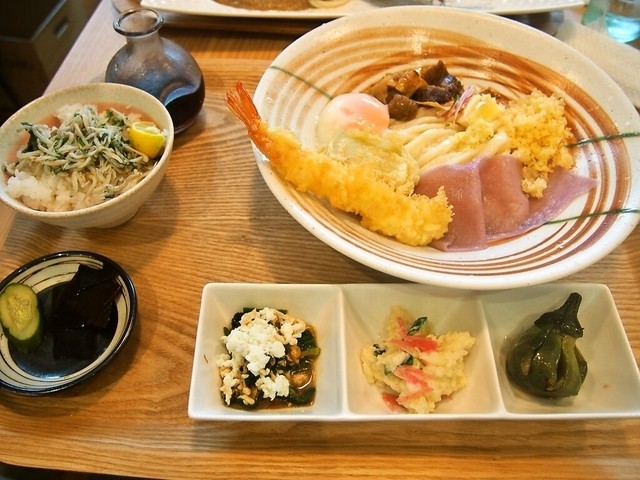
Approaching a small udon room in Minamihonmachi shifts Osaka dining’s rhythm. The city can make noodles feel transactional: stand, slurp, pay, leave. Here the cues are narrower: counter seating, a non-smoking room, and a format rewarding regulars who know udon is not just lunch but a texture discipline. The appeal is not formal luxury but repetition: customers returning for wheat, water, salt, and the small variations separating a competent bowl from one worth planning around.
Osaka has always treated flour seriously. Takoyaki and okonomiyaki dominate the shorthand, but udon belongs to the same konamon logic, where value is measured in dough handling as much as garnish. Udon Dining KONA×MIZU×SHIO makes this unusually clear because its identity joins udon and bread, a combination that sounds playful until placed in the city’s broader wheat culture. Tabelog selected it for Udon WEST 100 in 2024, a useful signal in a category where reputation is built more through local repetition than international awards circuits.
Where udon regulars read texture before toppings
The regulars’ view matters because udon houses are not judged by novelty alone. Kansai diners notice elasticity, temperature, broth balance, and how well a shop handles the lunch rush without flattening food into routine. The restaurant’s stated focus on “Mochi Mochi Udon” centers chew. In Japanese noodle culture, the phrase is not decorative; it means bounce, stretch, and resistance, the qualities that make udon feel alive rather than merely filling.
The menu’s second idea, U-Pan, extends the same flour logic into bread. The shop describes U-Pan and U-Pan Donuts as bread developed by incorporating boiled udon into the dough. That reframes udon not as one dish but as a structured ingredient. In a city where obsessives track tiny format differences across neighborhoods, this is the kind of detail that creates repeat custom: not a grand tasting-menu thesis, but a technical proposition checked bite by bite.
That dual identity separates the room from nearby noodle and casual-dining options. Hommachi Seimenjo Chukasobakobo and Menya Hanabusa sit in the ramen orbit; Zeroku Honmachi ten signals the inexpensive everyday end; Benikurage works the izakaya lane; KAMINOZA belongs to a higher-priced Japanese category. Against that context, this udon-and-bread format occupies a narrower lane: casual in posture, not generic in construction.
Sakaisuji Hommachi favors specialists over spectacle
Sakaisuji Hommachi is not Dotonbori theatre. It is office blocks, weekday habits, and lunch geography where a restaurant either becomes useful or leaves the rotation. That suits udon. The dish rewards consistency but exposes shortcuts quickly: overworked noodles, weak broth, or a room moving faster than the food can support. A 19-seat setup keeps the scale closer to a specialist counter than a high-volume chain.
The Tabelog 100 Udon WEST 2024 selection gives the place a credential, but the sharper signal is category fit. Udon recognition in western Japan is not imported prestige. It reflects a region with strong baseline expectations for wheat noodles, where a shop needs a distinct reason to enter the conversation. Here, that reason is the tension between fundamentals and a bread offshoot, the latter less gimmick than extension of the same ingredient study.
For travelers building an Osaka food itinerary, compare it not with formal kaiseki or sushi counters but with specialist casual rooms, places where narrow craft justifies crossing town. The same trip might include Chinese pork buns at 551 Horai (551蓬莱), bakery stops such as 52CHO-ME BAKERY, coffee at .cafe, Italian cooking at a canto (Italian), or pizza at 99 Pizza Napoletana Gourmet. The connective tissue is not cuisine type but Osaka’s appetite for focused formats that earn regular business.
How to place it in an Osaka dining day
This is sharper for a traveler who likes small-format, single-category dining than for someone seeking a long ceremonial meal. The room is family friendly and solo-dining friendly, which defines its social function: everyday Osaka as much as award-chasing itineraries. Counter seating suits the solo diner who wants to read the room, while the family-friendly policy keeps it from becoming precious.
The practical friction matters. The restaurant is not a conventional reservation-first destination, and payment is cash-oriented: credit cards, electronic money, and QR payments are not accepted. That places it closer to Osaka’s traditional small-shop economy than to the frictionless internationalized tier. Visitors should treat it as a planned specialist stop rather than a flexible fallback, especially because the udon dining window is compact and the bread side runs separately until sold out.
Its value differs from a splurge restaurant. Lunch is listed at JPY 1,000 to JPY 1,999, dinner at JPY 4,000 to JPY 4,999. That suggests two uses: a focused daytime noodle stop or a broader evening visit. Either way, the attraction is precision within a modest frame, not spectacle.
For broader planning, use Our full Osaka restaurants guide alongside Our full Osaka hotels guide, Our full Osaka bars guide, Our full Osaka wineries guide, and Our full Osaka experiences guide. Travelers comparing Japanese casual formats beyond Osaka might also look at -Grilled beef Sukiyaki- KAMAKURA TANUKIAN 鎌倉 たぬき庵 in Kamakura. 鮪と炭火焼き うお炭 秋葉原店 in Tokyo.know in Kumamoto, (Shoku) Vietnam in Kawasaki, [Curry Senmon Ten] Maruyama Kyoju. in Sapporo, [ki:] in Kyoto, Jōdo Saké Bar in Los Angeles, and Onigiri Time in Pasadena.
The critical read is simple: this Osaka specialist turns wheat into a repeatable argument. The udon carries the traditional burden of texture, the bread widens the idea, and the award recognition places the shop inside western Japan’s serious udon conversation without changing its everyday character.
Peers You’d Cross-Shop
Comparable venues to place this listing in its category.
| Venue | Cuisine | Price | Notes |
|---|---|---|---|
| Udon Dining KONA×MIZU×SHIOThis venue — the venue you are viewing | Modern udon dining with udon-based bread | $$ | Not listed |
| DINING | Japanese Kaiseki and Teppanyaki | Not listed | Osaka |
| Ampere Coffee & Kitchen | Japanese-International All-Day Cafe | $$ | Chūō |
| Yakitori Shokudo | Yakitori & Izakaya | $$ | Kita |
| Tahei | Traditional Yakiniku (Japanese BBQ) | $$ | Naniwa |
| Ramen Yashichi | Japanese Ramen | $$ | Kita |
Recognition history
Dated appearances from independent guides and award organizations, with the underlying list record or original source where available.
Tabelog 100 #82 · No. 82
Tabelog · Tabelog 100 - Udon - WEST - 2024
Continue exploring
More in Osaka
Restaurants in Osaka
Browse all →




Bars in Osaka
Browse all →

Hotels in Osaka
Browse all →



Wineries in Osaka
Browse all →
At a Glance
- Modern
- Cozy
- Trendy
- Quiet
- Solo
- Family
- After Work
- Casual Hangout
- Group Dining
- Standalone
- Design Destination
Small, non-smoking udon dining room with a stylish, café-like interior and counter seating, offering a relaxed, bright atmosphere suitable for solo diners, families, and casual lunches near the Sakaisuji Hommachi business district.