Shake Shack Battery Park City
Our verdict
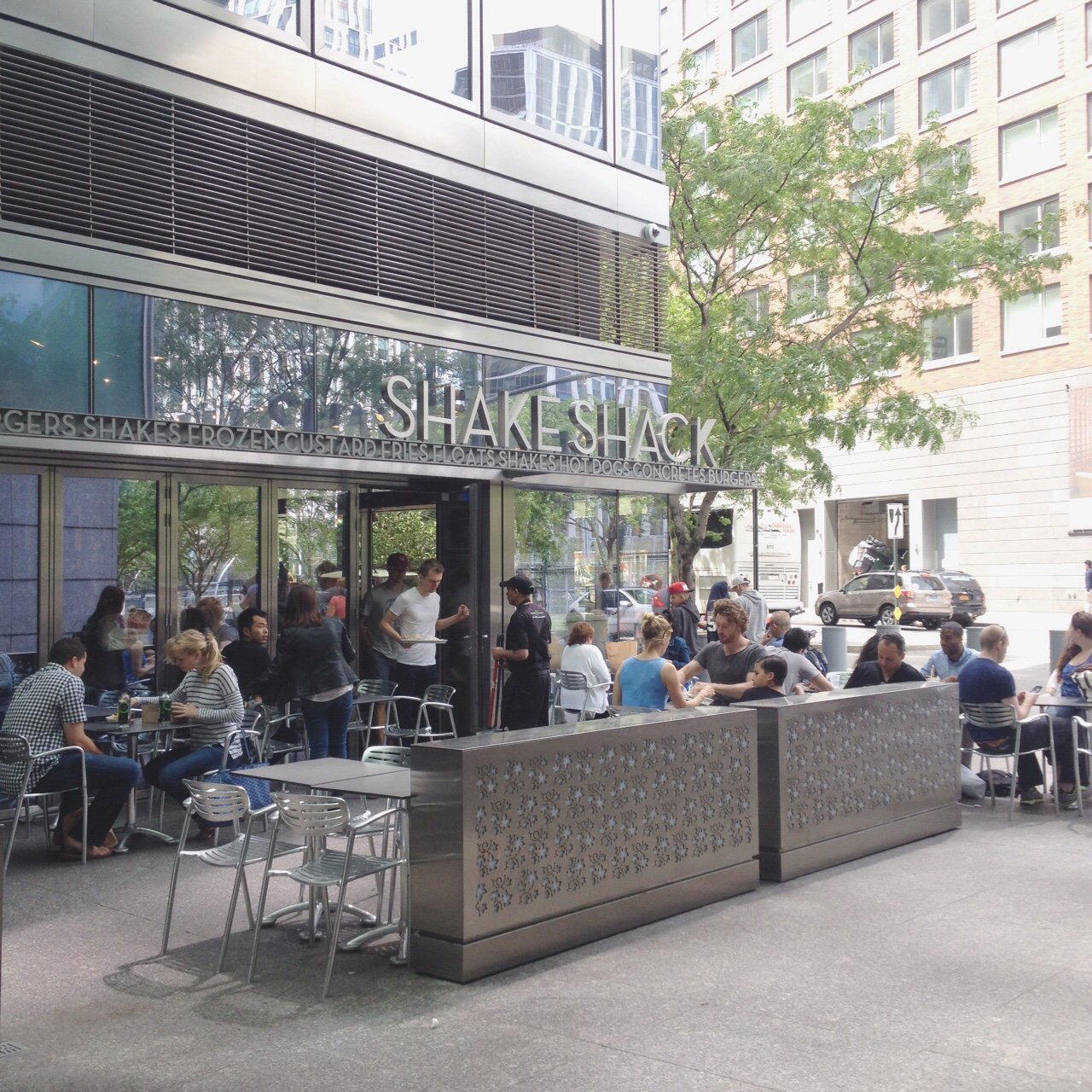
Shake Shack Battery Park City, at 215 Murray St, sits at the intersection where a post-2000s American fast-casual movement meets one of Lower Manhattan's most historically layered neighbourhoods. The chain that began as a single hot dog cart in Madison Square Park in 2001 now operates hundreds of locations globally, but the Battery Park City outpost places that story against the backdrop of the Hudson waterfront and the rebuilt downtown.

Pearl is the En Primeur Club membership app — saves, bookings, and concierge access live there. Same editors, same standards.
- Address
- 215 Murray St, New York, NY 10282
- Phone
- (646) 545-4600
- Hours
- Daily 10:30 AM–11 PM
- Website
- shakeshack.com
- Directions
- Get directions
The menu
What to order
- ShackBurger
- Crinkle-Cut Fries
- SmokeShack
- Shroom Burger
A Fast-Casual Format Rooted in a Specific New York Moment
The American fast-casual category did not emerge from a vacuum. It was a direct response to the gap between fast food's speed and sit-down dining's price and time commitment, and Shake Shack's founding story is one of the clearest illustrations of that shift happening in real time. What began in 2001 as a hot dog cart operated by Danny Meyer's Union Square Hospitality Group inside Madison Square Park evolved into a permanent kiosk by 2004, and from there into a publicly traded company with hundreds of outlets across multiple continents. The Battery Park City location at 215 Murray St sits within that expansion arc, but its neighbourhood context gives it a character distinct from midtown or tourist-corridor branches.
Battery Park City itself is a planned community built on landfill along the Hudson River, developed in earnest from the late 1970s onward and substantially rebuilt in the years following September 2001. The neighbourhood draws a mix of residential families, financial district workers spilling west from the World Trade Center complex, and visitors walking the Hudson River Greenway. That demographic layering shapes the rhythm of a counter-service spot in ways that a Times Square or Grand Central location would not: lunch peaks are sharp and work-driven, weekend mornings drift toward stroller-pushing residents, and late afternoons belong to tourists following the waterfront south toward Battery Park proper.
The Cultural Trajectory of the American Smash Burger
Shake Shack's menu format belongs to a specific lineage of American beef-forward counter culture that traces back through regional burger institutions across the midwest and southeast before resurging in the 2000s as a premium proposition in coastal cities. The ShackBurger format, two thin beef patties with American cheese on a Martin's potato roll, is an explicitly nostalgic construct: it references the roadside drive-in aesthetics of mid-twentieth-century America while applying sourcing standards and operational consistency that those original venues never prioritised. The distinction matters because it explains why Shake Shack occupies a different cultural register than either the legacy fast-food chains it superficially resembles or the sit-down burger restaurants that were emerging in parallel during the same period.
In the New York context, this positioning proved legible to a specific urban consumer who wanted speed and informality without the associations that came with legacy fast food. The original Madison Square Park location generated queues that became part of the cultural story around the brand, and those queues in turn became a form of endorsement that no advertising could have manufactured. By the time the company expanded beyond that single location, the format carried a credibility signal that most fast-casual concepts spend years trying to build.
New York's dining scene operates across a dramatically wide price spectrum. At the upper end, tasting-menu restaurants like Le Bernardin, Atomix, Eleven Madison Park, Masa, and Per Se define the city's fine-dining ceiling. Shake Shack occupies the opposite end of that spectrum, but its trajectory illustrates how New York's food culture has historically rewarded formats that execute a clear, honest proposition at any price point. The city's appetite for that kind of institutional fast-casual quality is not unique to Shake Shack — it shows up in the pizza-by-the-slice economy, the Halal cart ecosystem, and the bagel institutions that predate all of them — but Shake Shack formalised it into a reproducible model.
Battery Park City as a Dining Neighbourhood
Lower Manhattan's dining infrastructure has shifted considerably since the early 2000s, with Battery Park City remaining somewhat underserved relative to its residential density. The neighbourhood does not have the restaurant concentration of the West Village or Tribeca immediately to the north, which makes a reliable counter-service option with consistent execution more genuinely useful to locals than it might appear to visitors passing through. For someone walking the greenway between Brookfield Place and Battery Park, the 215 Murray St address provides a logical midpoint stop without requiring a detour into a more restaurant-dense corridor.
The broader context of fast-casual dining in American cities also shows up in how comparable formats have been received in other markets. The premium burger and shake format that Shake Shack institutionalised in New York has analogs in the craft-focused restaurant movements in cities like San Francisco, where venues such as Lazy Bear represent the fine-dining side of a similar local-sourcing ethos, and New Orleans, where Emeril's helped define a different kind of American dining identity. The sourcing conversation that underlies premium fast-casual is not separable from the broader American restaurant movements happening simultaneously at venues like The French Laundry in Napa, Blue Hill at Stone Barns in Tarrytown, or Single Thread Farm in Healdsburg, even if the price point and format sit at opposite ends of the spectrum.
Other American cities with strong fast-casual or chef-driven mid-market scenes worth cross-referencing include Chicago, where Smyth defines a very different tier, and Los Angeles, where Providence anchors the fine-dining end. At the destination end of American dining, venues like Addison in San Diego, The Inn at Little Washington, and Frasca Food and Wine in Boulder sit in a completely different register. Internationally, the contrast sharpens further when set against destination restaurants like Atelier Moessmer Norbert Niederkofler in Brunico or Dal Pescatore in Runate. For a full map of where Shake Shack Battery Park City sits within New York's dining range, the EP Club New York City restaurants guide covers the full spectrum.
Planning Your Visit
The Battery Park City location at 215 Murray St operates as a standard counter-service format: order at the counter, collect when called, seat yourself. No reservation is needed or possible. Lunch hours on weekdays see the sharpest demand, driven by the financial district and Brookfield Place workforce; arriving before 11:45am or after 1:30pm on a weekday will generally mean a shorter wait. Weekend timing is more variable and depends heavily on foot traffic from the greenway and tourists visiting the 9/11 Memorial nearby. For current hours and any seasonal or operational changes, checking directly with the location before visiting is the most reliable approach, as specific opening times were not available at time of publication.
Frequently asked questions
What part of town is Shake Shack Battery Park City in?
Shake Shack Battery Park City is located at 215 Murray St, New York, NY 10282, New York City.
Is Shake Shack Battery Park City a good option for dining near the Hudson River waterfront?
Battery Park City's dining options are relatively sparse compared to other Lower Manhattan neighbourhoods, which makes the 215 Murray St location a practical stop for visitors to the waterfront esplanade or nearby Brookfield Place. The counter-service format means turnover is quick, suited to a visit between outdoor activities rather than a sit-down occasion. New York City's broader fast-casual category offers more density further east, but proximity to the park is the locational argument here.
What's the signature dish at Shake Shack Battery Park City?
Shake Shack's ShackBurger is the chain's defining item: a beef patty with American cheese, lettuce, tomato, and ShackSauce on a Martin's potato roll. The format is consistent across all New York City locations, including the Battery Park City counter at 215 Murray St. Crinkle-cut fries and frozen custard concretes round out the core menu.
Should I book Shake Shack Battery Park City in advance?
No reservations exist at this location. Shake Shack Battery Park City operates as a walk-in counter-service format: order at the counter, wait for your name or number to be called, and seat yourself. Queue length varies by time of day, with midday peaks common in the Lower Manhattan area.
The Short List
Comparable venues nearby, for context on price, style, and recognition.
| Venue | Cuisine | Price | Notes |
|---|---|---|---|
| Shake Shack Battery Park CityThis venue — the venue you are viewing | American Fast-Casual Burgers | $10–20 | Not listed |
| Paul's Place | East Village, Classic American Burgers | Not listed | Not listed |
| Brooklyn Standard Deli (The Standard ) | American Deli | $10–20 | Greenpoint, American Deli |
| 16 Handles | Frozen Yogurt & Soft Serve | $1–10 | East Village, Frozen Yogurt & Soft Serve |
| H&H Bagels | Classic New York Bagels | $10–20 | Upper West Side (Central), Classic New York Bagels |
| Blank Street Coffee | Not listed | $10–20 | Greenwich Village, Modern coffee & matcha cafe |