
Sanuki Udon Byakuan belongs to Osaka’s serious everyday noodle culture rather than its luxury dining circuit. The appeal is in the compact room, counter-and-table rhythm, curry udon option, and repeated Tabelog Udon WEST 100 selections, which place it among Kansai’s better-documented udon addresses without turning the meal into ceremony.
Pearl is the En Primeur Club membership app — saves, bookings, and concierge access live there. Same editors, same standards.
- Address
- 大阪府大阪市淀川区新高6-12-7 三和マンション 1F
- Website
- tabelog.com
 Saves & bookings on Pearl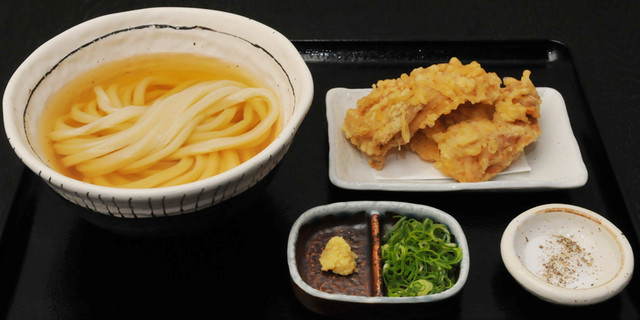
Approaching an Osaka udon shop of this scale, the first signal is compression: a ground-floor room, a short threshold, and a dining area built around fast decisions. Sanuki-style udon rewards this economy. The craft sits in dough, boil, broth, timing, and turnover, not theatrical plating or a long kitchen script.
Sanuki Udon Byakuan is a useful counterpoint to Osaka’s wider eating map. The city stretches from street snacks to counter kappo and late-night drinking rooms, yet udon remains one of its clearest daily measures of value. A Tabelog score of 3.78 and repeated selection for Tabelog Udon WEST 100, including 2024, place the shop in a documented specialist tier, while the format stays closer to a neighborhood noodle counter than destination dining choreography.
An 18-seat room built for noodles, not lingering
The room matters because udon changes character when served in a space designed for speed, visibility, and heat. Here the layout is small: 18 seats, split between 6 counter seats and 12 table seats. In Osaka, noodle shops must serve lone diners, pairs, and families without changing the kitchen’s tempo. Counter seats keep the meal focused; tables make the room usable for groups without restaurant formality.
The physical container also explains the appeal of specialization. Udon and curry udon are not broad menu categories here; they are a narrow operating language. Osaka has many casual staples competing for the same quick-meal window, from pork buns at 551 Horai (551蓬莱) to bakeries such as 52CHO-ME BAKERY and coffee-led stops like .cafe. Udon’s advantage is different: filling, technically exposed, and priced for repeat use rather than occasional celebration.
Compared with Osaka peers in other comfort-food lanes, the distinction is sharp. Negiyaki Yamamoto Honten operates in the griddle-and-sauce tradition at a higher spend band, while Chuka Soba Kirimen Souhonten and Chuka Soba Kokokara Sakie sit nearer the ramen end of the wheat-noodle spectrum. Meganeya and Nomiba Umeda Umeda speak more to drinks-and-dinner spending. Sanuki Udon Byakuan occupies a lower-cost, narrower, noodle-first category, where the modest footprint reinforces the point.
Sanuki technique inside Osaka's value grammar
Sanuki udon, associated with Kagawa, is judged heavily on noodle structure. Osaka adds quick lunches, station-adjacent routines, family usability, and a high tolerance for specialization when value is clear. The regular noodle serving is listed at 260 to 280 grams, with larger portions available for modest surcharges. Those details say more than ornamental menu language: portion logic and noodle texture carry the experience.
The curry udon category also matters. In Japan, curry udon is not a novelty add-on; it is a comfort format with expectations around viscosity, heat, and how sauce clings to the noodle. A shop listing both udon and curry udon works across two related tests: clean noodle-and-broth clarity on one side, richer coating power on the other. That duality gives the room broader daily usefulness without turning the menu into a catch-all.
The recognition history adds weight because Tabelog’s Hyakumeiten selections are category-specific. Selection for Udon WEST in 2017, 2018, 2019, 2020, 2022, and 2024 places the shop within a sustained Kansai noodle conversation rather than a single-season spike. For travelers, that signal is more relevant than a generic popularity claim. It suggests consistency in a category where local diners are unforgiving and repeat custom matters.
Osaka’s restaurant scene can look chaotic when mapped only by famous districts, but formats read it better. Pizza specialists such as 99 Pizza Napoletana Gourmet, Italian rooms such as a canto (Italian), and noodle counters do not compete on the same terms. They answer different needs in the day. Udon belongs to the city’s practical intelligence: short meals, direct flavors, and little tolerance for wasted motion.
How to place it in a wider Osaka itinerary
The smart use case is not a grand tasting schedule. It works better as a grounded meal that resets the palate between heavier Osaka plans. Travelers building a city itinerary should treat udon as part of the same cultural field as okonomiyaki, negiyaki, ramen, kissaten breakfasts, department-store food halls, and late drinks. The reward is not luxury signaling; it is calibration. After a few days in Osaka, a good udon counter shows how the city thinks about value.
For broader planning, Our full Osaka restaurants guide gives the food context, while Our full Osaka hotels guide helps with base selection. Drinking routes belong in Our full Osaka bars guide, and travelers extending the trip through producers or cultural programming can use Our full Osaka wineries guide and Our full Osaka experiences guide.
The larger Japan map shows how specialized casual dining travels across regions. Beef sukiyaki in Kamakura at -Grilled beef Sukiyaki- KAMAKURA TANUKIAN 鎌倉 たぬき庵 in Kamakura, charcoal tuna in Tokyo at. 鮪と炭火焼き うお炭 秋葉原店 in Tokyo, curry in Sapporo at [Curry Senmon Ten] Maruyama Kyoju. in Sapporo, and Kyoto dining at [ki:] in Kyoto all show the same principle: Japan’s casual categories can be as disciplined as its formal ones.
There is a useful overseas echo, too. Japanese food culture abroad often foregrounds sake, rice, or regional snacks, as seen at Jōdo Saké Bar in Los Angeles and Onigiri Time in Pasadena. Within Japan, the lesson is quieter and more precise. A compact Osaka udon room does not need to perform rarity; it needs to handle noodles, seating, and turnover with discipline. That is why Sanuki Udon Byakuan belongs on a serious Osaka food itinerary.
Travelers comparing regional breadth can also look beyond Kansai, from.know in Kumamoto to (Shoku) Vietnam in Kawasaki. The contrast clarifies the point: Osaka’s udon culture is not decorative abundance. It is a small room, a narrow menu, and a city that understands when a bowl of noodles has done enough.
Snapshot
Comparable venues to calibrate price, style, and recognition.
| Venue | Cuisine | Price | Notes |
|---|---|---|---|
| Sanuki Udon ByakuanThis venue — the venue you are viewing | Sanuki udon & curry udon shop | $ | Not listed |
| Sunshine | Retro Japanese kissaten & coffee shop | $ | Kita |
| Hirokawa Tailor | Japanese stand-up bar (tachinomi) | $ | Chūō |
| Spice curry 43 | Osaka-style spice curry | $ | Nishi |
| Kokopelli Curry | Japanese curry house | $ | Kita |
| Yotsubashi Cafe | Japanese yoshoku-style cafe specializing in hamburg steak | $ | Nishi |
Recognition history
Dated appearances from independent guides and award organizations, with the underlying list record or original source where available.
Tabelog 100 #77 · No. 77
Tabelog · Tabelog 100 - Udon - WEST - 2024
Continue exploring
More in Osaka
Restaurants in Osaka
Browse all →




Bars in Osaka
Browse all →




Hotels in Osaka
Browse all →



Wineries in Osaka
Browse all →
At a Glance
- Cozy
- Lively
- Classic
- Solo
- Family
- Casual Hangout
- After Work
- Group Dining
- Standalone
A small, relaxed neighborhood udon shop with simple decor, counter and table seating, bright but unpretentious lighting, and a cozy, family-friendly feel that often hums with the sound of waiting customers.