
Osaka’s curry scene has room for both quick comfort plates and tightly controlled specialist counters. Kokopelli Curry sits in the latter camp, with Tabelog Curry WEST 100 recognition in 2023 and 2024, an eight-seat counter format, and a health-driven spice-curry method built around dashi, brown rice, fermented seasonings, and a no-vegetable-oil approach.
Pearl is the En Primeur Club membership app — saves, bookings, and concierge access live there. Same editors, same standards.
- Address
- 2 Chome-6-12 Higashitenma, Kita Ward, Osaka, 530-0044, Japan
- Phone
- +81 70-5053-2161
- Website
- youtube.com
 Saves & bookings on Pearl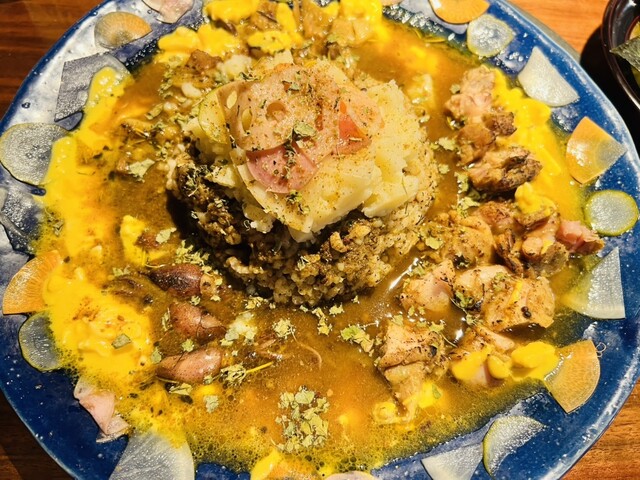
Approach this kind of Osaka curry counter expecting less clatter than the city’s usual lunch crush. The format is small, counter-led and deliberate, closer to a specialist tasting room than a casual curry stop. Kokopelli Curry belongs to a narrower Osaka category: spice curry treated as a controlled craft, where the kitchen’s process, the front-of-house rhythm and the room’s quiet rules shape the meal as much as heat level or portion size.
That matters in a city where curry has become one of the more elastic forms of everyday dining. Osaka supports quick roux counters, South Asian inflections, Japanese curry-rice comfort shops and newer spice-curry rooms that borrow from dashi, fermentation and regional produce. Kokopelli Curry’s inclusion in Tabelog Curry WEST 100 for 2023 and 2024 places it inside the specialist tier rather than the convenience tier. It is not competing with the city’s grab-and-go classics in the same way that 551 Horai (551蓬莱) answers a different Osaka appetite: speed, portability and civic habit.
Spice curry treated like a counter discipline
The defining idea here is subtraction. The curry is built without gluten, vegetable oils, dairy products or sugar, a framework the restaurant describes as “4 toxin removal.” The editorial point is not the health claim itself; it is the way that dietary constraint pushes the cooking toward Japanese structure. Dashi, fermented seasonings and brown rice move the plate away from standard curry-shop richness and toward a lighter, more Japanese grammar of umami and grain.
The method reads as a collaboration between roles even where names are not the story. The kitchen has to produce body without the usual shortcuts of fat, flour or dairy. The counter has to keep service measured in a room with only eight seats. Front-of-house discipline is explicit: quiet phones, restrained conversation and one order per person. That creates a social contract closer to small sushi or kappo counters than to a noisy curry lunchroom.
Technical claims are unusually specific. The curry uses two broths: one from bonito and another from kombu and shiitake extracted over 72 hours, then combined with handmade spice roux. Domestic meat, Tsuyahime brown rice from Yamagata, natural Japanese sea salt and traditional fermented seasonings such as mirin, soy sauce, miso, vinegar and sake provide the scaffolding. Twenty spices are used, but the point is not brute heat. The format aims for clarity rather than the heavy aftertaste associated with oil-based curry sauces.
Osaka diners already understand the appeal of compact specialisation. A bakery such as 52CHO-ME BAKERY, a coffee room such as .cafe, and a focused Italian kitchen such as a canto (Italian) all speak to a city that rewards narrow craft when it is executed with conviction. Curry can sit in that same economy of attention.
Where it fits in Osaka's specialist dining map
The useful comparison is not just other curry. In Osaka, small counters often signal a higher level of control: fewer seats, tighter pacing, less margin for distraction. Sushi Ichiei and Miyamoto occupy different culinary traditions, but both belong to the broader Osaka pattern in which intimate formats ask diners to accept the room’s rhythm. Kokopelli Curry applies that logic to spice curry, a category often treated as casual by default.
There is a pricing signal too, though the better read is value structure rather than expense alone. Osaka has plenty of curry at lower spend levels, including formats closer to everyday lunch. Fukuryu En, for instance, sits in a lower published budget band than the restaurant. The difference marks a category split: quick curry as urban utility on one side, ingredient-cost and process-led curry on the other. For travellers building a food itinerary, that distinction is more useful than asking which curry is “better.”
For a wider Osaka plan, this counter makes more sense beside focused food addresses than as a random stop between sightseeing blocks. The city’s restaurant spectrum runs from casual staples to reservation-minded rooms, and Our full Osaka restaurants guide is the better frame for mapping those decisions. Hotels, bars, wineries and experiences shape the same trip architecture; see Our full Osaka hotels guide, Our full Osaka bars guide, Our full Osaka wineries guide and Our full Osaka experiences guide for the surrounding edit.
The reader decision: come for controlled curry, not casual noise
The restaurant is a sharper fit for diners interested in modern Japanese spice-curry thinking than for anyone seeking a loose, high-turnover meal. The eight-seat counter, quiet-room expectations and health-led recipe framework all narrow the audience in a useful way. This is a meal for people who want to understand how Osaka’s curry scene has moved beyond standard roux and rice into dashi, fermentation and ingredient subtraction.
The counter also sits within a larger Japanese pattern of micro-specialists. Across the country, restaurants such as [Curry Senmon Ten] Maruyama Kyoju. in Sapporo, [ki:] in Kyoto.know in Kumamoto, (Shoku) Vietnam in Kawasaki, -Grilled beef Sukiyaki- KAMAKURA TANUKIAN 鎌倉 たぬき庵 in Kamakura and. 鮪と炭火焼き うお炭 秋葉原店 in Tokyo show how tightly defined formats can carry a whole dining identity. Japanese food abroad has taken the same lesson in another direction, from Jōdo Saké Bar in Los Angeles to Onigiri Time in Pasadena: specificity travels better than generality.
The strongest reason to prioritize the restaurant is not novelty, and not spectacle. It is the chance to see curry handled with the seriousness Osaka more often reserves for counters built around sushi, kappo or yakitori. The meal’s interest lies in a coordinated system: a kitchen working without common curry-building blocks, a compact room that limits drift, and a service style that asks diners to pay attention.
The Essentials
Comparable venues by cuisine and category.
| Venue | Cuisine | Price | Notes |
|---|---|---|---|
| Kokopelli CurryThis venue — the venue you are viewing | Kita, Japanese curry house | $ | Not listed |
| Sanuki Udon Imayuki | Kita, Traditional Sanuki Udon | $ | Not listed |
| Hyakka Koushin Shokudo | Not listed | $ | Chūō, Spice curry & small plates with natural wine |
| Menya Tsumugu | Ibaraki, Ramen shop | $ | Not listed |
| Umaiya Takoyaki | Tenma, Traditional Osaka Takoyaki | $ | Not listed |
| Motsuyaki Doppo Tenma ten | Kita, Japanese motsuyaki standing bar | $ | Not listed |
Recognition history
Dated appearances from independent guides and award organizations, with the underlying list record or original source where available.
Tabelog 100 #56 · No. 56
Tabelog · Tabelog 100 - Curry - WEST - 2024
Continue exploring
More in Osaka
Restaurants in Osaka
Browse all →




Bars in Osaka
Browse all →




Hotels in Osaka
Browse all →




Wineries in Osaka
Browse all →
At a Glance
- Standalone
Current opening hours
- Monday
- 11:30 AM–3 PM, 7–9:30 PM
- Tuesday
- 11:30 AM–3 PM, 7–9:30 PM
- Wednesday
- 11:30 AM–3 PM, 7–9:30 PM
- Thursday
- 11:30 AM–3 PM, 7–9:30 PM
- Friday
- 11:30 AM–3 PM, 7–9:30 PM
- Saturday
- 11:30 AM–3 PM
- Sunday
- 11:30 AM–3 PM
Hours can change for holidays and private events. Last verified .