Restaurant Gamarjoba
Our verdict
Restaurant Gamarjoba brings Georgian cuisine to Philadelphia's Northeast corridor at 13033 Bustleton Ave, a neighborhood where Eastern European and former Soviet immigrant communities have quietly sustained some of the city's most specific regional cooking. The name translates to 'hello' in Georgian, signaling an accessibility that extends to the menu. For Philadelphians tracking the city's expanding map of diaspora-driven restaurants, this is a useful address to know.

Pearl is the En Primeur Club membership app — saves, bookings, and concierge access live there. Same editors, same standards.
- Address
- 13033 Bustleton Ave, Philadelphia, PA 19116
- Phone
- (215) 677-6070
- Hours
- Mon–Thu 11 AM–11 PMFri 11 AM–12 AMSat 10 AM–12 AMSun 10 AM–11 PM
- Website
- gamarjoba.us
- Directions
- Get directions
- Booking
- Book on OpenTable
Where Northeast Philadelphia's Diaspora Dining Scene Takes Shape
Philadelphia's dining conversation tends to orbit Center City and its adjacent neighborhoods, but some of the city's most specific regional cooking happens well north of that radius. The stretch of Bustleton Avenue running through the Northeast has long served as a commercial artery for Eastern European and former Soviet immigrant communities, and the restaurants along it reflect that population directly: Georgian khinkali houses, Ukrainian delis, Russian bakeries operating without much press attention. Restaurant Gamarjoba, at 13033 Bustleton Ave, sits within that tradition rather than outside it.
The name is a direct signal. Gamarjoba means 'hello' in Georgian, a word of greeting that also carries a tone of welcome without ceremony. That framing matters in a culinary tradition that places hospitality at the center of the meal rather than treating it as a secondary consideration. Georgian food, rooted in the Caucasus with centuries of influence from Persian, Ottoman, and Russian cooking, is not a cuisine that has received the same institutional recognition in the United States as some of its European counterparts. That relative obscurity is precisely what makes addresses like this one worth tracking.
The Culinary Tradition Behind the Menu
Georgian cuisine occupies a distinct position in the broader map of Caucasian and Central Asian cooking. Unlike the flatter spice profiles of some Central Asian traditions, Georgian food layers fresh herbs, walnut paste, and fermented dairy with a tartness that comes from tkemali, a sour plum sauce, and pomegranate. The country sits at a geographic crossroads, and its food reflects that: bread baked in a clay tone oven, cheese-filled boats of adjara khachapuri, slow-braised meats, and dumplings called khinkali that are eaten by hand, the pleated leading discarded by convention.
Khinkali, in particular, are the dish most likely to anchor a first visit. Each dumpling holds a pocket of spiced meat broth that releases on the first bite, requiring a specific technique to avoid losing the liquid. In Tbilisi's dumpling houses, the count of khinkali consumed at a sitting is tracked by leaving the twisted tops on the plate. That ritual transfers to diaspora restaurants in cities across the United States, including Philadelphia, where Georgian communities have maintained enough critical mass to support dedicated kitchens.
The fermented, herb-forward, and walnut-heavy character of Georgian cooking also makes it naturally interesting for diners moving between European and Middle Eastern food traditions. Satsivi, a cold walnut sauce served over poultry, and pkhali, compressed vegetable preparations bound with walnut and garlic, appear across regional variations of the menu. These are preparations that reward attention to ingredient quality rather than technical flourish, which means the leading versions in diaspora settings are often the ones with the least translation for a non-Georgian audience.
Northeast Philadelphia as a Dining Context
Understanding Gamarjoba requires understanding what Northeast Philadelphia is as a dining environment. This is not a neighborhood that courts food media. The restaurants here operate on community logic: regulars from specific immigrant groups who know what they want, portions sized for the expectation that the table will be full, and pricing that reflects the neighborhood's economic register rather than Center City's. That means the experience at a place like Gamarjoba differs substantially from what you encounter at, say, Fork or Friday Saturday Sunday in Old City, or the Thai-inflected intensity at Kalaya in South Philadelphia.
Those venues operate within a framework of culinary press recognition and reservation-based demand. Gamarjoba almost certainly does not. This is a different tier of the city's dining ecosystem, one where the food's authority comes from community use rather than critical endorsement. Across Philadelphia's Northeast, that pattern repeats: Cambodian cooking at Mawn, French-inflected precision at My Loup, and a longer list documented in our full Philadelphia restaurants guide. The broader American fine dining circuit, represented by addresses like Le Bernardin in New York City, Alinea in Chicago, The French Laundry in Napa, Lazy Bear in San Francisco, or Providence in Los Angeles, operates on credentials and scarcity. Diaspora neighborhood restaurants like Gamarjoba operate on different logic entirely, and that difference is not a deficit.
For context on what award-recognized dining looks like in adjacent American cities, consider Emeril's in New Orleans, Addison in San Diego, The Inn at Little Washington, Blue Hill at Stone Barns in Tarrytown, Single Thread Farm in Healdsburg, Atomix in New York City, or 8 1/2 Otto e Mezzo Bombana in Hong Kong. The operating model, price architecture, and booking dynamics at those venues bear no resemblance to what you will find on Bustleton Avenue, and that contrast clarifies what Gamarjoba actually is: a neighborhood restaurant serving a specific community with food rooted in a specific place.
What to Expect at the Table
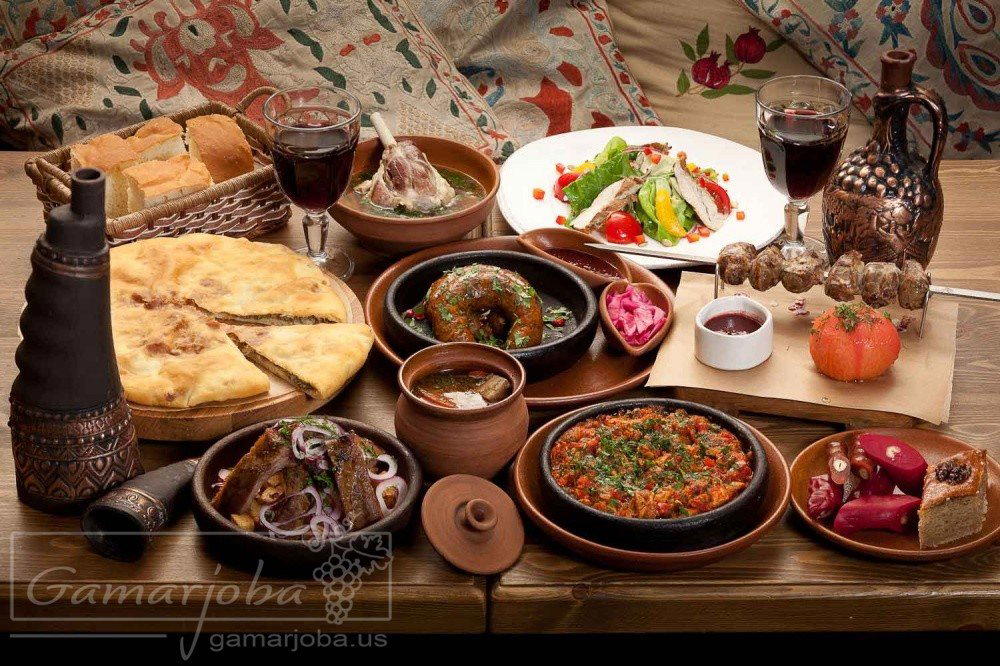
Georgian restaurants in diaspora settings typically present a menu that consolidates the country's most recognizable dishes without much concession to unfamiliarity. Khachapuri in its Adjaran form, the boat-shaped bread filled with molten cheese and a cracked egg, is almost always present. So are khinkali, badrijani nigvzit (fried eggplant rolled around walnut paste), and some version of a meat stew or grilled skewered meat. Wine, if available, may include Georgian natural wines made with skin-contact techniques in clay qvevri, a tradition the country has maintained for thousands of years and which now intersects with the global natural wine conversation in interesting ways.
Know Before You Go
- Address: 13033 Bustleton Ave, Philadelphia, PA 19116
- Neighborhood: Northeast Philadelphia
- Cuisine: Georgian (Caucasian)
- Price range: Not confirmed; expect neighborhood pricing consistent with the area
- Reservations: Not confirmed; call ahead to verify current hours and booking policy
- Hours: Not confirmed at time of publication
- Phone / Website:
- Do I need a reservation for Restaurant Gamarjoba?
- Neighborhood Georgian restaurants in Philadelphia's Northeast corridor generally operate without the advance booking windows required at Center City venues. Given the restaurant's location and community-facing format, walk-in visits may well be accommodated, but calling ahead is advisable, particularly for larger groups or weekend evenings.
- What makes Georgian cuisine distinct from other Eastern European cooking traditions found in Northeast Philadelphia?
- Georgian food draws from a different geographic and cultural base than the Ukrainian, Russian, or Polish cooking also present along Bustleton Avenue. The cuisine relies heavily on walnut-based sauces, fermented plum condiments, and fresh herb combinations that reflect the Caucasus region's particular agricultural tradition. The wine tradition is also distinct: Georgia is documented as one of the world's oldest wine-producing regions, with qvevri clay-vessel fermentation recognized by UNESCO. That specificity places Georgian restaurants in a separate culinary category from the rest of the Northeast Philadelphia Eastern European dining scene, and it is part of why addresses like Gamarjoba serve a community that could not easily find equivalent cooking elsewhere in the city.
Frequently asked questions
Where do I go for Restaurant Gamarjoba?
Restaurant Gamarjoba is located at 13033 Bustleton Ave, Philadelphia, PA 19116, Philadelphia.
Do I need a reservation at Restaurant Gamarjoba?
Given the neighborhood's community-driven dining culture at Bustleton Ave, demand can spike around weekends and diaspora community gatherings. Calling ahead is a practical precaution rather than a formal requirement.
What do people recommend at Restaurant Gamarjoba?
Georgian restaurants operating in diaspora settings like Northeast Philadelphia typically anchor their menus around the country's most recognized dishes: khachapuri in its regional variations, khinkali dumplings, and walnut-dressed vegetable plates. Gamarjoba sits on Bustleton Ave in the 19116 zip code, an area with an established Eastern European and Caucasian community, which tends to push restaurants toward authenticity over adaptation. For current dish specifics, checking with the restaurant directly is the most reliable route.
Do I need a reservation for Restaurant Gamarjoba?
Reservations are recommended for Restaurant Gamarjoba in Philadelphia. Confirm current policy via the venue's official channels.
Budget Reality Check
Comparable venues nearby, for context on price, style, and recognition.
| Venue | Cuisine | Price | Notes |
|---|---|---|---|
| Restaurant GamarjobaThis venue — the venue you are viewing | Authentic Georgian | $30–50 | Not listed |
| Baby's Kusina + Market | Modern Filipino | Not listed | Brewerytown, Modern Filipino |
| Mural City Cellars | Urban Winery & Wine Bar | $20–30 | Fishtown, Urban Winery & Wine Bar |
| Rice & Sambal | Modern Indonesian | $100–150 | East Passyunk Crossing, Modern Indonesian |
| Tabachoy | Filipino Comfort Food | $30–50 | Hawthorne, Filipino Comfort Food |
| LaScala's FIRE - Northeast | Wood-Fired Italian American | $20–30 | Northeast Philadelphia, Wood-Fired Italian American |