Our verdict
On Karl-Heine-Straße in Leipzig's Plagwitz district, Restaurant Casablanca occupies a stretch of the city that has shifted steadily from industrial heritage to considered dining. The kitchen draws on ingredient-led cooking in a neighbourhood that now sits alongside several of Leipzig's more serious restaurant addresses, making it a reference point for the area's evolving food character.

Pearl is the En Primeur Club membership app — saves, bookings, and concierge access live there. Same editors, same standards.
- Address
- Karl-Heine-Straße 47, 04229 Leipzig, Germany
- Phone
- +493412534614
- Hours
- Mon–Wed 5–10 PMThu–Sun 11:30 AM–10 PM
- Website
- casablancaleipzig.de
- Directions
- Get directions
The menu
What to order
- Lamb tajine
- Oriental lamb dishes
- Couscous
Karl-Heine-Straße and the Plagwitz Dining Shift
Leipzig's western districts took longer to develop a dining identity than the centre, and Karl-Heine-Straße tells that story in compressed form. The street runs through Plagwitz, a neighbourhood shaped by nineteenth-century textile and metalwork industries whose brick-fronted buildings now house studios, independent retailers, and restaurants that have accumulated slowly but with some durability. The corridor between the canal and the Lindenau border has become one of the more interesting stretches for eating in the city, not because of density but because of the variety of registers it supports: neighbourhood regulars alongside more destination-oriented kitchens. Restaurant Casablanca at number 47 sits within that character, operating on a street where the physical environment does some of the framing before you reach the door.
For context on where Leipzig's restaurant scene sits more broadly, our full Leipzig restaurants guide maps the city's dining by neighbourhood and price tier.
Ingredient Sourcing as Editorial Position
Across Germany's mid-tier cities, the restaurants that have built sustained reputations over the past decade have generally done so through a consistent approach to sourcing rather than through format innovation alone. The Berlin and Munich fine-dining circuits, where places like CODA Dessert Dining in Berlin and JAN in Munich have built recognition through specific conceptual commitments, show what happens when a kitchen takes a clear position. In Leipzig, the equivalent conversation is quieter but present. The city lacks the dense critical infrastructure of Hamburg or Munich, which means restaurants here build reputations more slowly and through word of mouth rather than through award cycles. That context matters when reading any Leipzig address: sustained operation on a street like Karl-Heine-Straße carries its own signal.
Ingredient sourcing has become a dividing line in German restaurant culture at most price points. Where older continental formats leaned on classical technique applied to standardised produce, kitchens that have opened or repositioned in the post-2010 period increasingly foreground provenance as a structuring principle. This is evident at the awarded end of the German market: Schwarzwaldstube in Baiersbronn and Waldhotel Sonnora in Dreis both operate within regional ingredient frameworks that are inseparable from their identity. Further down the formality register, the same logic applies: a kitchen that can articulate where its produce comes from and why tends to cook with more internal consistency than one that cannot.
Leipzig's Competitive Context
Restaurant Casablanca operates within a Leipzig dining scene that has a defined upper tier but a less charted middle. At the formal end, Stadtpfeiffer holds the city's highest creative position with a €€€€ price point and a track record that extends well beyond the local market. Kuultivo sits at €€€ with a modern cuisine format that addresses a similar demographic. These two define the ceiling. Below that, the city has a range of addresses that serve distinct communities without necessarily competing with one another directly: Addis Café for Ethiopian cooking, Alfa Restaurant in its own register, and 997 Sushi Restaurant for Japanese. Casablanca on Karl-Heine-Straße positions itself within this broader ecology, on a street that supports independent restaurant culture with a local-first clientele.
The name itself carries a specific cultural register: Casablanca as a reference point suggests a North African or Mediterranean-inflected identity, a framing that, if accurate, would place the kitchen within a lineage of European restaurants that draw on Maghrebi and southern Mediterranean ingredient logic. Preserved lemons, charmoula-adjacent spicing, slow-cooked lamb, and grain-forward dishes are the vocabulary of that tradition. Whether the kitchen here works directly within that frame or uses the name more loosely is a distinction that matters for sourcing: genuine engagement with North African ingredient culture implies a supply chain that reaches beyond standard German wholesale channels.
How It Reads Against the German Fine-Dining Circuit
Germany's most recognised kitchens have largely consolidated around a northern European fine-dining grammar, with strong classical French foundations and increasing Scandinavian influence on presentation and preservation. Vendôme in Bergisch Gladbach, Victor's Fine Dining by Christian Bau in Perl, Restaurant Haerlin in Hamburg, and Schanz in Piesport all operate within variants of that consensus. ES:SENZ in Grassau and Aqua in Wolfsburg push technical ambition further but remain within recognisable fine-dining parameters. Against that backdrop, a restaurant with a Mediterranean-North African name in a Plagwitz industrial conversion represents a different kind of ambition: the sourcing logic is different, the flavour vocabulary is different, and the price expectation is likely lower. That is not a lesser position. Some of the most interesting eating in Germany right now happens outside the awarded tier, in rooms that are not chasing Michelin cycles but are building coherent ingredient-led menus for a neighbourhood audience. The international comparison is instructive: at the other end of the ambition scale, places like Le Bernardin in New York City and Atomix in New York City demonstrate what sustained sourcing commitment looks like at the formal end, but the principle scales downward.
Planning Your Visit
Restaurant Casablanca is at Karl-Heine-Straße 47 in Leipzig's Plagwitz district, reachable by tram from the city centre in under fifteen minutes. The street has enough density of independent restaurants and bars that an evening here can extend beyond a single sitting. Current hours, booking availability, and pricing are best confirmed directly, as the venue's contact details are not currently listed on third-party platforms. Given the neighbourhood's character, the expectation is a walk-in-friendly format on quieter weekday evenings, with weekends more likely to require advance notice. Dress code is consistent with the Plagwitz register: the neighbourhood skews creative-professional and the dress expectation follows accordingly, smart-casual rather than formal.
Frequently asked questions
What is the signature dish at Restaurant Casablanca?
Given the name's North African cultural framing, the kitchen likely draws on slow-cooked preparations, grain and legume bases, and spice profiles associated with Maghrebi cooking traditions. Confirming the current menu directly with the restaurant is the most reliable approach before visiting.
Do they take walk-ins at Restaurant Casablanca?
In Leipzig, restaurants at this price tier on Karl-Heine-Straße generally accommodate walk-ins on weeknights, though weekend evenings in Plagwitz have become busier as the neighbourhood's dining reputation has grown. If your visit falls on a Friday or Saturday, contacting the restaurant in advance is the safer approach.
What do critics highlight about Restaurant Casablanca?
Restaurant Casablanca does not currently carry formal award recognition from sources such as Michelin or the major German food guides in the available venue data. Its position on Karl-Heine-Straße, within a neighbourhood that has attracted sustained independent restaurant openings, suggests a local reputation built through consistency rather than critical campaigns. Peer context on the Leipzig scene is available through our full Leipzig restaurants guide.
How does Restaurant Casablanca fit into Leipzig's wider dining scene for visitors interested in North African or Mediterranean cuisine?
Leipzig's restaurant landscape offers limited dedicated North African or Maghrebi representation compared with larger German cities, which gives an address with Casablanca's name and implied culinary orientation a distinct position in the city. For visitors exploring Karl-Heine-Straße, the street sits within easy reach of the broader Plagwitz and Lindenau neighbourhoods, which together form Leipzig's most concentrated independent dining corridor. Pairing a visit here with stops at addresses like Addis Café, which brings East African cooking to the same general district, gives a fuller picture of how Leipzig's non-European cuisine traditions are developing outside the city centre.
Credentials Lens
Comparable venues nearby, for context on price, style, and recognition.
| Venue | Cuisine | Price | Notes |
|---|---|---|---|
| Restaurant CasablancaThis venue — the venue you are viewing | Moroccan | $20–30 | Not listed |
| Bistro Syrien | Syrian Bistro | $1–10 | Volkmarsdorf |
| Café H.b.b. Funk West | Oriental Fusion Street Food | $10–20 | Lindenau |
| Cinnamoon | Innovative Levante Café | $10–20 | Altlindenau |
| Bistro Jasmin | Middle Eastern Bistro with Vegan Döner | $1–10 | Gohlis-Süd |
| Dipasquale - Italienische Feinkost | Authentic Italian Delicatessen & Café | $10–20 | Lindenau |
Continue exploring
More in Leipzig
Restaurants in Leipzig
Browse all →
Bars in Leipzig
Browse all →
Hotels in Leipzig
Browse all →

Details
- Cozy
- Romantic
- Casual Hangout
- Group Dining
- A La Carte
- Vegetarian Friendly
Current opening hours
- Monday
- 5–10 PM
- Tuesday
- 5–10 PM
- Wednesday
- 5–10 PM
- Thursday
- 11:30 AM–10 PM
- Friday
- 11:30 AM–10 PM
- Saturday
- 11:30 AM–10 PM
- Sunday
- 11:30 AM–10 PM
Hours can change for holidays and private events. Last verified .
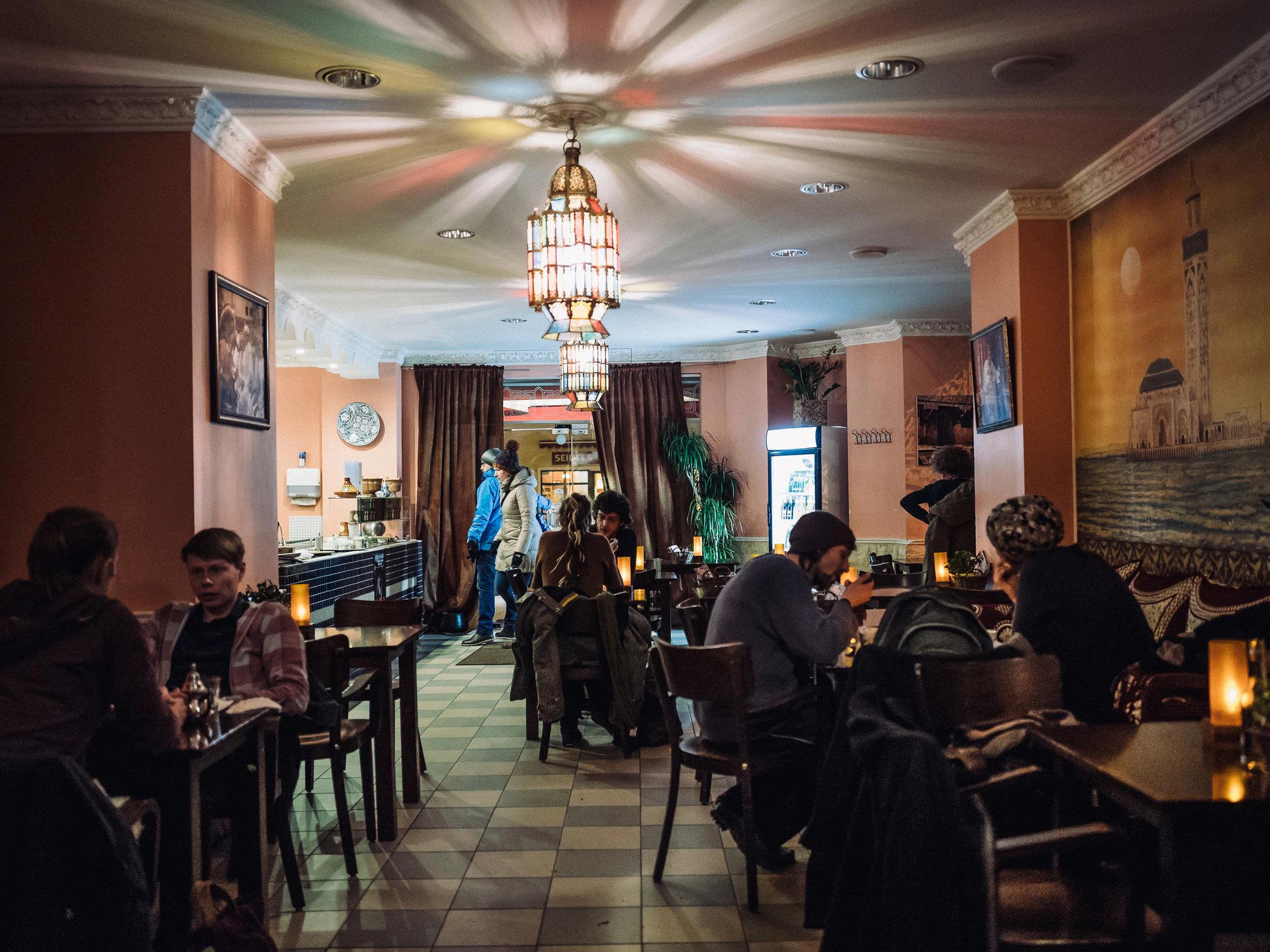
Cozy ambience with oriental elements creating a relaxed, feel-good atmosphere.