Tabelog 100 #37
Our verdict
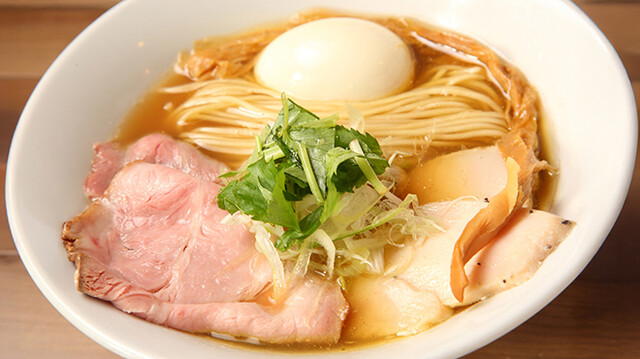
Ramen Sukoyaka brings Tokyo’s ingredient-driven ramen conversation to Mitaka, where a nine-seat counter serves ramen and tsukemen in the JPY 1,000–1,999 bracket. Its repeated selection for Tabelog Ramen TOKYO “Tabelog 100” from 2020 through 2025 gives the small shop a clear place among the city’s serious noodle addresses without pushing it into luxury territory.

Pearl is the En Primeur Club membership app, where members save venues, book tables and use the concierge.
The menu
What to order
- Salt ramen with double shellfish and chicken broth
- Special tsukemen with fragrant shellfish broth
- Shoyu ramen
- Niboshi ramen
The approach to a serious Tokyo ramen counter rarely announces itself with spectacle. In Tokyo, the signal is smaller: a focused shopfront, a counter-minded rhythm, and the clipped pace of a kitchen built for bowls rather than ceremony. Ramen Sukoyaka sits in that practical register, where the measure of ambition is not linen or theatre but how precisely a shop can turn a modest ticket into a coherent meal.
Tokyo ramen has grown more specialised, with the city’s strongest shops often defined by narrow choices and disciplined execution. Ramen Sukoyaka belongs within that ramen and tsukemen field. Its public category listing points to ramen and tsukemen, a combination that places the shop in a familiar but demanding Tokyo format, where seasoning, stock balance, and noodle handling carry the argument more than spectacle.
Tokyo's counter culture rewards precision over scale
Tokyo’s ramen reputation is often discussed through famous dining districts, but the wider city has long been part of the noodle map. A compact ramen setting changes the experience: turnover, pacing, and kitchen discipline become visible. There is little room for a large dining room to disguise inconsistency, and no tasting-menu apparatus to stretch the occasion. The bowl has to make its case quickly.
That small-format logic also clarifies where Sukoyaka sits in the city’s value hierarchy. At JPY 1,000 - JPY 1,999 for both lunch and dinner, it occupies a price band associated with serious everyday specialists rather than destination fine dining. Ganso Stamina Manten Ramen Suzuki, Gyoza no Harbin, Shichijo, Udon Stand Gozu, and Yakitori Yamamoto offer useful Tokyo reference points because the city’s restaurant economy can make a focused counter feel premium through scarcity and craft, even when the bill remains in daily-meal territory.
The recognition gives the argument weight. Ramen Sukoyaka is listed in the 2025 Tabelog Hyakumeiten selection, placing the shop within a citywide ramen filter rather than a one-season burst of attention. Its Tabelog score of 3.78 is high enough to matter in a category where local users grade aggressively and queues often form around incremental differences in execution.
Ramen, tsukemen, and the focused side of Tokyo dining
Ingredient sourcing and preparation are not only fine-dining talking points; in ramen, they are the architecture of the bowl. In a focused ramen format, choices about seasoning, broth, noodles, and finish leave little cover for muddled execution. The appeal of a shop like Sukoyaka is that it belongs to the broader Tokyo movement where restraint is not minimalism but control.
Tsukemen adds a second lens. Dipping noodles ask a shop to think differently about concentration: the broth can be denser, the noodle texture more assertive, the pacing slower. For travellers comparing styles across Tokyo, ordering ramen at one visit and tsukemen at another is a better way to read the kitchen than chasing a single headline bowl. No specific dish needs myth-making here; the interest lies in how one small shop moves between ramen service and the structural demands of dipping noodles.
Ramen Sukoyaka’s visibility in 2025 is useful context in a city where ramen attention can move quickly. Tokyo diners are informed, ratings are searchable, and category sorting is intense. A Tabelog Hyakumeiten listing and a 3.78 score suggest a shop that has earned notice within that competitive landscape, without needing to be inflated into something more formal than it is.
How to plan a Tokyo ramen stop
This is best treated as a focused ramen stop rather than a concierge-scale booking project. Lunch and dinner both fall in the same JPY 1,000 - JPY 1,999 range, keeping the meal firmly in accessible territory. The useful planning point is simple: build in flexibility, expect a compact format, and approach the visit as part of Tokyo’s wider casual-specialist dining culture.
The location is Tokyo. For visitors, that means the cleanest plan is to route it within a broader day of city eating rather than treating it as a stand-alone luxury occasion. Ramen Sukoyaka’s listed categories are ramen and tsukemen, so the decision is less about ceremony and more about timing, appetite, and whether the stop fits naturally into the rest of the day.
For a wider Tokyo eating plan, place this stop alongside city-level research rather than treating it as an isolated detour. EP Club’s Our full Tokyo restaurants guide gives the broader restaurant frame, while Our full Tokyo bars guide, Our full Tokyo hotels guide, Our full Tokyo wineries guide, and Our full Tokyo experiences guide help shape the rest of the itinerary. Nearby category contrasts across the city can be kept generic: other Tokyo dining rooms, casual counters, noodle specialists, and comfort-food formats all provide context for how a modest ramen ticket can still feel like a premium choice when execution is strong.
Frequently asked questions
Is Ramen Sukoyaka expensive?
Pricing at Ramen Sukoyaka is listed as JPY 1,000 - JPY 1,999 for dinner and JPY 1,000 - JPY 1,999 for lunch.
How do I find Ramen Sukoyaka?
Ramen Sukoyaka is located in Tokyo.
How hard is it to get a table at Ramen Sukoyaka?
Ramen Sukoyaka’s Tabelog Hyakumeiten recognition for 2025 and its 3.78 score signal meaningful local attention. Plan with flexible timing, especially around peak lunch and dinner periods in Tokyo.
What is Ramen Sukoyaka known for?
Ramen Sukoyaka is known as a Tokyo ramen and tsukemen shop with 2025 Tabelog Hyakumeiten recognition.
Where the Accolades Land
Comparable venues for cuisine and category context.
| Venue | Cuisine | Price | Awards | Notes |
|---|---|---|---|---|
| Ramen SukoyakaThis venue (the venue you are viewing) | Modern Clam-Focused Ramen & Tsukemen | $10–20 | Tabelog 100 #37 | Not listed |
| Gyoza no Fukuho (餃子の福包) | Traditional Japanese Gyoza | $1–10 | Not listed | Shinjuku |
| Buta Daigaku (豚大学) | Grilled Pork Bowl (Butadon) | $1–10 | Not listed | Shimbashi |
| Curry Shop Fennel | Japanese curry shop | $10–20 | Tabelog 100 #97 | Suginami |
| Echigo Tsuruy | Traditional Japanese mochi & wagashi shop | $1–10 | Tabelog 100 #24 | Suginami |
| CURRY SHOP Kujira Kouenji | Japanese Curry | $10–20 | Tabelog 100 #8 | Suginami |
Recognition history
Dated appearances from independent guides and award organizations, with the underlying list record or original source where available.
Tabelog 100 #37 · No. 37
Tabelog · Tabelog 100 - Ramen - TOKYO - 2025