Pyeongyangjip

Michelin Plate
Our verdict
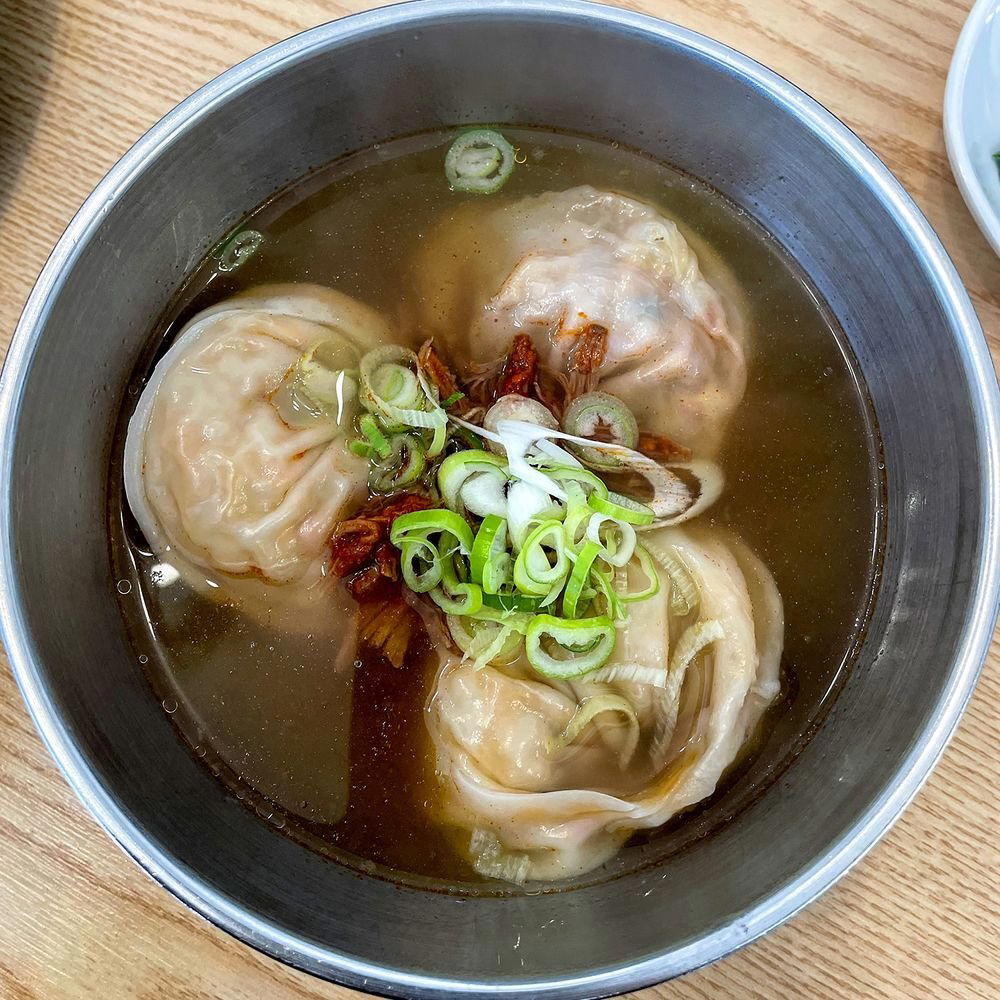
In Busan's Buk-gu district, Pyeongyangjip preserves a North Korean dumpling tradition that has largely disappeared from the peninsula's restaurant scene. The house speciality is mandu-guk: hand-formed dumplings filled with kimchi, glass noodles, tofu, and vegetables, served in a clear beef brisket and shank broth. The nokdujeon, made from stone-milled mung beans, completes a menu that is narrow, deliberate, and worth the trip from anywhere in the city.

Pearl is the En Primeur Club membership app, where members save venues, book tables and use the concierge.
The menu
What to order
- Manduguk
- Nokdujeon
A Tradition That Crossed the Border
North Korean-style cooking occupies a quiet corner of South Korea's food culture. It arrived with the diaspora that moved south during and after the Korean War, and it has been sustained largely by family operations rather than restaurant groups or culinary institutions. In Busan, a port city that absorbed waves of displaced northerners in the 1950s, that tradition has deeper roots than in most Korean cities. Pyeongyangjip, on a side street off Geumgok-daero in Buk-gu, is one of the places where it still holds.
The category itself is worth understanding before you arrive. North Korean cuisine tends toward restraint in seasoning: broths are clear and mineral-driven rather than red and fermented; dumplings lean vegetable-heavy rather than pork-dominant; textures carry more weight than heat. It sits in a different register from the brash, chili-forward southern Korean food that defines most of the country's restaurant export. Venues like 100.1. Pyeongnaeng, which specialises in naengmyeon, occupy a related niche in Busan's northern-style canon, but mandu is its own discipline entirely.
What the Room Tells You
The space at Pyeongyangjip is intimate and spotless. These are not incidental qualities. In small family-run Korean restaurants of this type, cleanliness is a form of professional statement: it signals that prep work is taken seriously and that the kitchen operates with the discipline of a household that has been doing this for generations rather than a commercial operation cutting corners. The room itself recedes as soon as the food arrives, which is exactly how it should be at a venue whose entire credibility rests on two or three dishes done with precision.
Operation is run by the owner and family, a format common to this tier of Korean dining. The comparison matters because it helps calibrate expectations: this is not a tasting-menu experience or a chef-led creative project. It is a family kitchen executing a specific regional tradition, and the standard it should be held to is whether it does that faithfully and well.
The Dumplings
Mandu-guk is the anchor. The dumplings are hand-formed with silky wrappers and filled with a combination of kimchi, glass noodles, tofu, and vegetables. That filling profile is characteristic of the northern style: the kimchi is used as a seasoning agent rather than the dominant flavour, and the overall effect is layered rather than sharp. The broth is made from beef brisket and shank, which produces a clear liquid with collagen depth and a low, clean savouriness that reads as a counterweight to richer Korean soup traditions.
Wrapper texture in mandu is one of the clearest markers of craft. Machine-rolled commercial wrappers are thicker at the edge and dry on contact with hot liquid. A well-made hand-wrapper holds its structure through the broth while staying supple throughout. The fact that Pyeongyangjip's wrappers are described as silky is a meaningful signal: it points to hand preparation and a recipe calibrated over time rather than adjusted for throughput.
For context, the standards being applied here are not local ones in isolation. Across Korea's food scene, venues with strong regional authenticity claims are measured against a national reference point that includes places like Mingles in Seoul or the temple kitchen tradition exemplified by Baegyangsa Temple in Jangseong-gun. The discipline of working within a constrained, tradition-bound format connects all three, even where the styles diverge sharply.
The Nokdujeon
The nokdujeon, or mung bean pancake, is made from beans ground on a stone metdol. That method matters because stone-grinding retains more of the bean's texture and moisture than industrial milling: the resulting batter is coarser, which produces a crispier exterior and an airier interior than a fine-ground version would allow. The addition of bean sprouts introduces a structural crunch that plays against the soft centre.
In the broader Korean pancake tradition, jeon quality is measured by the ratio of crust to interior and by whether the batter has been handled with enough care to hold together under heat without becoming dense. A poorly made nokdujeon is greasy and flat. A well-made one carries the mung bean's subtle earthiness and finishes clean. The stone-grinding detail at Pyeongyangjip is not decorative; it is a production choice that separates this from the average Korean lunch counter.
Where It Fits in Busan's Food Map
Busan's restaurant scene is wider than it is often given credit for. The city has developed a credible fine-dining tier, with venues like Born and Bred at the premium steakhouse end. It also carries deep roots in the kind of working Korean cooking that includes places like 1969 Buwondong Kalguksu, which operates in a similar low-price, high-craft register. Pyeongyangjip belongs to this latter group, where the value argument is not about discount dining but about accessing a form of cooking that does not scale or franchise.
The geography matters. Buk-gu is not a tourist-facing district in the way that Haeundae or Nampo-dong are. Getting here requires intent, and the venue rewards that intent. It is the kind of address that Korean food travelers seek out specifically, rather than stumbling upon, and the experience of eating here connects to a wider Korean culinary literacy that is worth developing across the country's different regions and traditions. For those building that knowledge, Kwon Sook Soo in Gangnam-gu and Double T Dining in Gangneung offer useful reference points at opposite ends of the formality spectrum.
Planning Your Visit
Pyeongyangjip is a family operation with a short, specific menu, which means visiting during off-peak lunch hours is advisable if you want to eat without pressure. The venue is in Buk-gu, a residential district that requires a deliberate transit or taxi journey from central Busan or the beach areas. No booking method is listed in public records, so arriving in person is the practical default. The menu is narrow by design: mandu-guk and nokdujeon are the pillars, and ordering both gives you the full picture of what the kitchen does. For a broader Busan itinerary, our full Busan restaurants guide, hotels guide, bars guide, experiences guide, and wineries guide cover the city in full.
Frequently asked questions
How would you describe the vibe at Pyeongyangjip?
Quiet and unhurried. The space in Buk-gu is small and family-run, kept spotlessly clean in the way that signals the kitchen takes the work seriously. There is no ambient soundtrack or designed atmosphere, the room is incidental to what comes out of it.
How do I find Pyeongyangjip?
Pyeongyangjip is located at 21 Geumgok-daero 20beon-gil, Buk-gu, Busan.
What awards or recognition does Pyeongyangjip have?
Pyeongyangjip has received recognition including: Pyeongyangjip serves North Korean-style mandu and nokdujeon. The house-made dumplings, filled with kimchi, glass noodles, tofu, and vegetables, are encased in silky wrappers and served with a clear broth of beef brisket and shank. The nokdu….
What should I order at Pyeongyangjip?
The mandu-guk is the primary reason to visit: hand-formed dumplings with silky wrappers, filled with kimchi, glass noodles, tofu, and vegetables, served in a clear broth made from beef brisket and shank. The nokdujeon, ground on a stone metdol and finished with crunchy bean sprouts, is worth adding to the order.
What's the best way to book Pyeongyangjip?
No phone number or online reservation system is publicly listed and it operates as a walk-in restaurant. Arriving during off-peak lunch hours gives the best chance of securing a table without a wait, given the limited seating.
What's the defining dish or idea at Pyeongyangjip?
The defining idea is fidelity to a North Korean dumpling tradition that crossed the border with the post-war diaspora and has become genuinely rare in South Korean restaurants. The mandu-guk here, silky wrappers, clear brisket broth, a filling built around kimchi and glass noodles, is made by the owner and family, not scaled for volume.
At-a-Glance Comparison
Comparable venues nearby, for context on price, style, and recognition.
| Venue | Cuisine | Price | Awards | Notes |
|---|---|---|---|---|
| PyeongyangjipThis venue (the venue you are viewing) | North Korean-style Mandu | Not listed | Michelin Plate | Not listed |
| IAán | Contemporary French-Korean Fusion | Not listed | Michelin Plate | Jung 2(i)-dong |
| Pyeongsanok | Traditional Korean Boiled Pork and Noodles | $10–20 | Michelin Plate | Choryang 1(il)-dong |
| ì목 본ì | Modern Korean Dwaeji-Gukbap | $10–20 | Michelin Bib Gourmand | Namcheon 1(il)-dong |
| Matsuzaki | Authentic Japanese Kaiseki Omakase | Not listed | Michelin Plate | Gwangan 2(i)-dong |
| ë경밥ì | Korean BBQ | $20–30 | Not listed | Gwangan 2(i)-dong |
Recognition history
Dated appearances from independent guides and award organizations, with the underlying list record or original source where available.
Michelin Plate
Michelin · 2026 Michelin Plate
Full recognition history (2 entries)
Michelin Bib Gourmand
Michelin
Continue exploring
More in Busan
Restaurants in Busan
All restaurants in Busan →
Bars in Busan
All bars in Busan →
Details
- Intimate
- Cozy
- Classic
- Casual Hangout
- Family
- Standalone
- A La Carte
Current opening hours
- Monday
- 10:30 AM–3:30 PM
- Tuesday
- 10:30 AM–3:30 PM
- Wednesday
- 10:30 AM–3:30 PM
- Thursday
- 10:30 AM–3:30 PM
- Friday
- 10:30 AM–3:30 PM
- Saturday
- 10:30 AM–3:30 PM
- Sunday
- Closed
Hours can change for holidays and private events. Hours as of .
Intimate, spotless, and family-run with a warm, comforting atmosphere.