Our verdict
On 20th Street West, Primal sits within Saskatoon's evolving independent dining corridor, where restaurants are increasingly framing prairie ingredients through direct, technique-driven formats. The address places it in a neighbourhood where the gap between casual and considered has narrowed considerably. Visitors looking for a read on the city's current dining direction will find 20th Street a useful starting point.

Pearl is the En Primeur Club membership app, where members save venues, book tables and use the concierge.
The menu
What to order
- Bison Carpaccio
- Spaghetti al Limone
- Bone Marrow
- Pesto Cavatelli
- Beef Heart Bolognese
20th Street West and the Shape of Saskatoon Dining
Saskatoon's 20th Street West corridor has spent the better part of a decade consolidating its identity as the city's most concentrated stretch of independent restaurants. The dynamic follows a pattern visible in mid-sized Canadian cities from Victoria to Moncton: a formerly industrial or transitional street gains a first wave of casual operators, attracts foot traffic, and eventually supports formats that require more from their guests in terms of attention and willingness to spend. The street is now at that second stage, with operators working in a register that treats prairie geography as a culinary argument rather than a marketing backdrop.
Primal, at 423 20th St W, occupies that context. The name signals an orientation: toward primary ingredients, direct treatment, and formats that do not obscure what they are working with. In Canadian cities where the dominant fine-dining grammar has long borrowed from French and European templates, restaurants that foreground local product in plainer, more material terms occupy a distinct niche. For a read on how that niche has developed nationally, our full Saskatoon restaurants guide maps the broader scene.
A Prairie City and Its Ingredient Logic
Saskatchewan's position within Canadian food culture is worth stating clearly. The province produces a disproportionate share of Canada's pulses, grains, and foraged product, yet that abundance historically flowed outward to processors and export markets rather than circulating back through urban restaurants. The shift toward direct-sourcing models in Saskatoon dining represents a recalibration: chefs treating the province's agricultural output as a starting point rather than an afterthought.
This is not a local phenomenon. Across Canada, a small tier of restaurants has spent the past decade making proximity-to-source a structural commitment. Eigensinn Farm in Singhampton made this argument in Ontario when it was still a minority position. Fogo Island Inn Dining Room in Joe Batt's Arm built an entire hospitality model around Newfoundland's coastal ecosystem. In Quebec, Tanière³ in Quebec City and Narval in Rimouski have pushed regional specificity into ambitious tasting formats. Saskatoon's version of this impulse is younger and less internationally legible, but the underlying logic is the same: the ingredient network available within a specific geography is a form of editorial authority.
Within Saskatoon, the relevant comparison is between restaurants that treat their prairie context as decoration and those that build their format around it. Hearth Restaurant represents one approach to local ingredient framing on the Saskatoon scene. La Bamba Cafe operates in a different register entirely, drawing on Latin-influenced formats. Primal's address on 20th Street places it in a corridor where these different orientations coexist, and where diners move between formats depending on the occasion rather than the neighbourhood.
At the higher end of the national market, Alo in Toronto and Restaurant Pearl Morissette in Lincoln demonstrate how far this orientation can travel when matched with ambition and execution depth. Primal operates at a different scale and in a different market, but the directional logic connects across these tiers.
The Cultural Stakes of Prairie Cooking
Cooking from the Canadian prairies carries a specific cultural weight that distinguishes it from analogous movements in coastal cities. The prairie diet's historical roots run through Indigenous foodways, settler agricultural traditions, and waves of immigrant communities who shaped regional cuisine in ways that are only now becoming visible in restaurant formats. Saskatoon berry preparations, bison, foraged mushrooms, and cold-climate grains are not simply local products: they are markers of a culinary history that urban fine dining spent decades ignoring in favour of imported European frameworks.
Restaurants that engage seriously with this history are making an argument as much as they are serving dinner. Internationally, the shift is visible at different scales: Le Bernardin in New York City built a canon around French technique applied to North Atlantic seafood; Lazy Bear in San Francisco leans into American hearth cooking as a cultural frame. The prairie equivalent remains less codified, which creates both an opening and a risk for operators working in this register. The opening is that there is no dominant template to compete against.
What to Expect on 20th Street
The address at 423 20th St W places Primal within walking distance of the corridor's denser cluster of independent operators. 20th Street's character rewards the kind of walking arrival that lets the neighbourhood's texture register before you sit down: the mix of long-established spots and newer entrants, the density of foot traffic in evenings, the absence of the chain-restaurant buffer that softens the character of other Saskatoon commercial streets. For visitors arriving from outside Saskatchewan, the street functions as a useful introduction to how the city organises its independent dining culture.
For a wider view of how Saskatoon's restaurant scene connects to broader Canadian dining trends, comparisons with operators like Cafe Brio in Victoria, Catch22 Lobster Bar in Moncton, Busters Barbeque in Kenora, Cat's Fish & Chips in Ottawa, and Jérôme Ferrer - Europea in Montreal illustrate how differently region-specific restaurants frame their ingredient commitments across Canadian geographies.
Planning Your Visit
Primal is located at 423 20th St W in Saskatoon's west side.
Frequently asked questions
What part of town is Primal in?
Primal is located at 423 20th St W, Saskatoon, SK S7M 0X3, Canada, Saskatoon.
How does Primal fit into Saskatchewan's broader food culture?
Saskatchewan is Canada's largest producer of pulses and a significant source of grains and livestock, which gives Saskatoon restaurants a sourcing infrastructure that most Canadian cities can't replicate at the same proximity. Primal's west-side position in Saskatoon puts it within a dining scene that has increasingly built menus around that provincial output rather than importing from outside the region. Whether the kitchen draws on that agricultural context directly is best confirmed with the restaurant at 423 20th St W.
What should I order at Primal?
Ask the floor staff what has come in recently, independent operators at this address level typically shift dishes around supply. The most useful question to a server on 20th Street is usually what the kitchen received that week.
Do they take walk-ins at Primal?
On 20th Street West, independent restaurants run the full range from reservation-only counters to relaxed drop-in formats. Contacting Primal directly before showing up is the practical move, particularly on weekend evenings when the corridor draws the most foot traffic.
What makes Primal worth seeking out?
Primal's address at 423 20th St W places it inside Saskatoon's most concentrated cluster of independent operators, a stretch where the city's serious dining culture is most legible. That corridor has spent nearly a decade differentiating itself from chain-heavy commercial strips, and restaurants that hold a position there tend to earn it through food rather than location rent. For anyone mapping Saskatoon's dining identity, 20th Street West is where that argument is being made most consistently.
Budget Reality Check
Comparable venues nearby, for context on price, style, and recognition.
| Venue | Cuisine | Price | Awards | Notes |
|---|---|---|---|---|
| PrimalThis venue (the venue you are viewing) | Italian Pasta with Prairie Ingredients | $50–100 | Not listed | Not listed |
| Hearth Restaurant | Thoughtful Prairie Canadian | $30–50 | Canada's 100 Best Restaurants #81 | Dining |
| La Bamba Cafe | Authentic Mexican | $20–30 | Not listed | East Side, Authentic Mexican |
| CinCin | Not listed | Not listed | Not listed | Robson Street, Wood-fired modern Italian fine dining |
Continue exploring
More in Saskatoon
Restaurants in Saskatoon
All restaurants in Saskatoon →
Bars in Saskatoon
All bars in Saskatoon →
Details
- Romantic
- Elegant
- Rustic
- Intimate
- Date Night
- Special Occasion
- Celebration
- Group Dining
- Private Dining
- Open Kitchen
- Sommelier Led
- Farm To Table
- Local Sourcing
- Organic
- A La Carte
- Prix Fixe
- Wine
- Vegetarian Friendly
- Vegan Options
Current opening hours
- Monday
- 5–10 PM
- Tuesday
- 5–10 PM
- Wednesday
- 5–10 PM
- Thursday
- 5–10 PM
- Friday
- 5–10 PM
- Saturday
- 5–10 PM
- Sunday
- Closed
Hours can change for holidays and private events. Hours as of .
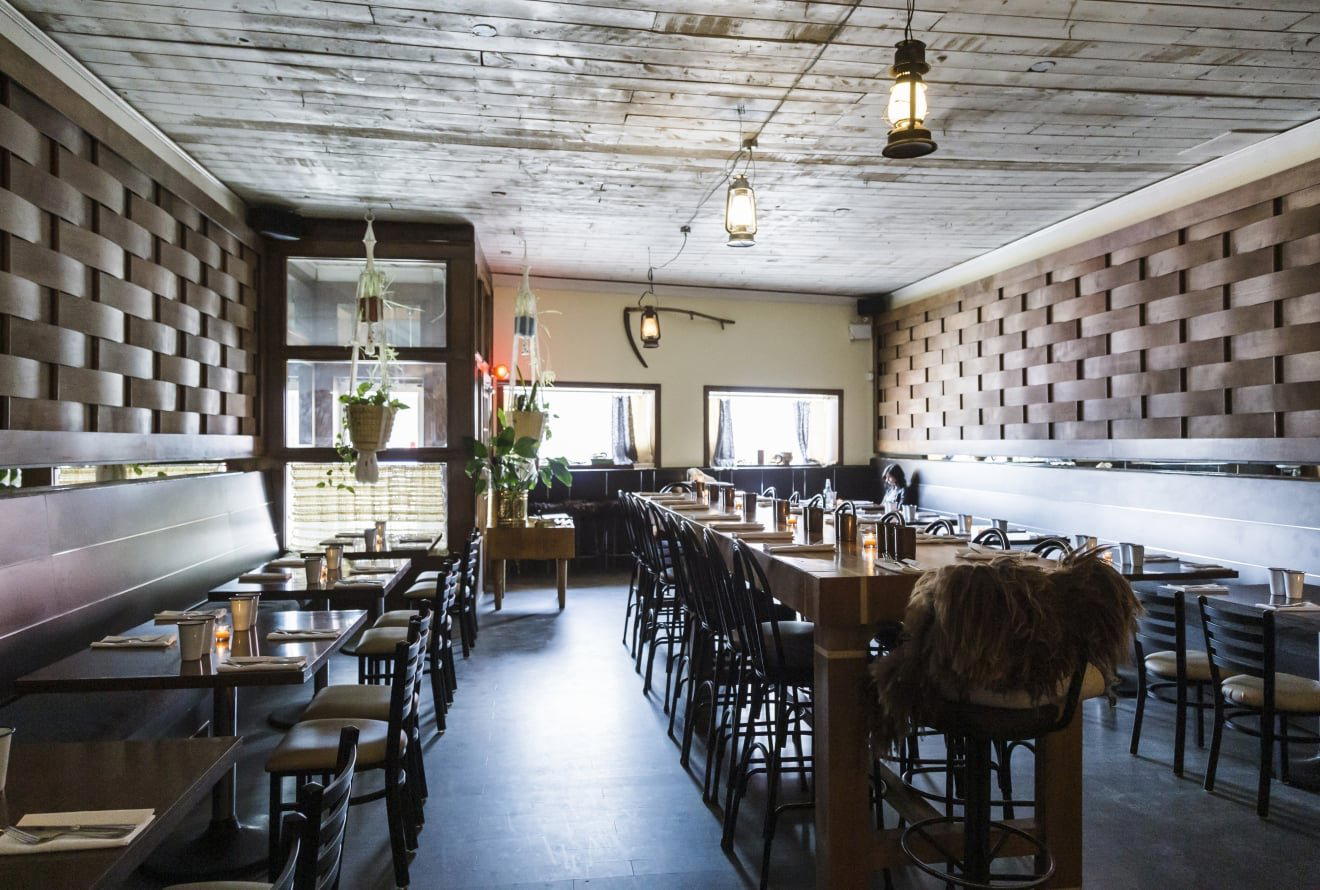
Rustic western atmosphere with intimate, sophisticated lighting; described by guests as fitting for dates and special occasions.