Potbelly
Our verdict
Potbelly at 333 7th Ave sits in one of Midtown Manhattan's most transited corridors, where the sandwich-counter format has held its ground against the neighbourhood's fast-casual churn. The address places it inside a dense lunch market shaped by office density and foot traffic rather than destination dining. Visitors looking for a quick, reliable counter meal in the Penn Station–adjacent stretch will find it consistent with that particular segment of New York's everyday eating scene.

Pearl is the En Primeur Club membership app — saves, bookings, and concierge access live there. Same editors, same standards.
- Address
- 333 7th Ave, New York, NY 10001
- Phone
- (212) 918-0232
- Hours
- Mon–Sat 10 AM–10 PMSun 10 AM–8 PM
- Website
- potbelly.com
- Directions
- Get directions
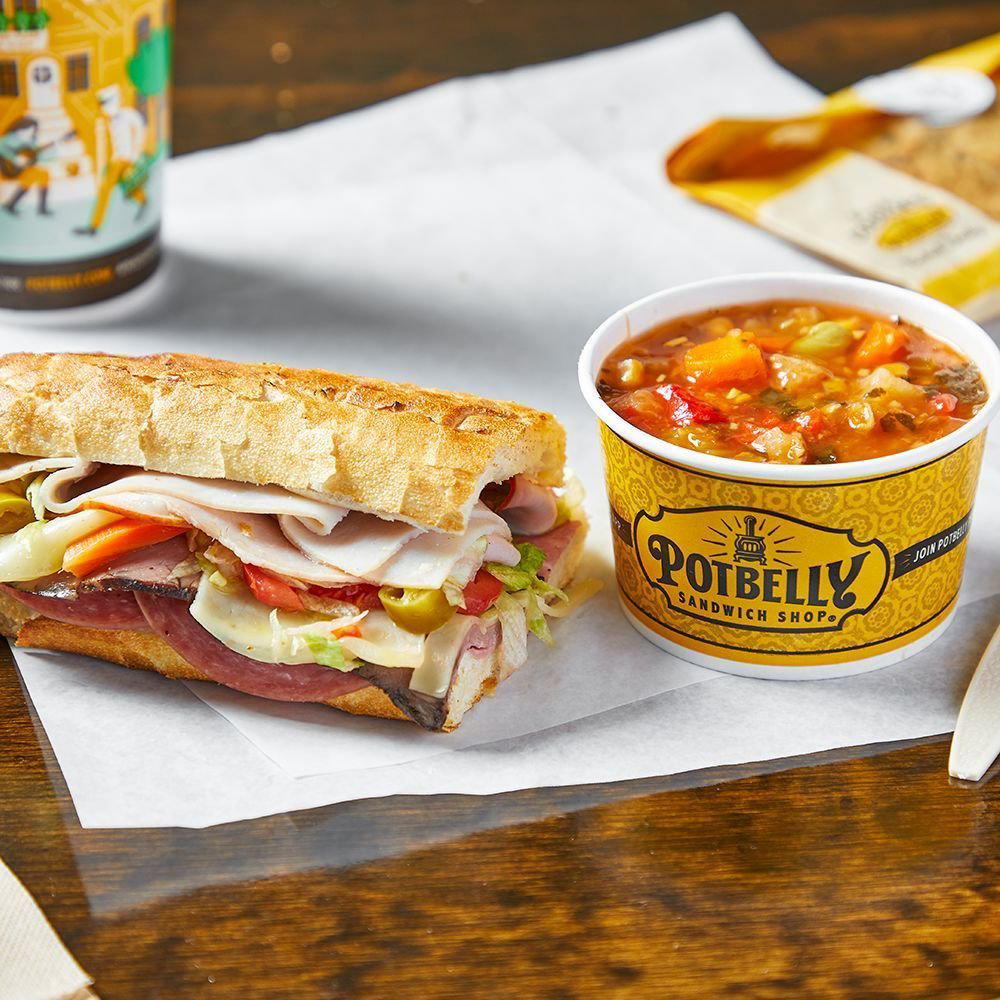
Midtown's Sandwich Counter in Context
The block of 7th Avenue between 28th and 34th Streets processes more pedestrian volume per hour than most American cities see in a day. Penn Station funnels commuters north, Madison Square Garden pulls crowds for events, and the surrounding office towers discharge lunch traffic at noon with the reliability of a shift whistle. In that environment, the sandwich counter format does not compete with destination restaurants — it competes with every other sub-ten-minute option within a two-block radius. Potbelly, at 333 7th Ave, occupies that specific tier: the fast-casual counter built for repeat visits, not deliberate evenings out.
That distinction matters for how you read the room. This stretch of Midtown has never been a neighbourhood defined by ambitious cooking the way that, say, the blocks around Le Bernardin or Per Se carry a culinary identity. The 7th Avenue corridor is defined instead by throughput, and the formats that thrive here are ones that resolve the midday problem for people who have forty-five minutes and no appetite for a reservation. Potbelly's counter model is calibrated to that exact pressure.
The Fast-Casual Counter as a Format
The sandwich-counter format Potbelly operates within has been a durable American institution, but its position inside New York City's eating hierarchy is worth examining. The city's fast-casual segment has fractured sharply over the past decade: on one end, assembly-line counters with ingredient transparency and sourcing narratives have pushed into the $18–22 lunch range; on the other, legacy chains and value-positioned counters hold the sub-$15 band. These two groups are now effectively different businesses serving different customers, even when they share a city block.
Potbelly sits in the latter cohort — a format built around consistency across locations rather than site-specific sourcing or seasonal variation. That is not a criticism; it is a description of the competitive logic. When the alternative for a Penn Station commuter is a vending machine or a delayed train, reliable execution at a predictable price point is the actual product. The format earns its place in the market by solving a real problem, even if that problem is different from the ones addressed by Eleven Madison Park or Atomix.
Collaboration Inside the Counter Format
The editorial angle of team dynamics reads differently at a fast-casual counter than it does at a chef's table. At tasting-menu restaurants like Masa, the interplay between kitchen, floor, and beverage program is a deliberate compositional choice that shapes every course. At a sandwich counter, the equivalent dynamic operates at a different register: the relationship between order-taker, sandwich-builder, and cashier is the service choreography, and its quality is what determines whether a high-volume lunch counter feels competent or chaotic.
Chains operating multiple locations across a city face a coordination challenge that single-location independents do not: the team dynamic has to be reproducible, not improvised. That reproducibility is exactly what a commuter corridor demands. The Penn Station adjacent lunch customer is not looking for a personalized interaction; they are looking for a system that works under pressure. The quality of that system, the team's ability to process volume without friction, is the service proposition here, stripped of the sommelier-and-chef dialogue that defines the upper end of dining. Concepts like Smyth in Chicago or Lazy Bear in San Francisco invest in that chef-floor-beverage choreography as a differentiator; the fast-casual format invests instead in operational discipline at scale.
Where This Sits in the New York Eating Map
New York's eating map is layered enough that a sandwich counter on 7th Avenue and a three-Michelin-star room four blocks away can coexist without either being out of place. The city's density makes that possible, and it means that any honest account of dining in the city has to account for the full range rather than privileging only the upper tier. Visitors focused on the high end of New York's restaurant scene should consult our full New York City restaurants guide, which maps the city's dining across price points, neighbourhoods, and formats in considerably more depth.
For comparison, the kind of sourcing discipline and kitchen-floor collaboration that defines the upper bracket in American dining appears at places like Blue Hill at Stone Barns in Tarrytown or Single Thread Farm in Healdsburg, where the growing calendar shapes the menu and the front-of-house is an extension of a farming philosophy. That context is not meant to diminish the fast-casual format, it is meant to map the distance between them accurately, so readers can calibrate expectations before they walk in.
Within the United States, restaurants like Providence in Los Angeles, Addison in San Diego, The French Laundry in Napa, Emeril's in New Orleans, The Inn at Little Washington, and Frasca Food and Wine in Boulder represent what deliberate kitchen investment looks like when it compounds over years. Internationally, Atelier Moessmer Norbert Niederkofler in Brunico and Dal Pescatore in Runate show the European equivalent of that long-horizon kitchen identity. These are the peer sets that matter when the editorial question is ambition and craft. Potbelly answers a different question.
Seasonal and Timing Considerations
The Penn Station corridor shifts character by season. Summer brings tourist volume tied to Madison Square Garden events and the general influx that peaks between June and August. September through November sees the commuter base return at full density as business travel resumes. For anyone eating at 333 7th Ave, the practical implication is that midday queues during weekday lunch service will be longer in high-traffic periods, and the counter's ability to move volume efficiently becomes the relevant variable. Early lunch before noon, or a mid-afternoon visit outside the main service window, will generally mean shorter wait times at this address.
Planning Your Visit
333 7th Avenue places Potbelly within walking distance of Penn Station and the 28th Street subway stop, making it accessible from most of Manhattan without additional transit. No reservation is required for counter service of this format. Current hours, menu options, and any dietary accommodation details should be confirmed directly, as those specifics were not available at the time of publication.
Quick reference: 333 7th Ave, New York, NY 10001, no booking required, counter service format, Penn Station adjacent.
Frequently asked questions
What should I eat at Potbelly?
What is the ideal way to book Potbelly?
What makes Potbelly worth seeking out?
Can Potbelly handle vegetarian requests?
How does Potbelly fit into the broader Midtown lunch market for someone visiting on a tight schedule between Penn Station and a meeting?
Similar Picks
| Venue | Cuisine | Price | Awards | Notes |
|---|---|---|---|---|
| PotbellyThis venue — the venue you are viewing | Toasted American Sandwiches | $10–20 | Not listed | Not listed |
| Le Bernardin | French Seafood Fine Dining | $300–500 | 3 Michelin Stars · World's 50 Best #13 | French, Seafood |
| Atomix | Modern Korean Tasting Menu | $300–500 | 2 Michelin Stars · World's 50 Best #7 | Modern Korean, Korean |
| Per Se | French Fine Dining Tasting Menu | $300–500 | 3 Michelin Stars · World's 50 Best #40 | French, Contemporary |
| Masa | Traditional Japanese Omakase | $500+ | 2 Michelin Stars · World's 50 Best #27 | Sushi, Japanese |
| Eleven Madison Park | Contemporary Plant-Based Fine Dining | $300–500 | 3 Michelin Stars · World's 50 Best #4 | French, Vegan |
Continue exploring
More in New York City
Restaurants in New York City
Browse all →
Bars in New York City
Browse all →
Hotels in New York City
Browse all →




Details
- Lively
- Cozy
- Casual Hangout
- After Work
- A La Carte
- Vegetarian Friendly
Current opening hours
- Monday
- 10 AM–10 PM
- Tuesday
- 10 AM–10 PM
- Wednesday
- 10 AM–10 PM
- Thursday
- 10 AM–10 PM
- Friday
- 10 AM–10 PM
- Saturday
- 10 AM–10 PM
- Sunday
- 10 AM–8 PM
Hours can change for holidays and private events. Last verified .
Fun, casual atmosphere with eclectic neighborhood decor, melty toasted sandwiches, and a neighborhood hangout vibe.