Pink Mamma is a sprawling Italian restaurant on Rue de Douai in the 9th arrondissement, occupying five floors of a Pigalle townhouse. It operates at the louder, more convivial end of Paris's casual-dining scene, and its sustained queues and social-media presence have made it a reference point for how Italian cooking translates to a French neighbourhood audience.
Pearl is the En Primeur Club membership app — saves, bookings, and concierge access live there. Same editors, same standards.
- Address
- 20bis Rue de Douai, 75009 Paris, France
- Phone
- +33 9 73 03 40 29
- Website
- bigmammagroup.com
- Directions
- Get directions
 Saves & bookings on Pearl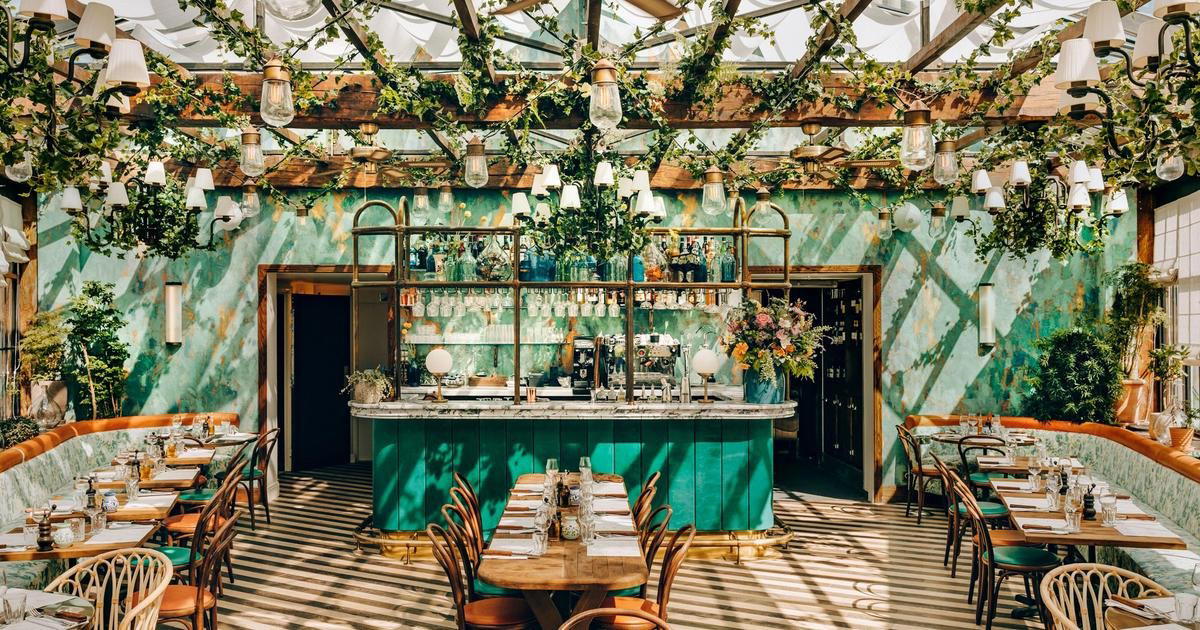
Five Floors Above Pigalle: What Pink Mamma Says About Paris's Casual Italian Scene
The 9th arrondissement has spent the past decade resolving a particular tension: how to absorb the energy of Pigalle and South Pigalle (SoPi, in the shorthand that estate agents adopted before restaurateurs) without tipping into the kind of self-conscious cool that ages badly. The streets around Rue de Douai offer a useful cross-section of how that tension has played out. You find neighbourhood bistros that have barely changed since the 1980s sitting alongside natural-wine bars that opened the year before last, and somewhere between those two poles sits Pink Mamma, at 20bis Rue de Douai, occupying a townhouse across five floors and functioning as something closer to a social event than a dinner reservation.
The building itself sets the tone before you reach a table. The exterior is draped in climbing plants, the kind of maximalist gesture that reads as either theatrical or sincere depending on your disposition. Inside, each floor carries a slightly different atmosphere: the ground level tends toward the animated and walk-in-friendly, while the upper floors slow down a little and allow for longer meals. Across the building, the design vocabulary is Italian osteria filtered through a French eye for curation: terracotta, trailing greenery, exposed brick, and vintage ceramics that suggest a grandmother's kitchen scaled up and then styled within an inch of its life. It is, notably, not trying to replicate a specific regional Italian moment. The reference is more broadly Mediterranean and aspirationally domestic.
The Ethical Sourcing Question in a High-Volume Setting
Paris's mid-market Italian restaurants occupy a complicated position on the question of provenance. At the formal end of the French dining spectrum, sourcing transparency has become almost obligatory: restaurants like Arpège, with its documented kitchen garden and supplier relationships, or Alléno Paris au Pavillon Ledoyen, which operates at the upper tier of creative French cuisine, have made traceability a structural part of their identity. The more interesting question is what happens to those values when the volume increases dramatically and the price point drops to meet a neighbourhood audience.
Pink Mamma's parent group, Big Mamma, has made public commitments to Italian sourcing: ingredients imported directly from Italian producers, with an emphasis on reducing the supply-chain distance between farm and kitchen. For a group operating multiple high-turnover venues across Paris and other European cities, this is a meaningful claim. It places Big Mamma in a different category from casual Italian chains that source generically from European food distributors, and it connects the restaurant to a broader shift in how sustainability is being discussed in the mid-market segment. Whether or not every ingredient on the menu carries the same traceability rigor, the directional intent is documented and distinguishes the operation from most competitors at this price tier.
This matters for the 9th arrondissement specifically. The neighbourhood's dining scene has generally been more interested in natural wine provenance than in kitchen sourcing, but the two conversations are converging. Restaurants that can speak credibly about both are finding an audience that was previously split between casual and formal options. Pink Mamma's positioning, whatever its execution gaps, reflects that convergence.
Contextualising the Format Against Paris's Broader Italian Scene
Paris has never lacked Italian restaurants, but the quality curve has historically been uneven. The city's formal dining tradition, represented at the leading by institutions like L'Ambroisie or Le Cinq at the Four Seasons George V, leaves little room for ambitious Italian cooking at equivalent luxury price points. What has grown is a more energetic mid-tier: Italian restaurants with genuine import relationships, fresh pasta made daily, and menus that move between Roman, Sicilian, and Neapolitan references without committing to any single regional identity. Kei, which sits at a different register entirely, demonstrates how French diners have absorbed Asian culinary inflection into fine dining; the Italian trajectory in Paris is a rougher, more democratic version of a similar story.
Pink Mamma operates at the volume-oriented end of that mid-tier. The queues that form outside the Rue de Douai building, particularly on weekend evenings, are a reliable data point: the restaurant does not take reservations for most sittings, which means that the wait functions as both a barrier and a social pre-experience. This is a deliberate format decision. It keeps the room at capacity and generates the street-level visibility that sustains word-of-mouth in a neighbourhood where foot traffic matters.
Across France, restaurants that have built reputations on provenance and place tend to operate differently. Mirazur in Menton sources from its own clifftop garden; Bras in Laguiole is built around the agricultural identity of the Aubrac plateau; Flocons de Sel in Megève draws its identity from Alpine terroir. These are destination restaurants where sourcing is architectural. The restaurant's version of that commitment operates at a different scale and with different commercial pressures, but the direction of travel is consistent with where the broader French dining conversation has been moving for fifteen years.
The 9th Arrondissement as Dining Context
Rue de Douai sits within walking distance of the Pigalle metro stop and roughly equidistant between the concentrated dining of the Martyrs street axis and the quieter residential streets that push toward the 18th. The neighbourhood rewards visitors who arrive without a fixed itinerary: the density of wine bars, small bistros, and increasingly ambitious casual restaurants means that the restaurant can function as either the main event or as context for a longer evening that starts or ends somewhere nearby.
The building's rooftop, when accessible, offers one of the more useful vantage points in this part of the city, with views north toward Sacré-Coeur. As a practical consideration, arriving early on weekday evenings significantly reduces wait times relative to the Friday and Saturday peak. The restaurant's format, with multiple floors and staggered capacity, means that even when the ground level is at capacity, movement through the building is generally possible within thirty to forty-five minutes of arrival.
For readers mapping Paris's broader dining scene, our full Paris restaurants guide covers the city's current range from formal temple dining to neighbourhood naturel bars, and includes comparison entries for the formal tier that restaurant operates well below, including Paul Bocuse's Auberge du Pont de Collonges, Troisgros in Ouches, Auberge de l'Ill in Illhaeusern, Les Prés d'Eugénie in Eugénie-les-Bains, La Table du Castellet, Georges Blanc in Vonnas, and Auberge du Vieux Puits in Fontjoncouse. For international comparison points on high-volume, provenance-conscious formats, Lazy Bear in San Francisco and Le Bernardin in New York City represent different solutions to similar questions about how sourcing commitments survive commercial scale.
Know Before You Go
- Address: 20bis Rue de Douai, 75009 Paris, France
- Nearest Metro: Pigalle (lines 2 and 12) or Blanche (line 2)
- Reservations: Walk-in format for most sittings; check directly for any bookable options on upper floors
- Leading timing: Weekday evenings before 7:30pm for shorter waits
- Format: Multi-floor Italian restaurant with distinct atmospheres per level, rooftop access seasonal
- Price tier: Mid-market; expect pricing consistent with a well-sourced casual Italian in a Paris tourist-adjacent neighbourhood
A small set of peers for context, based on recorded venue fields.
| Venue | Cuisine | Price | Awards |
|---|---|---|---|
| Pink MammaThis venue — the venue you are viewing | This venue | Not listed | Not listed |
| Alléno Paris au Pavillon Ledoyen | Creative | €€€€ | Michelin 3 Star |
| Kei | Contemporary French, Modern Cuisine | €€€€ | Michelin 3 Star |
| L'Ambroisie | French, Classic Cuisine | €€€€ | Michelin 3 Star |
| Le Cinq - Four Seasons Hôtel George V | French, Modern Cuisine | €€€€ | Michelin 3 Star |
| Pierre Gagnaire | French, Creative | €€€€ | Michelin 3 Star |
Continue exploring
More in Paris
Restaurants in Paris
Browse all →
Bars in Paris
Browse all →
Hotels in Paris
Browse all →
At a Glance
- Trendy
- Lively
- Rustic
- Elegant
- Cozy
- Date Night
- Group Dining
- Celebration
- Casual Hangout
- Open Kitchen
- Terrace
- Rooftop
- Design Destination
- Craft Cocktails
- Local Sourcing
- Street Scene
Current opening hours
- Monday
- 12–2:15 PM, 6–10:45 PM
- Tuesday
- 12–2:15 PM, 6–10:45 PM
- Wednesday
- 12–2:15 PM, 6–10:45 PM
- Thursday
- 12–2:15 PM, 6–11 PM
- Friday
- 12–2:15 PM, 6–11 PM
- Saturday
- 12–4 PM, 6–11 PM
- Sunday
- 12–4 PM, 6–10:45 PM
Hours can change for holidays and private events. Last verified .
Lively and convivial with bright skylights, colorful mosaics, metallic piping, greenhouse elements on the top floor, and warm exposed kitchen views throughout.