
Tabelog 100 #44
Our verdict
Pepe Rosso sits in Tokyo’s Italian conversation at the regional-cooking end rather than the red-sauce or hotel-Italian lane. Its Tabelog 100 Italian Tokyo 2025 selection, long-running Setagaya address, handmade-pasta emphasis, wine-bar dimension, and private-room flexibility make it a useful read on how Tokyo has absorbed Italy’s local traditions without flattening them into generic luxury dining.

Pearl is the En Primeur Club membership app, where members save venues, book tables and use the concierge.
The menu
What to order
- Charsons
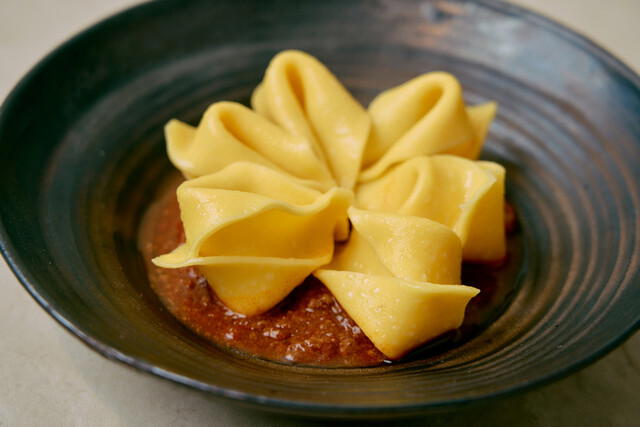
- Handmade pasta
- Freshly baked bread
Tokyo changes a dinner’s temperature before a plate arrives. Away from the city’s most theatrical luxury circuits, the rhythm can feel lower, residential, and local, not simply a sequence of famous counters and polished dining rooms. That matters for Italian food in Tokyo, where serious restaurants split many ways: formal tasting menus, wine bars with stronger kitchens, or restaurants that treat Italian cooking as a flexible dining language. Pepe Rosso sits in that conversation, with a format broad enough to read as restaurant, wine bar, and dining bar rather than a simple pasta stop.
Italian dining, read through Tokyo rather than imported whole
Tokyo’s Italian scene has moved beyond pasta, pizza, and celebratory hotel shorthand. Stronger addresses now declare a position: ingredient focus, wine-first cooking, course-led dining, or a Japanese-ingredient lens. Here, the useful signal is the venue’s categorization as Italian, wine bar, and dining bar, in a city where Italian restaurants can blur into seasonal tasting menus with Italian nouns attached.
The kitchen’s identity is best understood through the restaurant’s Italian framework and its place in Tokyo’s broader dining culture rather than through one trophy dish. The appeal is not fusion as spectacle, but the way a serious Tokyo room can translate Italian structure into a local evening. The restaurant’s listed categories explain the format. It is neither only a pasta counter nor only a bottle-led room with food on the side.
Recognition gives the position weight. Pepe Rosso is listed in Tabelog’s Hyakumeiten recognition for 2025 and carries a Tabelog score of 3.79. These are not Michelin-style global markers, but in Tokyo they matter because Tabelog category lists often catch serious local consensus, especially in genres where international awards are thinner. Within the city’s range, it occupies a different dining register from more casual-feeling rooms such as Katsuyoshi, spice kitchen moona, Pannya CAFE CURRY, Curry Spice Gelateria KALPASI, or Nanban Tei Shimokitazawa ten; the difference is not only category. The format asks diners to think in courses, wine, and a longer table.
From local Italian to a more deliberate wine-and-dining address
Evolution is the point. Pepe Rosso reads less like nostalgia than recalibration within Tokyo’s Italian scene. Many European-leaning restaurants survive by staying vague; this one has a clearer proposition through its Italian, wine bar, and dining bar identity. That mirrors a broader city pattern: longevity and relevance now need definition. A restaurant understood simply as a neighborhood Italian address must explain why it belongs beside newer, more specialized rooms.
Format changes the experience. The room is built for more than the extreme severity diners sometimes associate with high-intent meals in Tokyo. Its listed categories suggest a restaurant that can handle different kinds of evenings: a full dinner, a wine-led meal, or a more flexible gathering. That does not make it casual in the throwaway sense; it makes the restaurant more socially adaptable than many highly focused Tokyo dining rooms.
The beverage side is central to that flexibility because the venue is explicitly listed as a wine bar as well as an Italian restaurant and dining bar. In Tokyo, that combination signals several dining modes: dinner with wine, a longer evening around the table, or a meal where drinks help define the experience. The listed budget places dinner at JPY 10,000 - JPY 14,999 and lunch at JPY 8,000 - JPY 9,999, above everyday casual dining while still distinct from the city’s most expensive trophy counters.
The useful detail is the restaurant’s declared category position, not a personality narrative. Diners should judge it as a Tokyo Italian address with wine-bar breadth and dining-bar flexibility. It will make most sense to guests who care about the relationship between Italian cooking, a considered drinks program, and the way Tokyo restaurants can adapt imported forms without turning them into novelty.
Where it fits in a Tokyo itinerary
For travelers, the decision is less about checking off a famous dining district than choosing a Tokyo Italian meal with local texture. Pepe Rosso can anchor a Tokyo night for diners wanting Italian cooking without a hotel dining room, minimal counter format, or purely casual pasta stop. Its appeal is the middle ground: serious enough to plan around, but not framed as a once-in-a-lifetime spectacle.
The practical reading is clear. This is a Tokyo restaurant to approach as a planned meal rather than an improvised snack stop, especially given its listed dinner and lunch budgets. Guests with vegetarian, vegan, allergy, or other dietary requirements should arrange them in advance rather than as a last-minute table request. As with many Tokyo dining rooms, a little preparation helps the meal feel smoother and more relaxed.
Readers building a wider Tokyo plan can compare the city’s range through Our full Tokyo restaurants guide, then branch into hotels, bars, wineries, and experiences through Our full Tokyo hotels guide, Our full Tokyo bars guide, Our full Tokyo wineries guide, and Our full Tokyo experiences guide. Nearby and citywide contrasts can be drawn with other Tokyo dining rooms, from casual specialist counters to wine-led restaurants and more formal rooms. For a broader Japan-and-beyond dining map, use the city guides rather than treating any single venue as the whole story.
Pepe Rosso is strongest for diners who want Tokyo’s Italian evolution in concrete form: Italian cooking, wine-bar breadth, dining-bar flexibility, and a Tokyo setting that resists central-dining gloss.
Frequently asked questions
Is Pepe Rosso open every day?
Opening days and hours can change, so check directly with Pepe Rosso before planning a visit.
What's the pricing like at Pepe Rosso?
Pricing at Pepe Rosso is listed as Dinner: JPY 10,000 - JPY 14,999; Lunch: JPY 8,000 - JPY 9,999.
What's Pepe Rosso's location?
Tokyo.
What is Pepe Rosso known for?
Pepe Rosso is known as a Tokyo venue listed for Italian, wine bar, and dining bar service, with Tabelog Hyakumeiten recognition in 2025 and a Tabelog score of 3.79.
Can Pepe Rosso accommodate dietary restrictions?
Dietary needs should be discussed with the restaurant in advance. Pepe Rosso can be contacted at +81-3-6407-8998.
The Quick Read
Comparable venues at the same tier for side-by-side context.
| Venue | Cuisine | Price | Awards | Notes |
|---|---|---|---|---|
| Pepe RossoThis venue (the venue you are viewing) | Traditional Italian | $30–50 | Tabelog 100 #44 | Not listed |
| Katsuyoshi | Tonkatsu | $20–30 | Michelin Bib Gourmand | Not listed |
| spice kitchen moona | Spice-driven Indian & Asian curry bar | $20–30 | Tabelog 100 #11 | JPY 2,000 - JPY 2,999 JPY 1,000 - JPY 1,999 |
| Pannya CAFE CURRY | Japanese Curry Cafe | $10–20 | Tabelog 100 #21 | JPY 1,000 - JPY 1,999 JPY 1,000 - JPY 1,999 |
| Curry Spice Gelateria KALPASI | Indian-style curry and spice gelato | $10–20 | Tabelog 100 #17 | JPY 1,000 - JPY 1,999 JPY 1,000 - JPY 1,999 |
| Nanban Tei Shimokitazawa ten | Japanese Okonomiyaki | Not listed | Tabelog 100 #96 | JPY 3,000 - JPY 3,999 JPY 2,000 - JPY 2,999 |
Recognition history
Dated appearances from independent guides and award organizations, with the underlying list record or original source where available.
Tabelog 100 #44 · No. 44
Tabelog · Tabelog 100 - Italian - TOKYO - 2025
Continue exploring
More in Tokyo
Restaurants in Tokyo
All restaurants in Tokyo →




Bars in Tokyo
All bars in Tokyo →








Details
- Cozy
- Sophisticated
- Intimate
- Classic
- Date Night
- Special Occasion
- Group Dining
- Casual Hangout
- Standalone
- Local Sourcing
- Street Scene
- A La Carte
- Set Menu
- Wine
- Vegetarian Friendly
Current opening hours
- Monday
- Closed
- Tuesday
- 12–4 PM, 6–11 PM
- Wednesday
- 12–4 PM, 6–11 PM
- Thursday
- 12–4 PM, 6–11 PM
- Friday
- 12–4 PM, 6–11 PM
- Saturday
- 12–4 PM, 6–11 PM
- Sunday
- 12–4 PM, 6–11 PM
Hours can change for holidays and private events. Hours as of .
Cozy and relaxed, with a traditional Italian feel and a thoughtfully redesigned interior that supports a quiet, intimate dining experience.