Parsons

Parsons on Endell Street is one of Covent Garden's most focused seafood addresses, running a daily-changing single-sheet menu built around dayboat deliveries from the British coast. Small plates and a handful of sharing formats keep things informal, while the wine list leans heavily toward whites selected to travel well with fish. Walk-ins take the window seats; plan ahead for everything else.
Pearl is the En Primeur Club membership app — saves, bookings, and concierge access live there. Same editors, same standards.
- Address
- 39 Endell St, London WC2H 9BA, United Kingdom
- Phone
- +44 20 3422 0221
- Website
- parsonslondon.co.uk
- Directions
- Get directions
 Saves & bookings on Pearl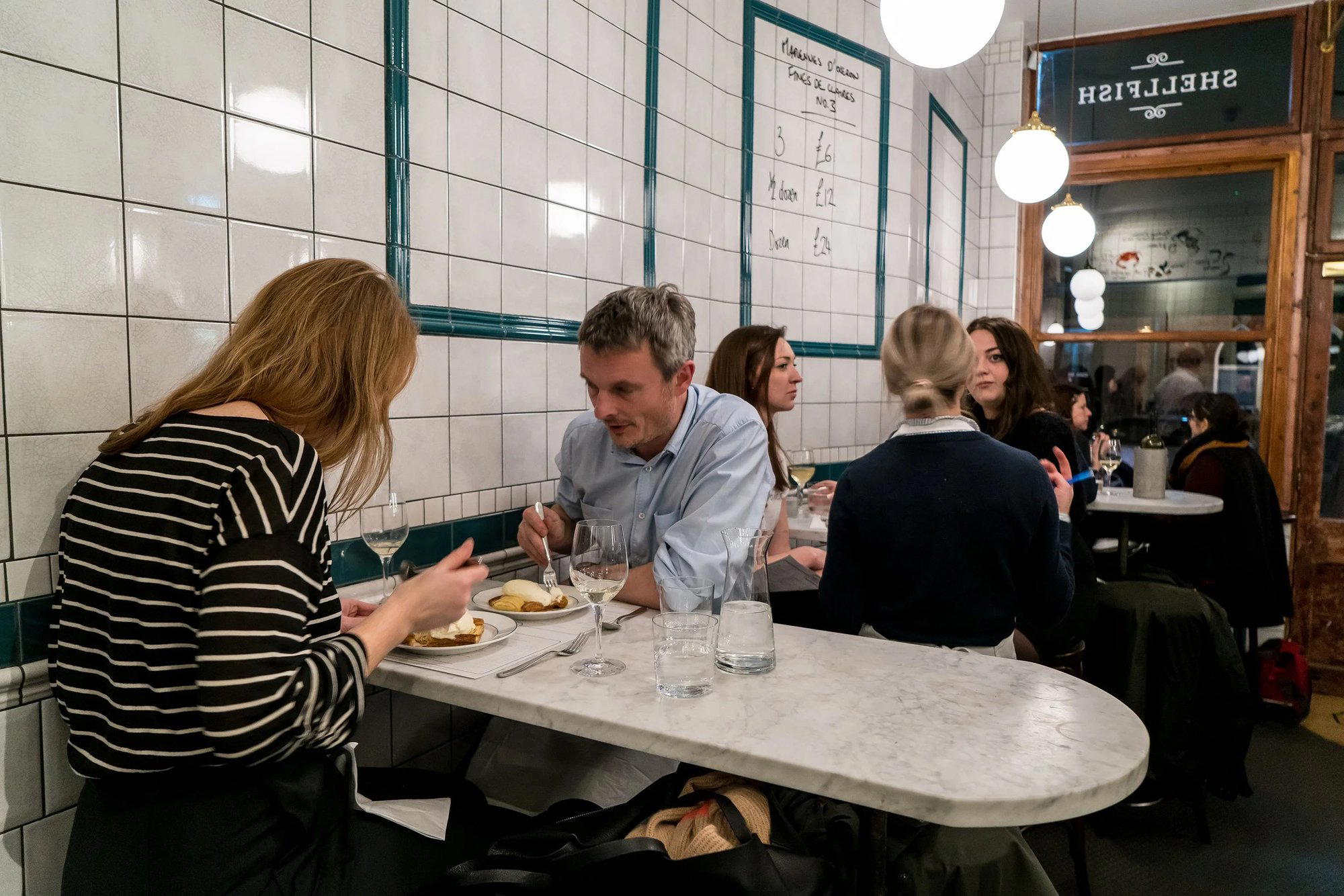
A Covent Garden Counter Built Around the Tide
Endell Street sits at the quieter western edge of Covent Garden, away from the tourist swell around the piazza. The neighbourhood has a working quality to it, print shops, rehearsal studios, the odd late-night café, and Parsons fits that register precisely. The room is compact and deliberately arranged: table seating lines one side, high-top stools occupy the other, window seats are held back for walk-ins, and a pavement terrace extends the footprint when the weather allows. There is no grand entrance or performance lobby. The design logic is utilitarian in the leading sense, squeezing a real dining operation into a space that a lesser operator would have turned into a wine bar with a cheese plate.
The Dayboat Model: What It Actually Means
London's relationship with fresh seafood has long been complicated by geography. The coast is never more than two hours away, yet the supply chains feeding most city restaurants prioritise volume over provenance, routing fish through wholesale markets that can add a day or two of transit to a catch. The dayboat model that Parsons operates on cuts most of that out. Two deliveries a day arrive from the coast, and what those boxes contain largely dictates the menu. This is the intersection that defines Parsons: British coastal produce moving through a kitchen that applies classical French technique with confidence and without ceremony.
That approach puts Parsons in a different conversation from the formally plated seafood at Le Bernardin in New York City, where the kitchen leads and the ingredient follows, and equally distinct from the tasting-menu format used to showcase marine produce at places like hide and fox in Saltwood. Here the produce sets the agenda, and the kitchen's job is to serve it rather than interpret it into abstraction.
The Menu: Small Plates Anchored by French Fundamentals
The single-sheet menu is a curatorial exercise as much as a cooking one. It lists snacks and small plates alongside a shorter selection of more substantial dishes, sides, and desserts, with the balance shifting according to what arrived that morning.
The kitchen is comfortable working across registers. Potted shrimp croquettes and smoked haddock chowder sit at the accessible end of the spectrum, readable crowd-pleasers built on good sourcing. The Loch Fyne scallop croque monsieur operates in a different register entirely, a format borrowed from the French brasserie tradition, reoriented around a Scottish bivalve, with the sweetness of the scallop working against the richness of butter and melted cheese. It is the kind of dish that only makes sense if you trust the ingredient enough to put it in a supporting role while keeping it entirely in charge of the flavour.
Further along the menu, a whole turbot for sharing with mussel beurre blanc and Avruga caviar represents the kind of centrepiece that most casual-format restaurants avoid on grounds of complexity and cost. Its presence signals something about the kitchen's ambition. The skrei cod served atop Jerusalem artichokes with lemon beurre blanc is another dish that demonstrates how classical French saucework, beurre blanc in both cases, functions here as a tool for amplifying British coastal produce rather than overriding it. Skrei, the migratory Norwegian-origin cod that arrives in British waters in winter, has a particular density and sweetness that rewards exactly this kind of direct, butter-led treatment.
The dessert list holds its own: blood orange sorbet is described in inspection notes as tart-sweet and spectacular, and Welsh rarebit appearing at the dessert stage is the kind of small eccentricity that suggests a kitchen paying attention to the full arc of a meal. Chocolate mousse with hazelnut crumb rounds things out on more conventional ground.
The Wine List: Whites Forward, Encourages Exploration
White wines dominate, as you would expect from a room built around fish. The list is described as eclectic rather than encyclopaedic, with something at most price points, though inspection notes flag that options by the glass are more limited than they could be. The framing that encourages veering off the beaten path suggests a list curated to reward curiosity rather than default to the obvious Chablis-Muscadet axis, which is the right instinct for a menu this responsive and variable. Will Palmer and Ian Campbell also operate 10 Cases Bistrot à Vin directly opposite, and the wine sensibility at Parsons reflects that background: this is a room run by people who think seriously about what is in the glass.
Where Parsons Sits in London's Seafood Picture
London's seafood restaurants occupy a wide range of formats and price tiers. At the formal end, fish-focused tasting menus are available at various multi-award venues. At the other end, a dozen oyster and fish-and-chip formats serve the tourist economy. Parsons occupies a middle tier that is harder to find: serious technique, provenance-led sourcing, and a casual format that does not charge for the formality it has deliberately removed. It shares that orientation with a small group of operations nationally, including Moor Hall in Aughton and L'Enclume in Cartmel, which demonstrate how seriously the British regions take ingredient-led cooking, though both operate at considerably higher formality and price. In London, the nearest tonal peers tend to be neighbourhood bistros rather than destination restaurants, which is both a compliment and a locating device.
The venue does not position itself against the city's formal seafood establishment, and it is worth being clear that it operates at a different register from the ££££-tier Modern British and European restaurants that dominate critical conversation in London. CORE by Clare Smyth, The Ledbury, Ikoyi, The Clove Club, and Alain Ducasse at The Dorchester each represent a different scale of ambition and spend. Parsons' proposition is elsewhere: accessible in format and price, rigorous in sourcing, and consistent enough in execution to have earned detailed inspection coverage. For London visitors looking beyond the headline addresses, it belongs in the planning alongside the broader London restaurants guide.
Comparable British coastal-produce cooking in formal register can be found at Waterside Inn in Bray and Gidleigh Park in Chagford, and the pub-dining equivalent at Hand and Flowers in Marlow occupies an analogous position in terms of format informality paired with serious cooking. Parsons slots into that broader national conversation about what British seafood cooking can do without the white tablecloths.
For those planning a broader London trip, the London hotels guide, bars guide, wineries guide, and experiences guide cover the wider picture.
Know Before You Go
- Address: 39 Endell St, London WC2H 9BA
- Walk-ins: Window seats are held for walk-ins; all other seating is likely to fill quickly, particularly at peak dinner service
- Menu format: Single-sheet, daily-changing; driven by dayboat deliveries twice daily from the coast
- Booking strategy: Advance reservation recommended for table or high-leading seating; walk-in window seats available on the day
- Wine: White-dominant list at various price points; by-the-glass selection is more limited than the bottle range
- Nearby: 10 Cases Bistrot à Vin is directly opposite and run by the same operators
- Area: Western Covent Garden, close to Seven Dials and a short walk from Tottenham Court Road (Elizabeth, Northern lines) and Covent Garden (Piccadilly line)
Comparison Snapshot
Comparable venues nearby, for context on price, style, and recognition.
| Venue | Cuisine | Price | Notes |
|---|---|---|---|
| ParsonsThis venue — the venue you are viewing | Modern British Seafood | $$$ | Not listed |
| Oystermen | British Seafood Oyster Bar | $$$ | Covent Garden |
| Randall & Aubin Soho | Classic Seafood Bar | $$$ | Soho |
| Saltie Girl London | Premium Tinned Fish & New England Seafood | $$$ | Mayfair |
| Rick Stein Barnes | British Seafood | $$$ | Mortlake |
| Orasay | Scottish-Inspired British Seafood | $$$ | Notting Hill |
Recognition history
Dated appearances from independent guides and award organizations, with the underlying list record or original source where available.
The Good Food Guide GFG Good
The Good Food Guide
Continue exploring
More in London
Restaurants in London
Browse all →
Bars in London
Browse all →
Hotels in London
Browse all →


At a Glance
- Cozy
- Intimate
- Elegant
- Date Night
- Special Occasion
- Standalone
- Extensive Wine List
Current opening hours
- Monday
- 12–10 PM
- Tuesday
- 12–10 PM
- Wednesday
- 12–10 PM
- Thursday
- 12–10:30 PM
- Friday
- 12–10:30 PM
- Saturday
- 12–10:30 PM
- Sunday
- Closed
Hours can change for holidays and private events. Last verified .
Cozy and intimate with white tiled walls, tight seating that fosters a lively yet sanctuary-like atmosphere away from Covent Garden crowds.