
On the Avenue de Friedland in the 8th arrondissement, Papillon sits at a different register from the grand-table circuit that dominates its neighbourhood. Chef Christophe Saintagne runs a straightforward, produce-led kitchen with a particular commitment to vegetables, drawing a loyal local following and recognition from the We're Smart vegetable-forward community.
Pearl is the En Primeur Club membership app — saves, bookings, and concierge access live there. Same editors, same standards.
- Address
- 8 Av. de Friedland, 75008 Paris, France
- Phone
- +33 1 42 99 62 88
- Website
- papillonparis.fr
- Directions
- Get directions
 Saves & bookings on Pearl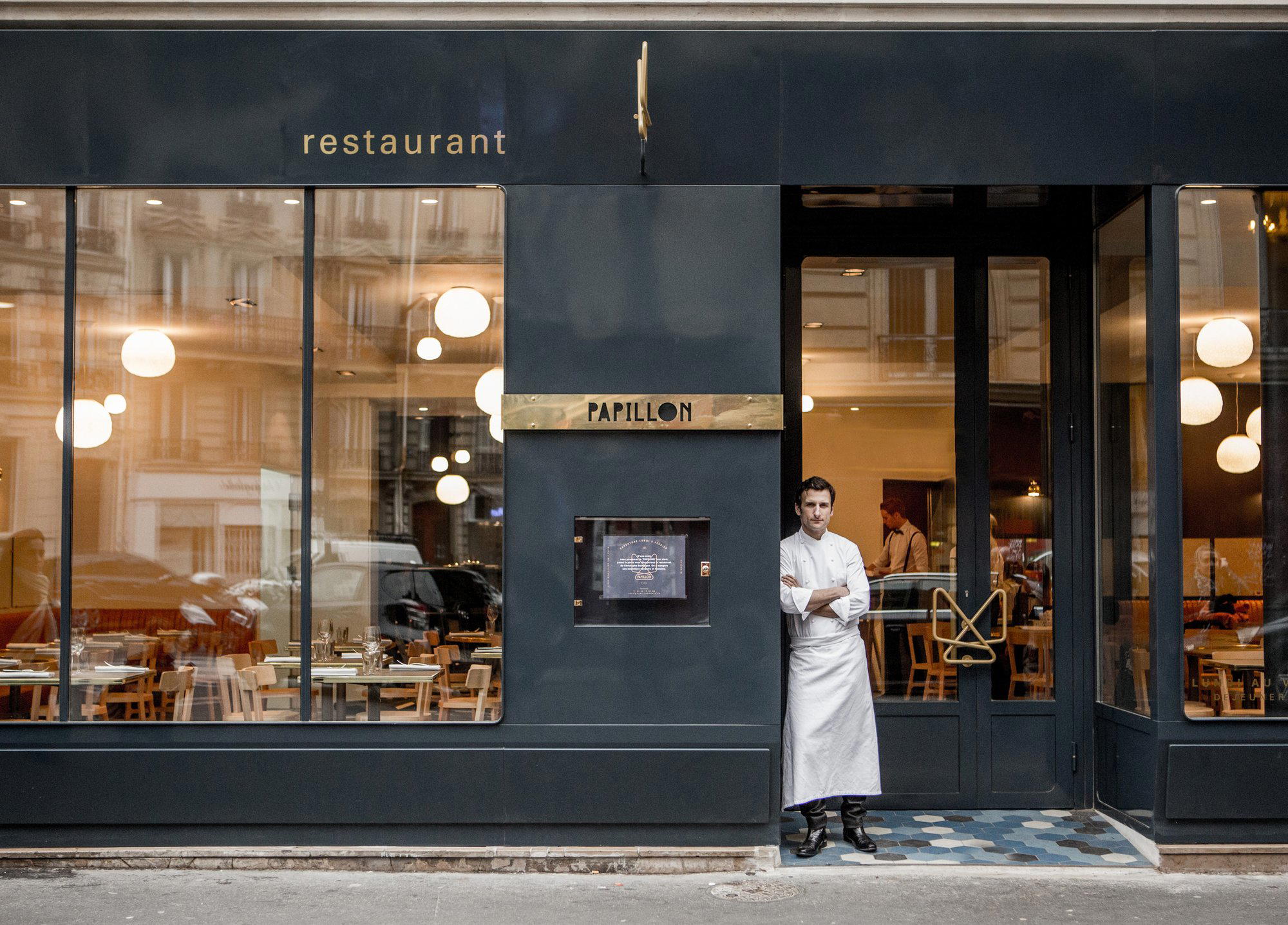
The 8th Arrondissement's Quieter Register
Paris's 8th arrondissement is most legible through its grand addresses. Le Cinq at the Four Seasons George V anchors one end of the neighbourhood's dining spectrum; the maximalist creativity of Alléno Paris au Pavillon Ledoyen anchors another. Between those poles, and largely indifferent to them, sits a smaller category of restaurant that draws its confidence not from spectacle but from consistency. Papillon, at 8 Avenue de Friedland, belongs to that category. The address is measured, the room does not announce itself, and the cooking does not perform. That restraint is the point.
In a city where the top tier of creative cuisine — Arpège, Kei, L'Ambroisie — commands attention through formal structure and multi-course architecture, a segment of Parisian dining operates on a different logic entirely: regular guests, a kitchen that knows its audience, and a menu that does not need to surprise in order to satisfy. Papillon has built its reputation in that space.
Lunch and Dinner: Two Different Propositions
The rhythm of a neighbourhood restaurant in Paris is rarely uniform across the day, and Papillon illustrates the point well. Lunch service in this part of the 8th draws a working crowd: people who understand the value of a well-executed midday meal without the ceremony of a three-hour dinner. The light tends to be kinder in the afternoon, the room less pressured, and the pace more forgiving. For a visitor with an afternoon schedule, lunch at a restaurant like this is often the more considered choice.
Evening service shifts the tone. Dinner in Paris's smarter arrondissements carries its own set of expectations, guests arrive with more time, and the kitchen has more latitude. At Papillon, that latitude shows most clearly in the vegetable preparations, which the We're Smart community has specifically noted as a strength worth watching. Whether the evening menu leans harder on this direction than the midday offering is a question worth asking at the time of booking, since produce-led kitchens often reserve their more ambitious constructions for dinner. The gap between a restaurant's lunch and dinner identities, in terms of depth and creative range, is frequently larger than menus suggest on paper.
For those weighing the two options, the general principle in this tier of Parisian dining holds: lunch often delivers comparable cooking at a different price point, while dinner offers a fuller version of what the kitchen considers its range. Neither is a lesser experience; they are different ones.
Vegetable Cookery as a Structural Commitment
Across French fine dining, the treatment of vegetables has shifted considerably over the past two decades. The tradition at places like Bras in Laguiole, where Michel Bras's gargouillou became a reference point for vegetable-forward cooking in France, established that a serious kitchen could treat produce with the same structural attention usually reserved for protein. That sensibility has migrated, unevenly, into urban restaurants.
Papillon's positioning within this conversation is specific. The We're Smart community, which tracks and recognises vegetable-forward cooking as a distinct area of culinary practice, has flagged the restaurant's vegetable preparations as a reason to visit. That kind of recognition sits outside the conventional Michelin or Gault&Millau; framework, which has historically privileged technique and ingredient sourcing in a broader sense. Being noted within a vegetable-specialist community signals something more targeted: that the kitchen has a genuine and developed relationship with produce, not merely a fashionable acknowledgement of it.
Chef Christophe Saintagne's kitchen operates, by all available accounts, without the theatrical apparatus of the avenue's flagship addresses. The cooking is described as no-nonsense, which in a Paris context carries precise meaning: no foam architecture, no tableside performances, no menus structured around conceptual frameworks. The emphasis is on taste and on the quality of what arrives on the plate. That is a more demanding standard than it appears, because there is no distraction if it falls short.
Where Papillon Sits in the Paris Dining Field
Mapping Papillon against Paris's wider restaurant field requires a honest acknowledgement of tiers. The city's most formally recognised tables, those with Michelin stars, consistent placement in major lists, or the kind of international profile that draws visitors specifically, form one competitive set. Papillon is not in that set, and does not appear to be positioned toward it. Its peer group is the layer below: serious neighbourhood restaurants with committed regulars, cooking that repays repeat visits, and a value proposition that is defined by reliability rather than occasion.
That is a legitimate and often more satisfying tier of dining. In cities like Lyon and Strasbourg, it is the backbone of the restaurant culture; in Paris, it sometimes gets overshadowed by the density of high-profile addresses. Restaurants in this register, comparable to what you find in the quieter quarters around establishments like Auberge de l'Ill in the Alsace tradition or the produce focus that defines kitchens like Flocons de Sel in Megève, earn their following through steadiness rather than spectacle.
The 8th's position as one of Paris's more expensive arrondissements means that even mid-tier restaurants here price at a premium relative to comparable cooking in the 11th or 18th. Visitors should calibrate accordingly.
Planning a Visit
Papillon is at 8 Avenue de Friedland, a short distance from the Arc de Triomphe and the Charles de Gaulle-Étoile metro hub, which makes it accessible from most parts of central Paris without complexity. The restaurant has built a following of regular guests, which means tables at peak service times, Friday and Saturday evenings in particular, are likely to require advance booking. Lunch on a weekday is the more accessible entry point for visitors without a reservation horizon. For dining context beyond this address, our full Paris restaurants guide maps the city's options across categories and price points. The Paris hotels guide, bars guide, and experiences guide cover the wider picture for those building a longer itinerary.
For context on the French restaurant tradition more broadly, the kitchens at Troisgros, Mirazur, and Paul Bocuse's Auberge represent the formal end of that spectrum; Papillon operates in a different register, but the same culinary culture underlies both ends of the range.
How Papillon Paris compares with similar nearby venues.
| Venue | Cuisine | Price | Awards |
|---|---|---|---|
| Papillon | Not listed | Not listed | We're Smart World 2025, 2 Radishes |
| Helen | Seafood, Southern Grill/Steakhouse | €€€€ | Not listed |
| Les 110 de Taillevent | French, Traditional Cuisine | €€€ | Not listed |
| Le Taillevent | French | $$$$ | Not listed |
Recognition history
Dated appearances from independent guides and award organizations, with the underlying list record or original source where available.
We're Smart World 2 Radishes
We're Smart World
Continue exploring
More in Paris
Restaurants in Paris
Browse all →
Bars in Paris
Browse all →
Hotels in Paris
Browse all →
At a Glance
- Cozy
- Classic
- Date Night
- Casual Hangout
- Family
- Live Music
Current opening hours
- Monday
- 10 AM–6 PM
- Tuesday
- 10 AM–5 PM
- Wednesday
- 10 AM–5 PM
- Thursday
- 10 AM–5 PM
- Friday
- 10 AM–5 PM
- Saturday
- Closed
- Sunday
- Closed
Hours can change for holidays and private events. Last verified .
Charming and cozy atmosphere with friendly service, occasional live music, and a calm, homey feel.
Know Before You Go
- Getting there
- 8 Av. de Friedland, 75008 Paris, France