Ottoman Taverna

A Michelin Plate-recognised Turkish restaurant in Washington D.C.'s Mt. Vernon Triangle, Ottoman Taverna translates Istanbul's culinary grammar into an American capital setting. The room announces itself with honeycomb wall patterns, a floor-to-ceiling Hagia Sophia mural, and deep-blue pendant lights. The menu moves from cold and hot meze through kebabs to house-made baklava, priced at the accessible end of D.C.'s dining spectrum.
Pearl is the En Primeur Club membership app — saves, bookings, and concierge access live there. Same editors, same standards.
- Address
- 906 4th St NW, Washington, DC 20001
- Phone
- (202) 847-0389
- Website
- ottomantaverna.com
 Saves & bookings on Pearl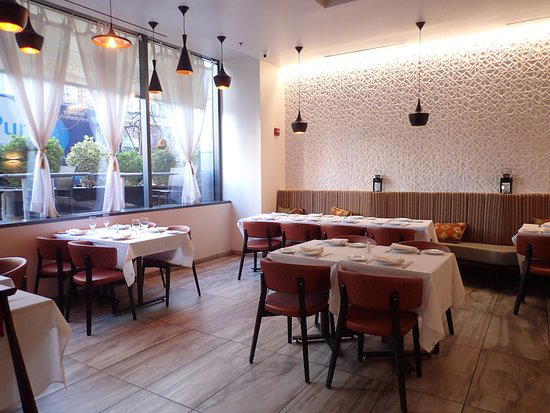
Istanbul on 4th Street
Washington D.C. has spent the last decade building a dining identity that extends well beyond its traditional power-lunch corridors. The Mt. Vernon Triangle neighbourhood sits at the centre of that shift, a compact grid that now holds a range of cuisines rarely associated with the American capital. Within that context, Ottoman Taverna occupies a particular position: a Turkish restaurant whose interior design reads as a deliberate argument about what the cuisine deserves in terms of setting and presentation.
The room makes its case immediately. Honeycomb geometric patterns cover the walls, referencing the tilework tradition found in Ottoman imperial architecture from Istanbul to Edirne. A large mural of the Hagia Sophia anchors one wall, not as kitsch decoration but as a compositional statement that orients the space culturally before a single dish arrives. Whitewashed surfaces reflect light from deep-blue pendant fixtures overhead, producing an atmosphere that sits somewhere between a modern Istanbul meyhane and a considered American interpretation of that form. The visual program is dense enough to reward attention across an entire meal.
The Meze Tradition in a D.C. Frame
Turkish dining at its most coherent is structured around the logic of meze: small, shareable preparations that build slowly toward larger proteins, with the quality of the spreads and cold plates functioning as a reliable indicator of the kitchen's seriousness. That tradition transfers well to the American capital's appetite for shared-format meals, and Ottoman Taverna's menu follows the pattern closely.
The cold meze section includes haydari, a labneh preparation flavoured with herbs that belongs to the class of yogurt-based dips ubiquitous across Turkish tables from Ankara to the Aegean coast. The falafel appears here as well, served with a yogurt sauce, a preparation that places the dish in its broader Levantine-Turkish continuum rather than isolating it as a standalone item. Hot meze follow the same logic, extending the table before the main sequence begins.
The kebab section anchors the menu's second register. The adana kebab is especially regionally specific option listed, a preparation originating in the city of Adana in southern Turkey where ground meat is seasoned with red pepper and herbs, hand-packed onto wide skewers, and cooked over charcoal. The version here arrives accompanied by bulgar pilav, the grain preparation that appears across the southeastern Turkish table as a counterpoint to the heat of the pepper-forward meat. That pairing is not incidental: it reflects the culinary geography of the dish's origin as accurately as a direct restaurant in D.C. is likely to get.
Where Ottoman Taverna Sits in D.C.'s Broader Dining Map
The restaurant is recognized for its Turkish cooking and accessible pricing in the capital.
For comparison, restaurants like Albi, the Middle Eastern table that operates at the upper end of D.C.'s price spectrum, and Causa, the Peruvian address at the same tier, represent the city's higher-spend end of culturally specific, chef-driven dining. Oyster Oyster sits in the middle tier with its sustainable New American format. The restaurant operates below all three in price while holding Michelin recognition, a combination that makes it one of the more efficient addresses in the city's culturally specific restaurant set. At the furthest end of the spectrum, D.C. holds tasting-menu institutions like Jônt and minibar, where the format and price are entirely different propositions.
dede in Baltimore represents one of the few comparable addresses in the region, while internationally, Narımor in Izmir offers a point of reference for what the cuisine looks like on home terrain.
Finishing the Meal
Turkish coffee and the dessert course that follows it operate as a distinct cultural ritual rather than an afterthought. The restaurant's house-made baklava fits into the tradition of nut-and-syrup pastry that runs from Istanbul's Karaköy patisseries to the Syrian border, where the preparation becomes progressively more pistachio-forward. The sutlaç, a rice pudding baked in individual clay vessels until the surface takes on a light char, is one of the more distinctively Turkish desserts on any menu in the city: it requires patience to make correctly and is frequently absent from Turkish menus outside Turkey itself. The apple-rose tea that the menu suggests as an entry point to the drinks list belongs to the same category of culturally grounded details that accumulate across the meal.
Le Bernardin in New York, Emeril's in New Orleans, Lazy Bear in San Francisco, Alinea in Chicago, The French Laundry in Napa, and Single Thread Farm in Healdsburg.
Know Before You Go
- Address: 906 4th St NW, Washington, DC 20001
- Neighbourhood: Mt. Vernon Triangle
- Cuisine: Turkish
- Price range: $$ (accessible mid-range)
- Awards: Michelin Plate 2024 3 from 1,967 reviews
- Reservations: recommended
A Pricing-First Comparison
Comparable venues nearby, for context on price, style, and recognition.
| Venue | Cuisine | Price | Awards | Notes |
|---|---|---|---|---|
| Ottoman TavernaThis venue — the venue you are viewing | Turkish | $$$ | Michelin Plate | Not listed |
| Elmina | Not listed | $$$ | Michelin Plate | U Street Corridor, Contemporary Ghanaian / Modern West African |
| Supra | Shaw, Authentic Georgian | $$$ | Michelin Plate | Not listed |
| The Pembroke | Not listed | $$$ | Michelin Plate | Dupont Circle, Contemporary American Brasserie |
| Cucina Morini | Not listed | $$$ | Michelin Plate | Mount Vernon Triangle, Southern Italian Coastal |
| St. Anselm | Capital City Market, American Steakhouse | $$$ | Not listed | Not listed |
Recognition history
Dated appearances from independent guides and award organizations, with the underlying list record or original source where available.
Michelin Plate
Michelin
Michelin Plate
Michelin
Continue exploring
More in Washington DC
Restaurants in Washington DC
Browse all →
Bars in Washington DC
Browse all →
Hotels in Washington DC
Browse all →

At a Glance
- Elegant
- Romantic
- Sophisticated
- Cozy
- Date Night
- Group Dining
- Special Occasion
- Open Kitchen
- Private Dining
- Terrace
- Craft Cocktails
Current opening hours
- Monday
- 11 AM–9 PM
- Tuesday
- 11 AM–9 PM
- Wednesday
- 11 AM–9 PM
- Thursday
- 11 AM–9 PM
- Friday
- 11 AM–9 PM
- Saturday
- 11 AM–10 PM
- Sunday
- 11 AM–9 PM
Hours can change for holidays and private events. Last verified .
Drop-dead gorgeous interior with glimmering deep-blue pendants, whitewashed walls, honeycomb patterns, and sumptuous, romantic setting fit for royalty.