.png)
Positioned on Arezzo's Piazza Grande with direct views of the Loggia Vasariana, Osteria Grande opened in 2022 and has already earned a Michelin Plate. The kitchen works a seasonal contemporary Italian register, pigeon prepared across multiple cuts, produce-led combinations, and a wine program that treats pairing as integral rather than optional. At €€€, it occupies the mid-upper tier of the city's dining scene.
Pearl is the En Primeur Club membership app — saves, bookings, and concierge access live there. Same editors, same standards.
- Address
- Piazza Grande 28, 52100 Arezzo Italy
- Phone
- +39 348 691 0306
- Website
- osteriagrande.it
 Saves & bookings on Pearl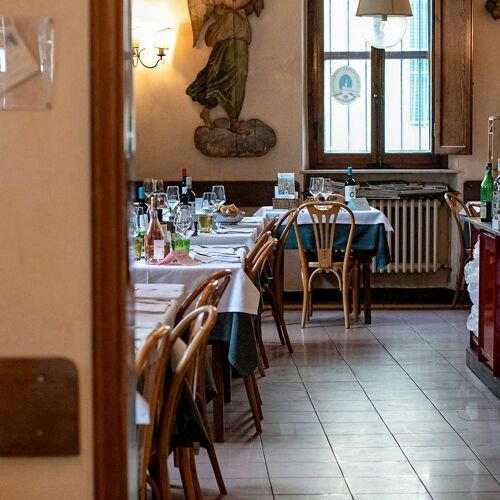
Piazza Grande as Dining Room
Few squares in Tuscany carry the architectural weight of Arezzo's Piazza Grande. The sloping medieval piazza, framed on one side by Vasari's sixteenth-century loggia, functions as a kind of open-air stage, and Osteria Grande has claimed one of the better seats in the house. From its position at number 28, the restaurant looks directly across toward the Loggia Vasariana, an arrangement that makes the surrounding stonework feel less like backdrop and more like context. Contemporary Italian kitchens in smaller Tuscan cities often lean on setting as a substitute for culinary seriousness; what distinguishes Osteria Grande is that the kitchen earns its place rather than borrowing it from the view.
Where Osteria Grande Sits in Arezzo's Dining Scene
Arezzo's restaurant tier at the €€€ price point sits between accessible neighbourhood trattorias and the fuller-commitment formats found in larger Tuscan cities. Within that bracket, the city has developed a small but coherent group of restaurants working contemporary Italian registers. Octavin pushes further into creative territory at €€€€, while Le Chiavi d'Oro and Saffron operate at the more accessible €€ level. Osteria Grande occupies a deliberate middle ground: seasonal, product-focused cooking that reads as genuinely contemporary without reaching for the kind of conceptual abstraction that defines the highest end of Italian fine dining. The restaurant's Michelin Plate recognition confirms the kitchen's consistency. That distinction is not a criticism, Osteria Grande is doing something more locally rooted than either of those houses.
Food and Wine as a Single System
In the Italian fine dining tradition, the division between kitchen and wine service has long been treated as artificial. The most coherent restaurants, from Dal Pescatore in Runate to Uliassi in Senigallia, treat pairing not as an add-on but as a structural element of the meal. Osteria Grande operates within that logic. The kitchen is led by Fatjon, while Lorenzo oversees the wine selection and pairing recommendations directly at the table.
The pairing philosophy on display here rewards attention. Consider the kitchen's pigeon preparation: breast, leg, and fillet each treated according to the cut's specific requirements, served with sweet onion and cocoa nibs, a dish that layers savouriness with vegetal sweetness and mild bitterness. Lorenzo's documented response to this dish is instructive: rather than defaulting to a predictable Tuscan red, he has suggested the Maturato Tiberini 2018, a white wine produced from grapes left to ripen on the vine past the standard harvest window. The result is a wine with enough oxidative development and structural weight to hold against the pigeon's depth without overwhelming the more delicate cuts. It is a pairing that operates against type, which is precisely where Italian wine service becomes interesting.
This instinct, treating wine as a counterpoint rather than a mirror, connects Osteria Grande to a broader shift in how contemporary Italian restaurants are thinking about their lists. The rigid regional pairings that once structured Italian wine service (Chianti with Florentine steak, Barolo with Piedmontese braise) are giving way to a more fluid interpretive approach, particularly among younger sommeliers. Lorenzo's willingness to suggest a late-harvest white alongside a meat-forward dish reflects that evolution without being programmatic about it. For those who want to trace this approach further across Italy's fine dining tier, Enrico Bartolini in Milan and Quattro Passi in Marina del Cantone represent different regional expressions of the same underlying philosophy.
The Kitchen's Register
Contemporary Italian cooking in Tuscany often defaults to a kind of comfortable classicism: local produce, restrained technique, familiar flavour profiles. Osteria Grande's documented dishes suggest a kitchen willing to complicate that formula without abandoning it. The pigeon preparation, with its division of cuts and the pairing of offal-adjacent depth with cocoa and sweet onion, points toward cooking that thinks in terms of contrast and specificity. This positions the restaurant closer in spirit to a place like Agli Amici Rovinj or L'Olivo in Anacapri than to the rustic Tuscan format that many visitors to this region expect.
The seasonal framing matters here. In a kitchen that changes its menu with the market and the growing calendar, the pigeon preparation documented in the Michelin record represents a point in time rather than a permanent fixture. Guests arriving in different seasons will find a different set of combinations, but the underlying logic, cut-specific preparation, thoughtful counterpoint in accompaniments, wine-integrated conception, should remain consistent.
Planning a Visit
Osteria Grande sits at Piazza Grande 28 in Arezzo's historic centre. At €€€, a full meal with wine pairing will place it above a casual trattoria dinner but well within range of a considered evening out in a mid-sized Tuscan city. Booking in advance is advisable, particularly during the Giostra del Saracino periods in June and September.
A Minimal comparable set
Comparable venues nearby, for context on price, style, and recognition.
| Venue | Cuisine | Price | Notes |
|---|---|---|---|
| Osteria GrandeThis venue — the venue you are viewing | Piazza Grande, Modern Italian Trattoria | $$$ | |
| Le Chiavi d'Oro | Historic Centre, Modern Tuscan Italian | $$$ | |
| ‘O Scugnizzo | city center, Neapolitan Pizza | $$ | |
| Octavin | $$$$ | heart of Arezzo, Modern Tuscan Fine Dining | |
| Saffron | $$$ | Piazza S. Agostino, Mediterranean-Japanese Seafood Fusion | |
| Paolo Teverini | $$$ | Bagno di Romagna, Classic Italian Fine Dining |
Continue exploring
More in Arezzo
Restaurants in Arezzo
Browse all →
Bars in Arezzo
Browse all →
Hotels in Arezzo
Browse all →
At a Glance
- Elegant
- Intimate
- Sophisticated
- Rustic
- Date Night
- Special Occasion
- Open Kitchen
- Terrace
- Historic Building
- Extensive Wine List
- Craft Cocktails
- Street Scene
Gorgeous minimal interior with terrace views of the historic square; comfortable and delightful atmosphere occasionally with house music.