
Osteria e Bar Geno places Spanish technique inside Osaka’s appetite for compact, counter-led dining. Its Tabelog 100 selection for Spanish cuisine in 2026, small room, wine focus, and Esaka location make it a useful read on how serious European cooking in Osaka often happens away from the city’s louder central corridors.
Pearl is the En Primeur Club membership app — saves, bookings, and concierge access live there. Same editors, same standards.
- Address
- 5-5 Toyotsucho, Suita, Osaka 564-0051, Japan
- Phone
- +81 6-6821-8878
- Website
- tabelog.com
 Saves & bookings on Pearl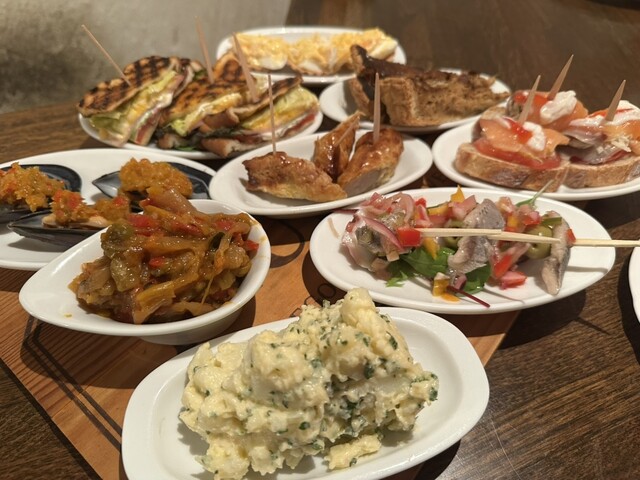
Esaka’s dining rhythm is quieter than Namba’s late-night crush or Umeda’s department-store polish. Around the station, the better rooms reveal themselves by scale, not spectacle: short counters, modest frontage, regulars from the Midosuji Line, and menus that trust the kitchen to speak without theatre. Osteria e Bar Geno fits that Osaka pattern: a small Spanish restaurant whose size changes the meal’s tempo.
Osaka is often reduced to takoyaki, okonomiyaki, and high-volume pleasure, but its more interesting European cooking works in another register. Italian, Spanish, and French kitchens here are often compact, ingredient-led, and calibrated for repeat local use rather than destination grandstanding. Spanish technique in Japan rarely arrives as a museum piece; it is filtered through local seafood, seasonality, counter service, and the Japanese expectation that even casual rooms show discipline.
Spanish technique through Osaka's compact-counter grammar
The useful comparison is not a large Spanish dining room built around spectacle, but Osaka’s broader small-format serious dining culture. Tempura counters such as the city’s stronger restaurant tier show how much Japanese diners value proximity to the kitchen, pacing, and a narrow field of attention. Osteria e Bar Geno’s format reads less like an imported bar-restaurant template than a local adaptation: Spanish cooking compressed into an Osaka room where the counter is the organizing principle.
The Tabelog 100 selection for Spanish cuisine in 2026 is the key external signal. Tabelog’s Hyakumeiten lists reward depth within category rather than international name recognition, making the recognition especially relevant outside Osaka’s most touristed dining zones. The restaurant was also selected for the Spanish cuisine list in 2024, giving the award trail more weight than a single-year appearance. Its Tabelog score of 3.52 places it where Japanese diners judge consistency, value, and category fit with scrutiny harsher than casual star-chasing suggests.
Food category matters because Spanish cuisine in Japan has moved beyond paella-and-tapas shorthand. Stronger kitchens use Spanish methods as a framework: olive oil, plancha work, wine-friendly seasoning, stews, cured elements, and seafood handling, then adapt them to Japanese produce and dining expectations. Osaka’s access to regional vegetables, fish markets, and Kansai’s lighter seasoning gives Spanish cooking a different register from Tokyo’s more formal European rooms.
That difference explains the wine emphasis. Spanish restaurants in Japan often function as informal wine rooms as much as dinner rooms, especially at small scale. Wine service in this tier is not only about labels; it is about how the kitchen sets salt, oil, and acidity against what people drink through the evening. Osaka diners, used to moving between izakaya, kappo, tempura, and Western-style counters, understand that rhythm intuitively.
Esaka makes the case for leaving the central dining circuit
Esaka is not where first-time visitors usually begin, which is precisely the point. Osaka’s central areas reward convenience, but the city’s dining culture is not confined to the obvious map. Suita, north of the core, has the residential-commercial mix that supports restaurants built for returning diners, not only travellers with checklists. Read the meal as a neighbourhood serious-dining experience, not a stage-managed destination production.
Within Osaka, that puts the restaurant in a different decision set from high-formality counters and luxury hotel dining. Shunsaiten Tsuchiya represents the city’s tempura conversation at a more expensive level, while casual and specialist addresses such as 551 Horai (551蓬莱), 52CHO-ME BAKERY, .cafe, 99 Pizza Napoletana Gourmet, and a canto show how broad the city’s non-Japanese dining spectrum has become. Osteria e Bar Geno sits in the middle: serious enough for category recognition, intimate enough to avoid the stiffness that can flatten European dining in Japan.
The small capacity sharpens the experience. Thirteen seats, including counter seating and a small table allocation, make this a dinner for people who pay attention. That does not mean silence; Osaka rarely wants solemn dining for its own sake. It does mean the room suits diners who prefer conversation, wine, and visible service mechanics over a loud group meal. Private rooms are not part of the format, so the social contract is shared-room dining at close range.
Practical interpretation is simple. This is a reservations-available restaurant with limited seating, no parking, and station access that favours rail over taxi-and-doorstep planning. It is non-smoking inside, with smoking handled outside at the entrance, and payment is more card-friendly than cash-only traditionalists might expect. The annual long purchasing break matters for tightly planned Osaka itineraries, because small restaurants can vanish from a traveller’s calendar for reasons unrelated to demand.
How to place it inside an Osaka itinerary
For travellers building an Osaka dining week, this is not the slot for maximal Kansai nostalgia. It is the slot for seeing how the city absorbs foreign technique without losing local scale. Pair it with a tempura counter, a kappo meal, a casual pork-bun stop, and one serious Italian or French-leaning room, and Osaka looks less like a street-food caricature and more like one of Japan’s sharper dining cities for adaptable formats.
The broader map helps. Use our full Osaka restaurants guide for nearby dining context, then match the evening with our full Osaka hotels guide, our full Osaka bars guide, our full Osaka wineries guide, and our full Osaka experiences guide when the itinerary stretches beyond dinner. For a wider Japan-and-beyond reading list, compare how specialist formats travel through -Grilled beef Sukiyaki- KAMAKURA TANUKIAN 鎌倉 たぬき庵 in Kamakura. 鮪と炭火焼き うお炭 秋葉原店 in Tokyo.know in Kumamoto, (Shoku) Vietnam in Kawasaki, [Curry Senmon Ten] Maruyama Kyoju. in Sapporo, [ki:] in Kyoto, Jōdo Saké Bar in Los Angeles, and Onigiri Time in Pasadena.
The appeal is not novelty. It is evidence of Osaka’s quieter confidence: a Spanish category restaurant, recognised by a domestic dining list, working at a scale where the city’s preference for closeness and rhythm shapes the meal. Travellers who only chase obvious central addresses will miss that part of Osaka’s food culture.
Budget and Context
Comparable venues for orientation by cuisine and category.
| Venue | Cuisine | Price | Notes |
|---|---|---|---|
| Osteria e Bar GenoThis venue — the venue you are viewing | Esaka, Cozy Spanish Osteria & Bar | $$$ | Not listed |
| DENDA | Not listed | $$$ | Nishi, Basque / Spanish restaurant and wine store |
| TXAGORVA | Not listed | $$$ | Kita, Wood-Fired Modern Spanish (Asador) |
| utage dotonbori | Not listed | $$ | Chūō, Modern standing wine bar with Spanish-style small plates |
| Unagiya Unagi | Not listed | $$$ | Yodogawa, Traditional Kansai-style unagi (eel) counter |
| Sushi Akazu | Not listed | $$$ | Kita, Traditional Edomae Omakase Sushi with Red Vinegar Rice |
Recognition history
Dated appearances from independent guides and award organizations, with the underlying list record or original source where available.
Tabelog 100 #16 · No. 16
Tabelog · Tabelog 100 - Spanish cuisine - 2026
Continue exploring
More in Osaka
Restaurants in Osaka
Browse all →




Bars in Osaka
Browse all →




Hotels in Osaka
Browse all →



Wineries in Osaka
Browse all →
At a Glance
- Cozy
- Intimate
- Romantic
- Date Night
- Casual Hangout
- After Work
- Solo
- Standalone
- Chefs Counter
- Extensive Wine List
Current opening hours
- Monday
- Closed
- Tuesday
- Closed
- Wednesday
- 5:30–10 PM
- Thursday
- 5:30–10 PM
- Friday
- 5:30–10 PM
- Saturday
- 5:30–10 PM
- Sunday
- 5:30–10 PM
Hours can change for holidays and private events. Last verified .
A small, non-smoking hideaway with counter-focused seating that feels like a cozy Spanish tavern, relaxed and intimate, popular for dates and casual evenings with friends.