A Garden That Sets the Scene Before You Sit Down Arriving at One Dining Teahouse & Restaurant requires passing through the Chinese Garden of Friendship in Haymarket, which is itself an editorial statement about what kind of dining this is. The...
Pearl is the En Primeur Club membership app — saves, bookings, and concierge access live there. Same editors, same standards.
- Address
- Chinese Garden of Friendship, Haymarket NSW 2000, Australia
- Phone
- +61297587388
- Website
- onedining.com.au
- Directions
- Get directions
 Saves & bookings on Pearl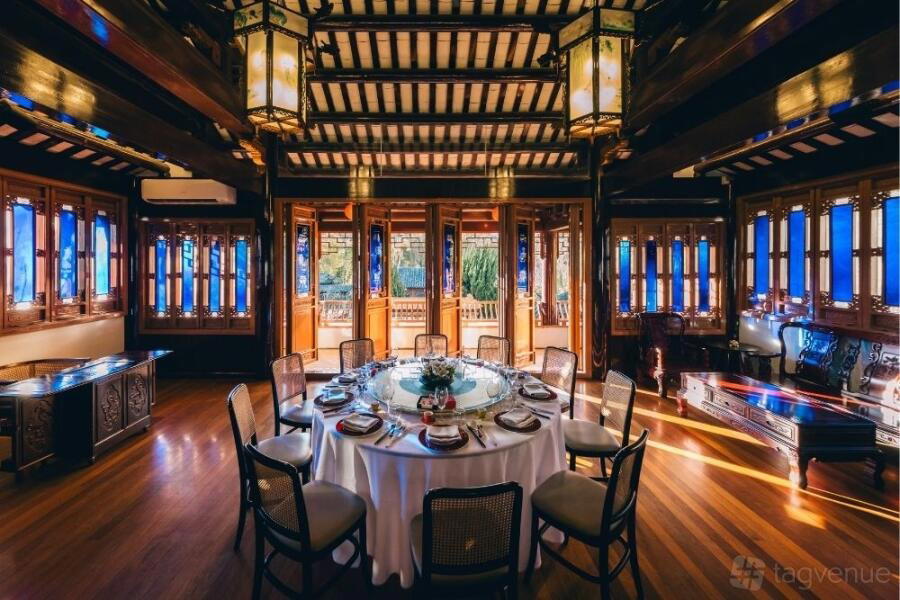
A Garden That Sets the Scene Before You Sit Down
Arriving at One Dining Teahouse & Restaurant requires passing through the Chinese Garden of Friendship in Haymarket, which is itself an editorial statement about what kind of dining this is. The garden, a formal Suzhou-style range of pavilions, ponds, and stone pathways in the middle of Sydney's inner-city, does considerable atmospheric work before any food arrives. Few restaurants in Sydney are physically framed by a heritage cultural site in this way. The transition from the Darling Harbour footpath to the garden's interior shifts the register of the meal entirely, and that shift is not incidental to the experience.
Haymarket sits at the southern edge of the CBD, adjacent to Chinatown and the broader precinct that has anchored Sydney's Chinese dining culture for well over a century. Venues in this corridor tend to operate across a wide spectrum: high-volume roast duck houses, regional specialists, and occasional fine-dining operations that draw from that same culinary tradition but apply a different level of deliberation. One Dining occupies a distinct position in this mix, shaped by its address inside a public garden that has its own entry and governance, and its positioning as a sit-down restaurant rather than a casual teahouse-only operation.
Chinese Garden Dining and What It Means for the Format
Teahouse-within-a-garden dining is a well-established format in China, particularly in older urban parks where pavilion restaurants have operated for generations. The model imports to Sydney with some modifications. The setting naturally limits scale, and the garden's cultural status means the venue operates within a context that is not purely commercial. For diners, this creates a rare condition in Sydney: an outdoor-adjacent Chinese dining setting that prioritises the relationship between environment and meal rather than throughput.
Across the broader Sydney restaurant scene, Chinese cuisine is represented at a high level across multiple subcategories. The city's Cantonese yum cha institutions, Sichuan specialists, and modern Chinese fine-dining operations each occupy a distinct tier. The teahouse format, where tea service and lighter food occupy the same event as a longer meal, is less common in the premium segment. Internationally, venues like Atomix in New York City have demonstrated how a tasting format built around a specific cultural tradition can hold its own against European fine dining in terms of critical recognition. The question in Sydney's Chinese dining category is whether the same depth of cultural framing can translate into equivalent critical standing.
The Wine Question in a Tea-Forward Context
The editorial angle here deserves careful treatment. One Dining is a teahouse as much as a restaurant, which places it in a category where the beverage program ordinarily centres on tea rather than wine. In Chinese dining traditions, the pairing logic is built around tea typology: green teas with lighter steamed dishes, aged oolongs with richer preparations, pu-erh with heavier proteins. This is a parallel sophistication to wine pairing, and in better teahouse restaurants it is curated with comparable rigour.
In Sydney's premium dining market, the expectation of a considered wine list has become near-universal, even in restaurants where the cuisine tradition has its own beverage logic. The more interesting question for a venue in this position is how it negotiates between the two systems. Chinese cuisine and wine pairing has a long and contested history in fine-dining circles: the tannin structure of red wine can conflict with certain soy-based preparations, while aromatic whites and natural wines have found more consistent footing alongside Cantonese and Shanghainese cooking. Riesling, in particular, has an established track record as a pairing partner for Chinese food, and Australian producers in the Clare and Eden Valleys make strong cases for the category. If One Dining has approached its beverage program with the same cultural seriousness it brings to its physical setting, the tea list rather than the wine list is likely where that deliberation is most visible.
For diners considering how One Dining compares to Sydney venues where the wine list is the primary editorial focus, it is worth noting that the comparative set is different. Rockpool and Saint Peter operate in a tradition where European cellar depth is a core credential. One Dining operates in a tradition where that credential is less directly applicable. For wine-forward diners, the expectation adjustment is part of the editorial story.
How It Fits the Sydney Scene
Sydney's premium dining market has diversified considerably in the past decade. The conversation once centred on European technique applied to Australian produce, a model that Rockpool helped define and that venues like 10 William St and 1021 Mediterranean continue in different registers. The wider shift has been toward cuisine traditions that do not need European framing for legitimacy, and Chinese dining in Sydney has been part of that shift.
In Melbourne, the conversation about cultural specificity in dining has produced operations like Attica and Brae in Birregurra, which are not Chinese dining but which illustrate how deep cultural rootedness can produce critical standing independent of European reference points. The same logic applies across cuisine traditions. For Sydney's Chinese dining category, the garden setting of One Dining creates a form of rootedness that is harder to replicate than a strong wine list or a Michelin-adjacent chef pedigree.
Other Sydney venues worth visiting alongside a trip to Haymarket include bills in Bondi Beach for a contrasting register of Australian casual dining, and Bayly's Bistro in Kirribilli for neighbourhood bistro eating on the north side. The full Sydney restaurants guide covers the broader field. For those planning a longer trip through New South Wales, Johnny Bird in Crows Nest and Kulcha Restaurant Wollongong are worth adding to the itinerary.
Planning Your Visit
One Dining Teahouse & Restaurant is located within the Chinese Garden of Friendship in Haymarket, accessible from Darling Harbour and a short walk from the CBD and Central Station. The garden itself has its own opening hours and entry, which affects restaurant access. Entry during busy seasonal periods, including the Lunar New Year and peak summer months, can see the garden receive higher visitor volumes, making a weekday visit preferable for a quieter experience.
| Venue | Cuisine | Setting | Booking | Price Tier |
|---|---|---|---|---|
| One Dining Teahouse & Restaurant | Chinese / Teahouse | Chinese Garden of Friendship, Haymarket | Not published | |
| Rockpool | Australian | CBD, The Rocks | Online via venue | High |
| Saint Peter | Australian Seafood | Paddington | Online via venue | High |
| 10 Pounds | Contemporary | Inner Sydney | Online via venue | Mid-high |
Continue exploring
More in Sydney
Restaurants in Sydney
Browse all →
Bars in Sydney
Browse all →
Hotels in Sydney
Browse all →

At a Glance
- Elegant
- Serene
- Sophisticated
- Celebration
- Group Dining
- Business Dinner
- Garden
- Sake Program
- Garden
Current opening hours
- Monday
- 11 AM–3 PM, 5:30–9:30 PM
- Tuesday
- 11 AM–3 PM, 5:30–9:30 PM
- Wednesday
- 11 AM–3 PM, 5:30–9:30 PM
- Thursday
- 11 AM–3 PM, 5:30–9:30 PM
- Friday
- 11 AM–3 PM, 5:30–9:30 PM
- Saturday
- 11 AM–3 PM, 5:30–9:30 PM
- Sunday
- 11 AM–3 PM, 5:30–9:30 PM
Hours can change for holidays and private events. Last verified .
Casual yet sophisticated tea house ambiance with garden views, tranquil lighting, and serene garden surroundings.
Know Before You Go
- Getting there
- Chinese Garden of Friendship, Haymarket NSW 2000, Australia