Tabelog 100 #52
Our verdict
Osaka’s udon culture rewards speed, texture, and repetition rather than ceremony for its own sake. Odoru Udon Takii honten belongs to that everyday specialist tier: a 21-seat Takii counter-and-table room with Tabelog Udon WEST 100 recognition in 2024 and a price band that keeps the ritual grounded in daily eating rather than occasion dining.

Pearl is the En Primeur Club membership app, where members save venues, book tables and use the concierge.
The menu
What to order
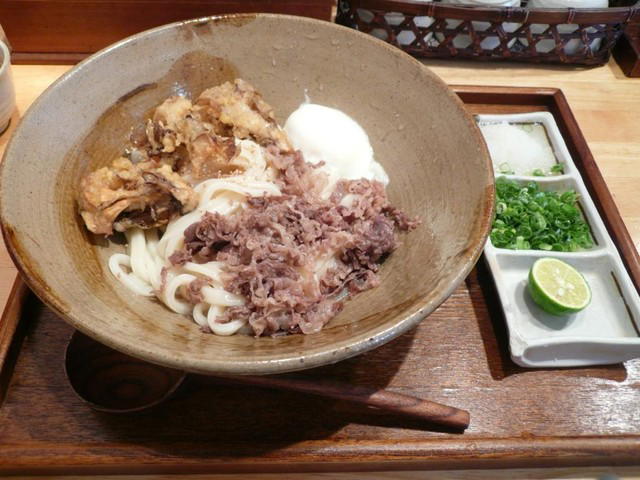
- Maitake Tempura Meat Bukkake
- Bukkake Udon
- Kamatama Udon
Approaching a small udon shop in Osaka, the rhythm is set before the bowl arrives: local traffic, neighborhood regulars, fast-turning seats, and a room built for noodles, not lingering. Osaka has long understood this meal. Its serious casual dining is not confined to formal counters or polished rooms; it also lives where wheat noodles, broth, toppings, and timing make the case.
Odoru Udon Takii honten fits that category with unusual clarity. The format is compact and focused, with cooking rooted in udon rather than broader tasting-menu territory. Its Tabelog Hyakumeiten udon recognition in 2024 matters because the category is competitive and consistency counts more than theatre. A 3.74 Tabelog score places it in the serious local conversation without changing the expectation: come for a focused bowl, not a staged performance.
Osaka udon as a ritual of pace, texture, and restraint
Visitors often misread Osaka udon as simple lunch. In practice, the ritual has codes: the room moves quickly, the format suits solo diners as well as small groups, and success depends on balance rather than luxury signals. The noodle is judged through texture, broth, topping discipline, and service temperature, all of which matter more than decorative flourish.
That context explains why a low-price specialist can command attention in a city crowded with higher-spend dining. The budget here is listed at - JPY 999 for both lunch and dinner, putting the emphasis squarely on execution. Nearby noodle peers such as Mensho Jikon, Yamada Seimensho, Teuchi Udon Beniy, and Kadoya make the comparison less about status than queue tolerance, timing, and how much of a trip to build around one bowl. Tonkatsu Fujii belongs to another comfort-food lane, useful mainly as proof that Osaka’s value dining is not a consolation prize but one of the city’s native strengths.
The ritual is direct: order, sit, eat while the noodles are in their intended condition, and free the seat. This is not severity; it respects the format. Udon loses its point when treated like a long-form social meal. The same discipline runs through Osaka’s casual canon, from quick stops to other everyday breaks. The city is fluent in short meals that still repay attention.
Why the recognition matters in a city that takes noodles seriously
Tabelog Hyakumeiten recognition is not a Michelin-style signal, but in this category it is useful: it marks a specialist whose reputation belongs to a regional field rather than a tourist checklist. Recognition from a category-specific source is especially relevant for inexpensive noodle shops, where the daily test is repeat demand, steady execution, and a bowl that holds attention without leaning on spectacle.
The room’s scale shapes the experience. At a compact udon specialist, casual wandering has less margin, especially at a place known among udon followers. The meal belongs to the walk-in culture that defines much of Japan’s everyday specialist dining. That lack of ceremony keeps the encounter closer to neighborhood eating than destination dining, even after recognition widened the audience.
For travelers mapping Osaka by category, the comparison is instructive. Other dining rooms in the city show how varied formats have settled into Osaka, but udon remains a local grammar with fewer translation layers. It asks less explanation and more attention. The value lies in knowing when to treat a modest meal with the seriousness usually reserved for higher-priced rooms.
There is a broader Japan-wide lesson too. Regional specialists rarely behave like destination restaurants in the Western sense. Across Japan, everyday formats each follow their own etiquette, from counter meals to casual noodle shops and quick specialist kitchens. Udon’s is among the least decorative: arrive prepared, read the room, and let the noodle set the pace.
How to fit Takii into an Osaka food day
Odoru Udon Takii honten works better as a deliberate Osaka stop than a vague add-on between unrelated plans. The meal suits travelers who enjoy seeking out focused specialists rather than only booking around prestige addresses. The practical reward is that the format does not demand a long evening; it can anchor a focused lunch or early dinner before broader Osaka dining, drinking, or hotel plans.
Payment and service conventions matter in this tier, but the safest expectation is simplicity rather than ceremony. Small Japanese specialists often run on direct, efficient service, and this address is best approached with that mindset. The core audience is anyone serious about inexpensive noodle craft. Extended hosting is not the point; the experience is practical and close to the kitchen’s cadence.
For a wider Osaka plan, use the city by appetite rather than prestige hierarchy. Start with the broader Osaka restaurant landscape, then layer in bars for evening and hotels for the right base. Travelers extending the trip can think across experiences, regional detours, and other casual formats, using Odoru Udon Takii honten as a reminder that Japanese everyday dining often travels best when its pace and purpose are respected.
The editorial case is plain: this is not luxury dining disguised as simplicity. It is an Osaka noodle ritual on its own terms, with low pricing and external recognition from a category-specific source. That combination makes it a sharp choice for travelers who understand that a city’s food culture is often clearest where the meal is brief, affordable, and judged by regulars.
Frequently asked questions
What part of town is Odoru Udon Takii honten in?
Osaka.
What should I budget for a meal at Odoru Udon Takii honten?
Pricing at Odoru Udon Takii honten is listed as - JPY 999 - JPY 999.
What time does Odoru Udon Takii honten open and close?
Specific opening hours are not provided here; check directly before visiting Odoru Udon Takii honten.
What is Odoru Udon Takii honten known for?
Odoru Udon Takii honten is known for udon in Osaka and has Tabelog Hyakumeiten udon recognition for 2024.
Compact Comparison
Comparable venues by category and price.
| Venue | Cuisine | Price | Awards | Notes |
|---|---|---|---|---|
| Odoru Udon Takii hontenThis venue (the venue you are viewing) | Japanese Udon | $1–10 | Tabelog 100 #52 | Not listed |
| Mensho Jikon | Ramen & Tsukemen Shop | $10–20 | Tabelog 100 #80 | JPY 1,000 - JPY 1,999 JPY 1,000 - JPY 1,999 View spending breakdown |
| Teuchi Udon Beniy | Handmade Udon & Curry Udon | $1–10 | Tabelog 100 #39 | JPY 999 - JPY 999 |
| Tonkatsu Fujii | Modern Tonkatsu | $30–50 | Michelin Bib Gourmand · Tabelog Bronze #72 | Tonkatsu |
| Yamada Seimensho | Kama-age udon & oden shop | $10–20 | Tabelog 100 #31 | JPY 1,000 - JPY 1,999 - JPY 999 |
| Kadoya | Japanese sweets cafe (wagashi, kakigori & ice cream) | $1–10 | Tabelog 100 #32 | JPY 999 - JPY 999 |
Recognition history
Dated appearances from independent guides and award organizations, with the underlying list record or original source where available.
Tabelog 100 #52 · No. 52
Tabelog · Tabelog 100 - Udon - WEST - 2024