Ode

Michelin Plate
Our verdict
In the heart of Dokkum's historic market square, Ode builds its multi-course menu around an 80/20 plant-to-animal ratio rooted in Frisian terroir. The open kitchen and black-and-white interior set the scene for technically precise, fermentation-forward cooking from chef Liudger van der Meer. Guestrooms above the restaurant make an overnight stay the logical extension of dinner.

Pearl is the En Primeur Club membership app — saves, bookings, and concierge access live there. Same editors, same standards.
- Address
- Markt 38, 9101 LS Dokkum, Netherlands
- Phone
- +31 519 235 508
- Hours
- Mon–Tue ClosedWed–Sat 5–10 PMSun Closed
- Website
- restaurantode.nl
- Directions
- Get directions
- Booking
- Book on the venue's website
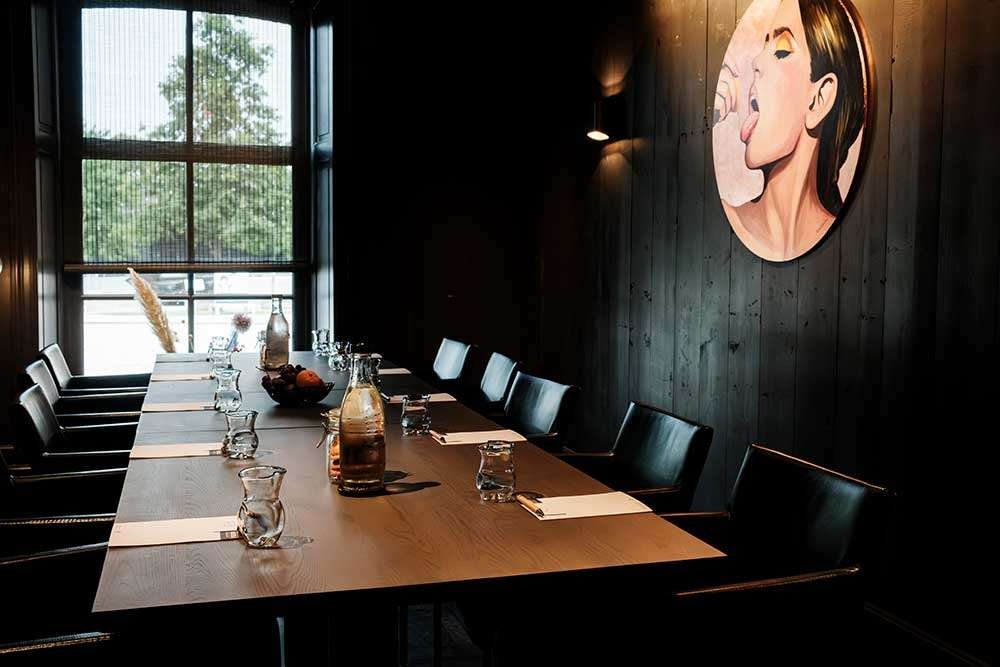
A Frisian Market Square and What Grows Around It
Dokkum is one of the smallest historic cities in the Netherlands, and the Markt that anchors its centre is the kind of square that genuinely slows you down. The cobblestones, the canal lines running close by, the measured pace of a Frisian provincial town that draws architecture tourists rather than stag weekends: this is the physical context into which Ode places itself, at Markt 38, directly on the square. Before you consider the menu, the address already says something about what the kitchen values: locality, legibility, and a deliberate distance from the restaurant density of Amsterdam or The Hague. For more on what Dokkum offers beyond the table, see our full Dokkum restaurants guide.
The Room: Marble, Monochrome, and an Open Stage
The interior resolves immediately into two registers: a strict black-and-white palette and the open kitchen anchored by marble worktops, which functions as the room's organising principle. There is no mystery about what is happening in the kitchen; the preparation is the spectacle. That transparency is a deliberate editorial choice on the part of the restaurant: the cooking is technical enough to reward observation, fermentation crocks and careful plate construction visible from the dining room. The effect is closer to a working studio than a theatre backdrop, which suits the food's ethos. Across the Netherlands, premium kitchens have moved steadily toward open-plan formats over the past decade, and Ode's version is among the more architecturally committed: the marble worktops give the space a material seriousness that bare-brick or stainless-steel equivalents rarely achieve.
The 80/20 Principle and Why It Matters Here
Dutch Cuisine as a formal movement holds to a specific proportion: roughly 80 percent plant-based, 20 percent animal-based. That ratio is not a marketing stance at Ode; it is a structural rule that shapes how the sourcing works. When animal protein appears on the plate, it arrives as accent rather than centrepiece, which places intense pressure on the provenance and quality of what is chosen. Friesland's agricultural profile makes this approach coherent rather than aspirational: the province produces dairy at scale, manages significant wetland and coastal ecosystems, and sits adjacent to the Wadden Sea, which supplies shellfish and eel to kitchens across the northern Netherlands.
The logic extends to fermentation, which at Ode is not a trend signal but a preservation and flavour-development tool tied to seasonal availability. Fermenting allows the kitchen to extend the lifespan of peak-season Frisian ingredients and to build acidity structures that reduce reliance on imported citrus or vinegar. Fermented flavours running through a predominantly plant-based menu also do structural work that fat from animal proteins would otherwise perform: they hold the palate's attention across a multi-course sequence without the progressive heaviness that rich meat dishes can accumulate.
The asparagus preparation documented in the restaurant's own description illustrates the approach: multiple textures of asparagus, a vinaigrette built from the vegetable blended with pine nut oil, an eel fillet, an asparagus tube filled with crayfish farce, saffron, and marinated stem lettuce. The dish is not a piece of protein with a vegetable garnish; it is a set of problems posed by a single local ingredient, resolved in multiple directions simultaneously. That is what Dutch Cuisine's plant-forward ratio demands of a kitchen at this level.
For a comparison of how country-cooking kitchens elsewhere in the Netherlands handle terroir sourcing at the same price tier, De Kromme Watergang in Hoofdplaat and Tres in Rotterdam represent the same €€€€ country-cooking category from different regional starting points.
Ode in the Context of Dutch Fine Dining
The Dutch fine dining tier has historically concentrated in Randstad cities and the wealthier commuter zones around them. De Librije in Zwolle, Aan de Poel in Amstelveen, and Ciel Bleu in Amsterdam operate within relatively dense urban markets where a four-evening week is commercially direct. The more interesting pattern over the past several years has been the emergence of destination kitchens in smaller provincial settings: De Lindenhof in Giethoorn, Brut172 in Reijmerstok, and Inter Scaldes in Kruiningen are all examples of restaurants that justify travel rather than incidentally receiving it.
Ode belongs to this pattern. Dokkum has fewer than 13,000 residents; the restaurant's market cannot be local walk-ins at €€€€ pricing. The proposition is explicitly a destination one, reinforced by the availability of guestrooms, which converts an evening's drive from Amsterdam or Groningen into a two-day trip rather than a calculation about late trains north. De Groene Lantaarn in Staphorst and De Lindehof in Nuenen operate on a similar logic: the restaurant anchors a small-town visit that the town alone would not generate.
De Nieuwe Winkel in Nijmegen, which operates an almost entirely plant-based kitchen at €€€€, represents one pole of this movement. Ode's 80/20 split sits between that position and the more protein-centred menus at kitchens like Fred in Rotterdam or De Bokkedoorns in Overveen. The distinction matters because it signals a specific sourcing philosophy: produce and ferment-led, with animal ingredients functioning as precision accents rather than primary structure.
Planning a Visit
Ode sits on the Markt in central Dokkum, reachable by car from Groningen in under an hour and from Amsterdam in approximately two and a half hours via the A7. The restaurant operates a multi-course set menu format, which means the kitchen controls pacing and the evening has a defined shape; arrive knowing that dinner here is a commitment of several hours rather than a flexible à la carte progression. Given Dokkum's scale and the absence of a significant hotel offer elsewhere in the city centre, booking one of the guestrooms at the restaurant itself is the most coherent overnight option: it removes the drive calculation and allows a proper exploration of the Markt and surrounding canals the following morning. For complementary Dokkum planning, our full Dokkum hotels guide, our full Dokkum bars guide, our full Dokkum wineries guide, and our full Dokkum experiences guide cover the surrounding options.
Frequently asked questions
Where exactly is Ode?
Ode is located at Markt 38, 9101 LS Dokkum, Netherlands, Dokkum.
Comparable Spots, Quickly
Comparable venues nearby, for context on price, style, and recognition.
| Venue | Cuisine | Price | Awards | Notes |
|---|---|---|---|---|
| OdeThis venue — the venue you are viewing | Nieuwe Friese Keuken | Not listed | Michelin Plate | Not listed |
| De Waard van Napels | Napolitan Italian with Frisian Fusion | $30–50 | Not listed | Centrum |
| QuiDine | Modern Dutch Fine Dining | $50–100 | Michelin Plate | Binnenstad |
| De Salentein | Refined South American with Argentine Influences | $100–150 | Michelin Plate | Nijkerk |
| OH30 | Modern Cuisine in Historic Windmill | $50–100 | Michelin Plate | Weert |
| NOÏS | Modern Plant-Forward Fine Dining | Not listed | Michelin Plate · We're Smart World 2 Radishes | Binnenstad |
Recognition history
Dated appearances from independent guides and award organizations, with the underlying list record or original source where available.
Michelin Plate
Michelin
Continue exploring
More in Dokkum
Details
- Modern
- Elegant
- Intimate
- Special Occasion
- Date Night
- Open Kitchen
- Natural Wine
- Local Sourcing
- Tasting Menu
- Set Menu
- Vegetarian Friendly
Current opening hours
- Monday
- Closed
- Tuesday
- Closed
- Wednesday
- 5–10 PM
- Thursday
- 5–10 PM
- Friday
- 5–10 PM
- Saturday
- 5–10 PM
- Sunday
- Closed
Hours can change for holidays and private events. Last verified .
Elegant black-and-white interior centered around a large open marble kitchen with well-suited acoustics.