Michelin Guide Bib Gourmand · Michelin Bib Gourmand
Our verdict
New Lucky Claypot Rice at Holland Drive Market and Food Centre has held back-to-back Michelin Bib Gourmand recognition in 2024 and 2025, placing it among Singapore's most consistently decorated hawker stalls. Operating from a second-floor market stall in the Holland Village neighbourhood, it represents the city-state's tradition of slow-cooked claypot rice at a price point that makes the accolade all the more telling.

Pearl is the En Primeur Club membership app, where members save venues, book tables and use the concierge.
The menu
What to order
- Wu Wei Claypot Rice
- Claypot Chicken Rice with Salted Fish and Chinese Sausage
Holland Drive's Hawker Floor and the Case for Claypot
Singapore's hawker centres occupy a specific cultural position that no amount of fine-dining expansion has displaced. The country's street food ecosystem, which earned collective UNESCO recognition in 2020, is built on the premise that technical precision and repetition matter as much at a $5 stall as at a $500 omakase counter. Holland Drive Market and Food Centre, on the second floor of a Housing Development Board block in the Holland Village area, is exactly the kind of venue that sustains that argument. The stalls here serve a predominantly local crowd, the lighting is functional, the seating is communal, and the cooking is the entire point.
New Lucky Claypot Rice, operating from stall #02-19 on that floor, has received the Michelin Bib Gourmand in both 2024 and 2025. In the context of Singapore's hawker scene, consecutive Bib recognition is a meaningful signal: the Michelin inspectors return, they eat anonymously, and they measure consistency. A single year's listing can be attributed to a good run; two consecutive years indicates that the kitchen's standard holds. Chef Choong Yee Hong operates the stall, and the cuisine classification is direct: street food, with claypot rice as the central discipline.
What Claypot Rice Demands
The claypot rice tradition in Singapore and southern China is one of the more technically demanding formats in hawker cooking precisely because it resists shortcuts. Rice is cooked directly in a clay vessel over charcoal or gas, and the timing must account for the residual heat that continues cooking the ingredients after the flame drops. The crust that forms at the base, known locally as the scorched rice layer, is considered the most prized part of the dish by regular eaters: it carries a depth of flavour that the softer leading layer cannot replicate. Achieving that crust without burning through to the rice requires sustained attention and a feel for the vessel's heat retention that only repetition builds.
That technical baseline is why Bib Gourmand recognition at a claypot rice stall carries more weight than it might at a format where the margin for error is wider. Compare this to the noodle-centred recognition that stalls like Hill Street Tai Hwa Pork Noodle or 545 Whampoa Prawn Noodles have received: each format has its own technical demands, but claypot rice's reliance on heat management and timing makes consistency particularly hard to sustain at volume.
Where This Sits in Singapore's Hawker Award Tier
Singapore's Michelin Bib Gourmand list for hawker stalls has expanded since its first hawker entries in 2016, but the total number of stalls listed in any given year remains small relative to the thousands of active hawker operations across the island. Within that tier, the price point matters: Bib Gourmand recognition is specifically designed for venues offering good cooking at moderate cost, and at the single-dollar sign level that New Lucky Claypot Rice occupies, it sits at the accessible end of Singapore dining, cheaper per head than the $$ Cantonese work at Summer Pavilion, and a different register entirely from $$$$ venues like Zén or Born.
That price positioning is part of what makes the consecutive recognition notable. The Michelin framework was not built for hawker stalls, and its application to Singapore's street food scene has been debated since introduction. What consecutive Bib listings do confirm, regardless of that debate, is that inspectors find the cooking worth returning to at the current standard. For stalls at the $$ or $$$ tier, investment in premium ingredients can carry a weaker execution further. At the single-dollar-sign level, the cooking itself does the work.
Other Bib-recognised Singapore street food operations worth benchmarking against include 91 Fried Kway Teow Mee, A Noodle Story, and Adam Rd Noo Cheng Big Prawn Noodle. Each represents a different single-dish discipline, and together they map out the range of formats the Michelin programme has validated in Singapore's hawker tier.
The Holland Village Context
Holland Village has a dual character that is worth understanding before visiting. The ground-level street running through the area is lined with bars, mid-range restaurants, and international food chains aimed at the expatriate community that has historically concentrated in the surrounding residential corridors. The hawker centre above Holland Drive operates in a different register: it serves the local neighbourhood, the prices are lower, and the clientele at peak hours skews toward residents rather than visitors. That separation is not unusual in Singapore, hawker centres within mixed HDB developments frequently operate on a different social circuit from the retail strips nearby, but it means first-time visitors to Holland Village who stick to the main street may not register the food centre exists.
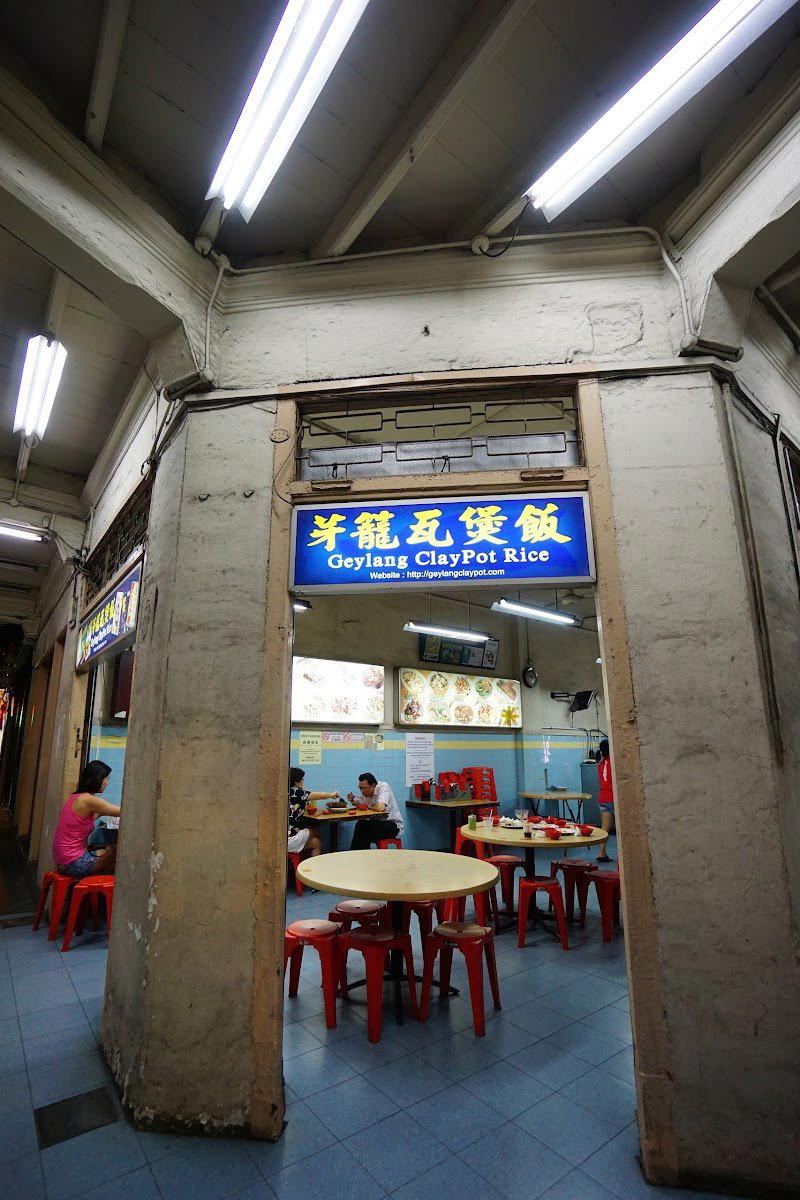
The second-floor location also shapes the experience. Arriving at the food centre requires taking the stairs or lift inside the HDB block rather than walking in from a street-level entrance. Once there, the setting is a standard Singapore wet-market-adjacent hawker configuration: tiled floors, ceiling fans, permanent stalls, and shared seating on plastic stools and folding tables. There is no ambient soundtrack beyond the clatter of the kitchen and the surrounding stalls. The food is the reason for being there, and regulars understand that.
Street Food Across the Region
Claypot rice in the Bib-recognised tier is a Singapore-specific achievement, but the broader tradition of recognised street food cooking across Southeast Asia is worth situating alongside it. In George Town, stalls like 888 Hokkien Mee (Lebuh Presgrave), Ah Boy Koay Teow Th'ng, and Air Itam Duck Rice operate within a similar framework: single-dish specialists, decades of practice, and a customer base that returns for consistency rather than novelty. The Thai street food tradition, represented by operations like A Pong Mae Sunee in Phuket and Anuwat in Phang Nga, follows the same logic. The single-dish discipline model that underpins Singapore's hawker recognition is a regional pattern, not a local anomaly. Even in Hong Kong, dessert and snack specialists like Banana Boy operate in a comparable vein.
What Singapore has that most regional peers lack is the formal infrastructure for recognising these operations at international level, which is where the Michelin programme, for all its imperfections, has shifted the conversation. The Bib Gourmand tier was the mechanism through which hawker cooking entered that conversation, and New Lucky Claypot Rice's consecutive listings place it inside that shift.
Planning Your Visit
New Lucky Claypot Rice operates from stall #02-19 at Holland Drive Market and Food Centre, 44 Holland Drive, Singapore 270044. Reservations: No booking system; queue at the stall. Budget: Single-dollar-sign pricing, among the most accessible price points in the Bib Gourmand tier. Getting there: Holland Village MRT station (Circle Line) is the closest transit point; the food centre is a short walk through the HDB estate. Timing: Claypot rice preparation takes longer per order than noodle or rice plate formats, arriving during off-peak hours reduces wait time. Dress: No requirements; hawker centre casual throughout.
For broader planning across Singapore, see our full Singapore restaurants guide, Singapore hotels guide, Singapore bars guide, Singapore wineries guide, and Singapore experiences guide. For street food comparisons in the region, see the George Town entries including Air Itam Sister Curry Mee and Ali Nasi Lemak Daun Pisang.
Frequently asked questions
Is New Lucky Claypot Rice child-friendly?
Holland Drive Market and Food Centre is an open-air hawker centre with communal tables, making it a practical setting for families with children. The format is informal and self-service, with no dress code or age restrictions. Claypot rice arrives hot from the stall, so supervise young children around the clay vessels.
What should I expect atmosphere-wise at New Lucky Claypot Rice?
Stall #02-19 sits on the second floor of Holland Drive Market and Food Centre, a working neighbourhood hawker centre rather than a tourist-facing food hall. Expect plastic stools, shared tables, and the kind of queue that reflects two consecutive Michelin Bib Gourmand recognitions (2024 and 2025). The pace is brisk and the setting is purely functional.
Is New Lucky Claypot Rice Michelin-listed?
New Lucky Claypot Rice has received recognition including: Michelin Bib Gourmand (2025); Michelin Bib Gourmand (2024).
What should I order at New Lucky Claypot Rice?
The core dish is claypot rice, the format that earned chef Choong Yee Hong back-to-back Bib Gourmand recognition in 2024 and 2025. Claypot rice is the only reason to visit this stall, and ordering it is straightforward, the discipline of the format means the kitchen's attention is concentrated on a single preparation rather than a broad menu.
What's the cuisine at New Lucky Claypot Rice?
What's the price range at New Lucky Claypot Rice?
Pricing at New Lucky Claypot Rice is listed as $.
Peers You’d Cross-Shop
| Venue | Cuisine | Price | Awards | Notes |
|---|---|---|---|---|
| New Lucky Claypot RiceThis venue (the venue you are viewing) | Traditional Charcoal-Fired Claypot Rice | $1–10 | Michelin Guide Bib Gourmand · Michelin Bib Gourmand | Not listed |
| Zén | Yakitori & Japanese Izakaya | $50–100 | Tabelog 100 #92 | European Contemporary |
| Jaan by Kirk Westaway | Modern British Fine Dining | $200–300 | 2 Michelin Stars · Michelin Guide 2 Stars | British Contemporary |
| Burnt Ends | Modern Australian Barbecue | $100–150 | 1 Michelin Star · Michelin Guide 1 Star | Australian Barbecue, Barbecue |
| Summer Pavilion | Michelin-Starred Cantonese | $100–150 | 1 Michelin Star · Michelin Guide 1 Star | Cantonese |
| Born | Contemporary Fusion Fine Dining | $200–300 | 1 Michelin Star · Michelin Guide 1 Star | Creative Cuisine, Innovative |
Recognition history
Dated appearances from independent guides and award organizations, with the underlying list record or original source where available.
Michelin Guide Bib Gourmand
Michelin Guide
Michelin Bib Gourmand
Michelin
Full recognition history (3 entries)
Michelin Bib Gourmand
Michelin