Nathan's Famous
Open since 1916 on Coney Island's Surf Avenue, Nathan's Famous occupies a specific and durable place in American fast food history: the counter-service hot dog stand that outlasted nearly every contemporary. The menu is narrow by design, the setting is deliberately unchanged, and the address alone functions as a kind of argument about what endures in New York's eating culture.
Pearl is the En Primeur Club membership app — saves, bookings, and concierge access live there. Same editors, same standards.
- Address
- 1310 Surf Ave, Brooklyn, NY 11224
- Phone
- +17183332202
- Website
- nathansfamous.com
- Directions
- Get directions
 Saves & bookings on Pearl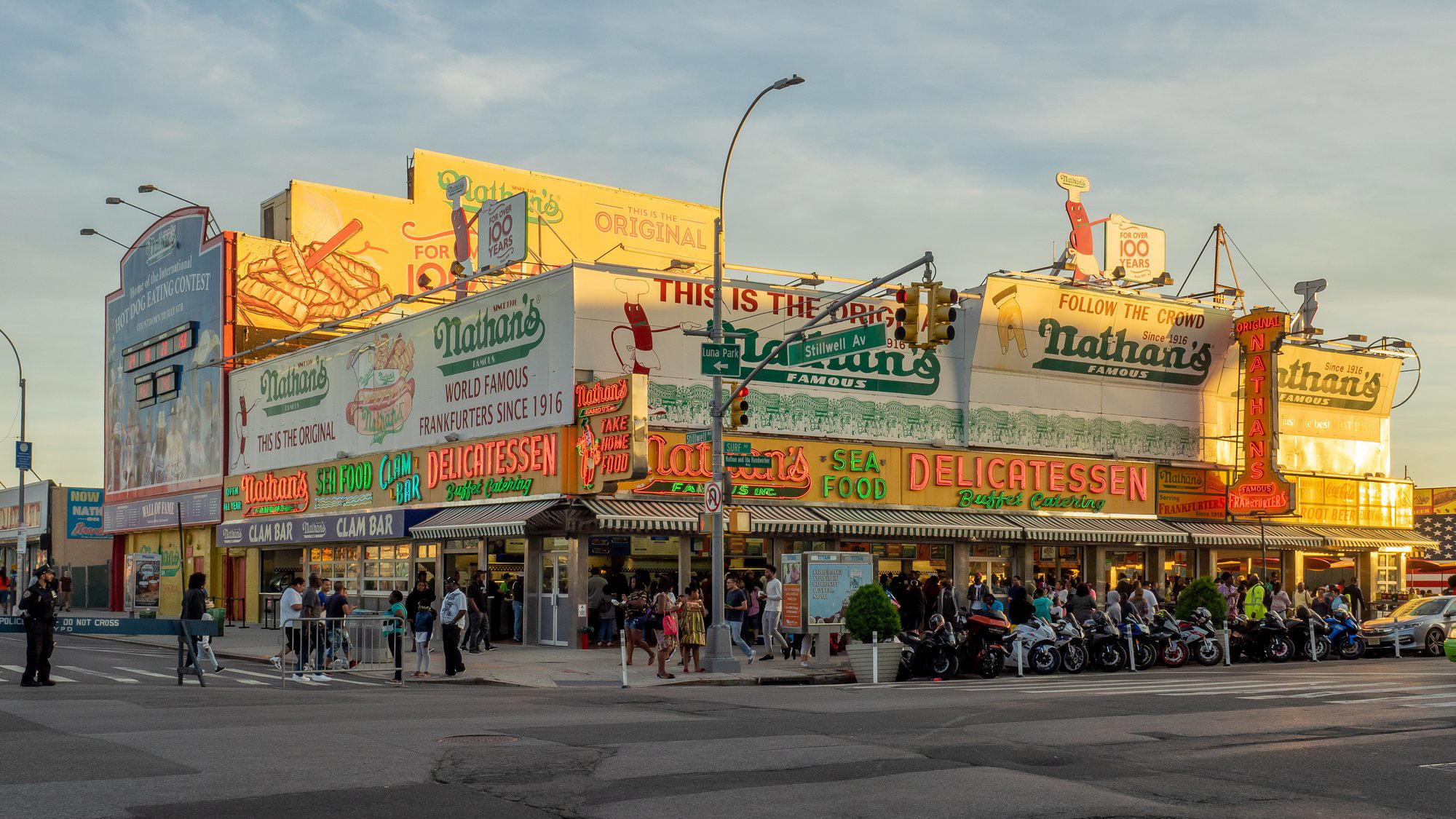
A Menu That Has Always Known What It Is
Nathan's Famous is a classic American hot dog restaurant in Brooklyn, New York City, with. American dining has cycled through wave after wave of reinvention since 1916, the year Nathan Handwerker opened a hot dog stand at the corner of Surf and Stillwell Avenues in Coney Island. Tasting menus have grown and shrunk. Counter service has been disrupted and revived. Fast casual has bifurcated into dozens of sub-categories. Nathan's Famous has done essentially none of that. Its menu is, by the standards of any contemporary food operation, almost aggressively narrow, and that narrowness is the editorial point worth examining before anything else.
In a city where restaurants like Masa and Per Se represent one pole of culinary ambition, and where Le Bernardin or Atomix anchor mid-to-upper tiers of formal dining, Nathan's occupies a different register entirely. It is not competing on technique or sourcing narrative or tasting-menu architecture. It competes on consistency, volume, and the specific authority that comes from doing one thing for over a century without apparent apology.
The Logic of a Short Menu
Short menus can signal two different things in American food culture. At the high end, a short menu signals editorial confidence: the chef has decided what matters and removed everything else. That is the operating logic at places like Blue Hill at Stone Barns or Single Thread Farm in Healdsburg, where the limited scope of the menu is a statement of philosophy. At the counter-service end, a short menu signals something different but equally deliberate: the operation has found what sells, what it can execute at scale, and what customers will return for reliably. Nathan's sits in the latter category, and the longevity of the format suggests the logic has held.
The hot dog itself, as a format, requires precision of a particular kind: casing texture, snap, the balance of fat and seasoning, the temperature differential between the dog and the bun. These are not problems solved by Michelin-starred technique, but they are problems that separate good execution from poor execution at the counter-service level. Nathan's built its early reputation partly on price (Handwerker reportedly undercut Coney Island competitors from the outset) and partly on a product that was consistent enough that customers came back. The model is closer to that of a specialist food producer than a traditional restaurant.
That positioning is worth comparing against the broader American food scene. Operations like Alinea in Chicago or The French Laundry in Napa represent dining as a designed, time-extended experience. Nathan's represents something categorically different: eating as a transaction that takes roughly the same amount of time every visit, at a price point accessible to the full economic range of Coney Island's historically mixed crowd. Both models have survived in American food culture. Nathan's has done so for longer than almost any other named food brand in New York.
Coney Island as Context
The address at 1310 Surf Avenue, Brooklyn, places Nathan's Famous in a neighbourhood that has been many things simultaneously: a working-class resort, a post-industrial stretch, a seasonal amusement district, a subject of urban redevelopment debates. Coney Island's food culture has historically been defined by the boardwalk economy, where seasonality, volume, and accessibility matter more than the kind of year-round fine dining concentration you find in Manhattan. The Nathan's flagship sits within that context, functioning as much as an institution of place as a food destination.
That distinction matters. When New York diners discuss the city's dining scene in totality, from the Michelin-mapped rooms of Midtown and the West Village to the outer-borough counters and the immigrant-food corridors of Queens and Brooklyn, Nathan's Coney Island location belongs to a particular strand: the civic institution category, the places that are referenced as markers of city identity rather than as competitive dining destinations. Jungsik New York exists on a different map entirely. The restaurant occupies this one, and the map is not less interesting for being different.
The Hot Dog Counter in American Food History
The restaurant did not invent the American hot dog, but its Coney Island location became among the more referenced origin points in the food's popular mythology. The annual hot dog eating contest, held on the Fourth of July, has run for decades and has generated more mainstream press coverage for the Surf Avenue address than any food review could. The contest is, in one reading, a marketing mechanism. In another, it is a strange and durable piece of American folk performance that the location has come to anchor. Neither reading is wrong, and both explain something about how the brand has stayed culturally relevant beyond the actual eating of hot dogs.
Compared to the kind of narrative weight that places like Emeril's in New Orleans or The Inn at Little Washington carry in their respective cities, the restaurant operates with a different kind of cultural capital. It is less about culinary lineage or chef pedigree and more about duration, repetition, and a specific kind of democratic accessibility that has become rarer as food culture has stratified. That the original location has remained at the same Coney Island address for over a century is itself a data point worth registering in a city where restaurant turnover is typically measured in years, not decades.
Nathan's represents the opposite end of the register: no reservations, no tasting menu, no dress code, no sommelier. Its value is its specificity of place and its age.
Reputation Context
Comparable venues nearby, for context on price, style, and recognition.
| Venue | Cuisine | Price | Notes |
|---|---|---|---|
| Nathan's FamousThis venue — the venue you are viewing | Classic American Hot Dogs | $ | Not listed |
| Paul's Place | Classic American Burgers | $ | East Village |
| Chelsea Papaya | American Hot Dogs & Comfort Food | $ | Chelsea-Hudson Yards |
| Skylight Diner | Classic American Diner | $ | Chelsea-Hudson Yards |
| Mike's Coffee Shop | Classic American Diner | $ | Clinton Hill |
| Emack & Bolio's | Creative American Ice Cream | $ | Upper West Side (Central) |
Continue exploring
More in New York City
Restaurants in New York City
Browse all →
Bars in New York City
Browse all →
Hotels in New York City
Browse all →



Wineries in New York City
Browse all →


At a Glance
- Well Known
- Lively
- Casual Hangout
- Family
- Historic Building
- Street Scene
Current opening hours
- Monday
- 10 AM–10 PM
- Tuesday
- 10 AM–10 PM
- Wednesday
- 10 AM–10 PM
- Thursday
- 10 AM–10 PM
- Friday
- 10 AM–11 PM
- Saturday
- 10 AM–11 PM
- Sunday
- 10 AM–10 PM
Hours can change for holidays and private events. Last verified .
Casual fast-food atmosphere with a bustling, energetic vibe near the boardwalk.