Positioned among North Bridge Road's long-standing Minangkabau institutions, Nasi Padang Sabar Menanti serves the kind of communal rice-table format that defines the Padang tradition in Singapore. Where fine-dining tasting menus along Orchard and the CBD command three-figure covers, this address holds its place in a different but equally serious register of the city's eating culture.
Pearl is the En Primeur Club membership app — saves, bookings, and concierge access live there. Same editors, same standards.
- Address
- 719 N Bridge Rd, Singapore 198687
- Website
- sabarmenanti2.pickngosg.com
- Directions
- Get directions
 Saves & bookings on Pearl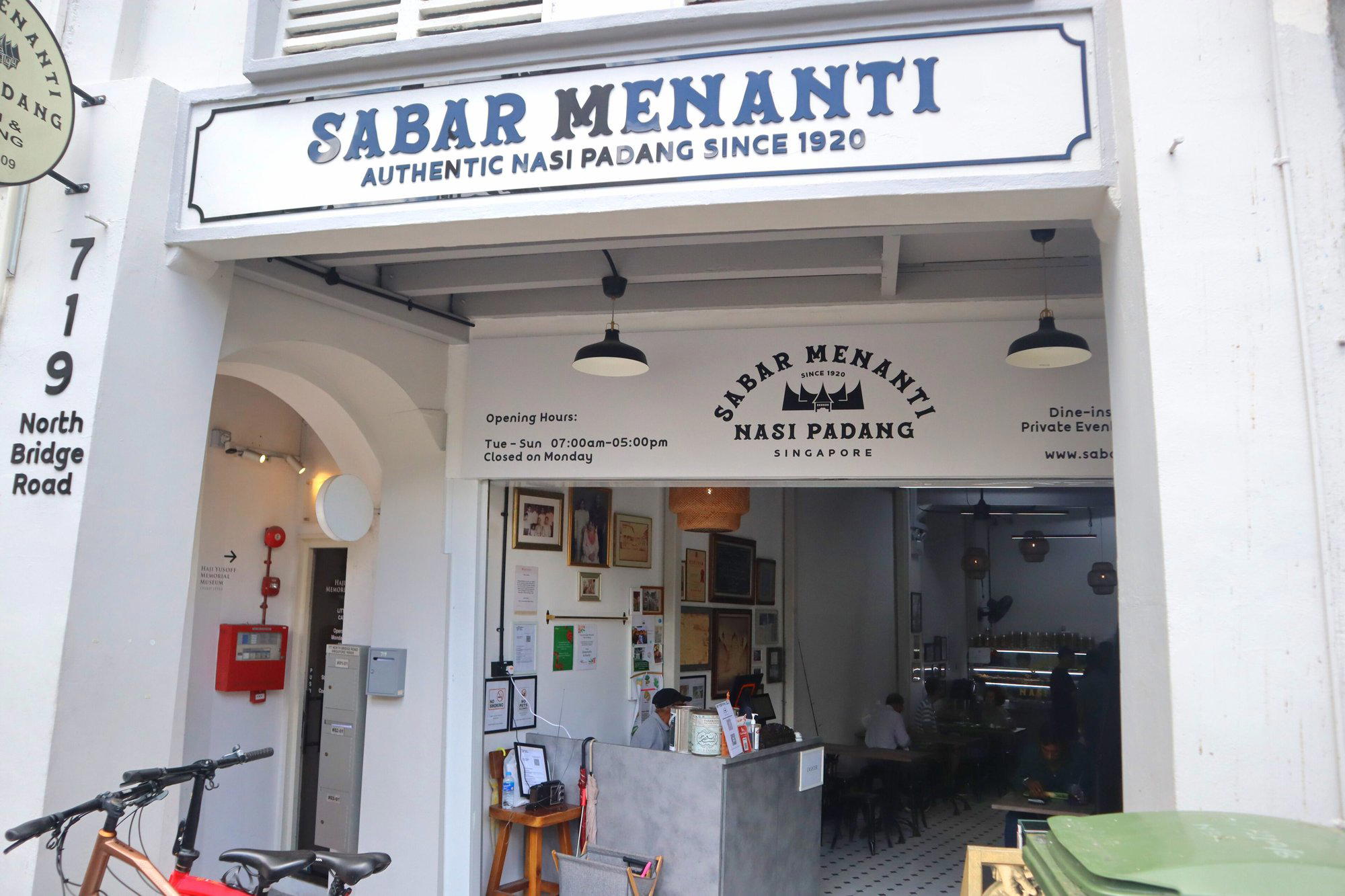
North Bridge Road and the Padang Tradition
Odette, Les Amis, and Zén occupy a rarefied tier of European-influenced fine dining. North Bridge Road operates on a different logic entirely. The stretch running through Rochor and toward Kampong Glam has historically been one of the city's most culturally layered corridors, where Malay, Peranakan, and Minangkabau food cultures have coexisted with shophouse architecture for generations. Nasi Padang Sabar Menanti, at 719 North Bridge Road, sits squarely within that tradition. The address alone places it in a neighbourhood where the food conversation is about heritage and daily practice, not tasting-menu progression.
Nasi Padang as a format is worth understanding before arriving. It originates from West Sumatra's Minangkabau culture and operates on a principle that is almost the inverse of the modern tasting counter: rather than a fixed sequence decided by the kitchen, diners select from a spread of pre-cooked dishes displayed at the counter, composing their own plate over steamed rice. The logic is communal and democratic. Every dish has been simmered, rendered, or spiced to hold its flavour across a service window, which demands a different kind of technical discipline than à la carte cooking. The rendang is especially scrutinised benchmark in any Padang kitchen, a dry-braised beef preparation that can take hours to reduce properly and whose quality signals the overall standard of the house.
What the Kampong Glam Setting Means for the Experience
Kampong Glam, the historic Malay-Arab quarter a short walk from this address, has gone through significant gentrification pressure over the past decade. Haji Lane draws younger visitors with its boutiques and cafés, while Arab Street sees a rotating cast of newer food operators. The northern stretch of North Bridge Road has absorbed some of that energy but retained more of its original character. Eating at Sabar Menanti means arriving on a block where the surrounding shophouses still perform quotidian functions: provision shops, modest eateries, prayer houses. The physical environment communicates something about the register of the meal before any food arrives. This is not a destination engineered for the Instagram round-trip. It functions as a neighbourhood institution, and the experience is shaped by that.
For visitors approaching from the CBD, Cicheti in Rochor represents the newer, Italian-inflected side of the same corridor, while the Kampong Glam area itself holds a range of Malay and Middle Eastern options that extend a sensible eating itinerary. The MRT infrastructure around Bugis and Lavender stations makes North Bridge Road reasonably accessible from most parts of the city, and the walk between either station and the address passes through some of the more characterful streetscape in central Singapore.
The Padang Counter Format in Context
The nasi Padang format creates a different set of expectations than the prix-fixe or à la carte structures that dominate fine-dining coverage. Singapore has several long-running Padang houses, and the competitive set is measured in reputation for specific dishes, consistency of spice depth, and the breadth of the daily spread rather than chef credentials or sommelier programs. At the upper end of the city's restaurant spectrum, Jaan by Kirk Westaway and Meta compete on tasting-menu ambition and international press recognition. Padang institutions compete on entirely different terms: the quality of the gulai, the tenderness of the ayam pop, the oil content and dryness of the rendang. These are craft signals legible to a regular diner who has eaten the format across multiple operators, and Sabar Menanti's longevity on North Bridge Road is itself a form of endorsement in that comparable set.
Across Singapore's hawker and heritage restaurant ecosystem, institutional age carries specific weight. An address that has held its position in the same neighbourhood across decades, without rebranding or format reinvention, communicates something about consistency that newer openings cannot replicate. For comparison within the heritage rice-plate register, Bugis Street Ah Huat Hainanese Chicken Rice represents another long-running single-dish institution, and KTMW chicken rice tea-cafe in Bedok shows how the format translates to other districts. Padang, however, demands a wider spread and a longer preparation window than chicken rice, which raises the operational complexity and narrows the field of operators doing it at a serious level.
Planning a Visit
Nasi Padang Sabar Menanti operates as a counter-service establishment, which means timing matters. The spread is fullest early in service, before popular dishes sell through. Arriving at opening, or close to it, gives the widest selection. By mid-afternoon, sold-out dishes are common at any serious Padang house, and the rhythm of the place rewards early arrival over lingering reservation windows. There is no booking infrastructure for addresses in this format: the queue and the counter are the interface. Ah Ter Teochew Fishball Noodles in Downtown Core and Asian Twist by 365 Food in Queenstown offer different registers of the hawker continuum, useful for mapping the breadth of the city's non-fine-dining food culture. Our full Singapore restaurants guide covers the range from Michelin-listed counters to neighbourhood institutions across every district.
the contrast with operators like Béni in Orchard or Etna Restaurant in Outram illustrates how different the decision frameworks are between Singapore's fine-dining tier and its heritage institutions. The spend at a Padang counter runs at a fraction of a tasting menu, and the experience of composing a plate from a dozen prepared dishes involves a different kind of attention than a sequenced kitchen narrative. Neither is a substitute for the other, but they represent the full width of what serious eating in Singapore actually looks like. Globally, the communal, counter-selection format has analogues in traditions far from Singapore: the technical precision of Le Bernardin or the format experimentation at Lazy Bear in San Francisco share almost no surface features with nasi Padang, which is precisely the point. The format's logic is its own, and Sabar Menanti's position on North Bridge Road is the product of a neighbourhood and a culinary tradition that has been self-sustaining for longer than most of the city's fine-dining addresses have existed.
The Minimal Set
Comparable venues nearby, for context on price, style, and recognition.
| Venue | Cuisine | Price | Notes |
|---|---|---|---|
| Nasi Padang Sabar MenantiThis venue — the venue you are viewing | Not listed | $$ | Not listed |
| Vernacular Coffee | Not listed | $$ | Guillemard Road, Specialty Coffee and Viennoiseries |
| Traditional Haig Road Putu Piring | Geylang, Traditional Malay Putu Piring | $ | Not listed |
| The Original Katong Laksa | UPPER PAYA LEBAR, Original Katong Laksa | $ | Not listed |
| Fortuna | Pizza | Not listed | Not listed |
| Guan Hoe Soon Restaurant | Not listed | $$ | GEYLANG EAST, Authentic Peranakan (Nyonya) |
Continue exploring
More in Singapore
Restaurants in Singapore
Browse all →
Bars in Singapore
Browse all →
At a Glance
- Classic
- Rustic
- Casual Hangout
- Historic Building
Current opening hours
- Monday
- Closed
- Tuesday
- 7 AM–5 PM
- Wednesday
- 7 AM–5 PM
- Thursday
- 7 AM–5 PM
- Friday
- 7 AM–5 PM
- Saturday
- 7 AM–5 PM
- Sunday
- 7 AM–5 PM
Hours can change for holidays and private events. Last verified .
Casual bustling atmosphere in a pre-war shophouse with point-and-choose buffet-style service amid the lively Kampong Glam neighborhood.