Three of Penang's most closely watched hawker institutions share a single itinerary: Nasi Kandar Deen Mutiara for the curry-drenched rice tradition that defines the island's Muslim-Indian eating culture, Padang Tembak Claypot for slow-cooked, coal-fired claypot rice, and Loh Kei Duck Meat for braised duck in spiced loh sauce. Together they map the structural diversity of George Town's street-food canon.

Pearl is the En Primeur Club membership app — saves, bookings, and concierge access live there. Same editors, same standards.
Three Formats, One Argument About How Penang Eats
Walk the older quarters of George Town on any given morning and the eating happens in overlapping waves: nasi kandar lines forming before the sun clears the shophouse rooflines, claypot smoke drifting from back-lane kitchens by mid-afternoon, braised duck stalls hitting their stride as evening traffic thickens. The rhythm is not accidental. Penang's hawker culture has always operated less like a restaurant industry and more like a distributed kitchen, with each specialist format covering a different time slot, a different protein, a different cooking technology. Nasi Kandar Deen Mutiara, Padang Tembak Claypot, and Loh Kei Duck Meat sit at three distinct coordinates within that system, and visiting all three in sequence is one of the more efficient ways to understand how the city's street-food architecture actually works.
Nasi Kandar Deen Mutiara: The Logic of the Curry Counter
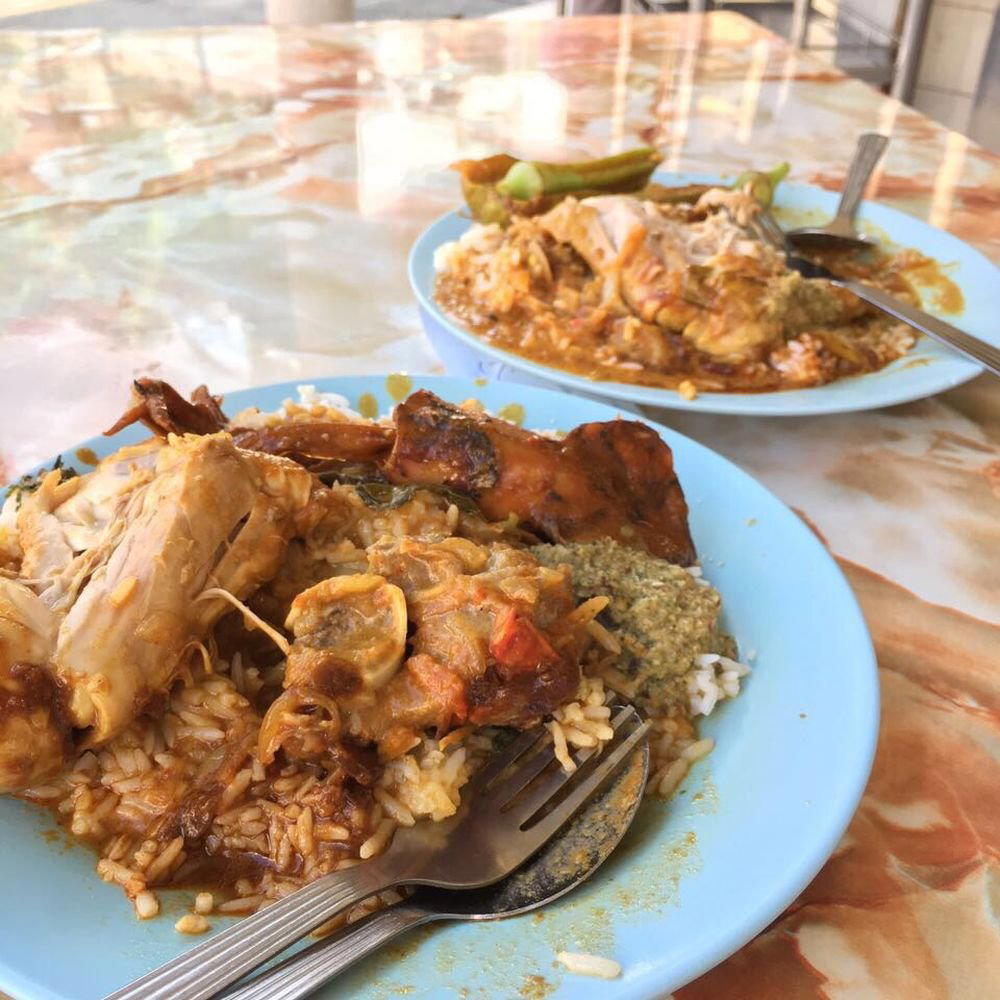
Nasi Kandar as a format is worth understanding before you join the queue. The tradition originated with Indian-Muslim hawkers who carried rice and curries through the streets on a kandar, a shoulder pole balanced across two buckets. The fixed counter replaced the pole, but the underlying architecture stayed the same: a central mound of steamed rice, a row of curried proteins and vegetables, and the defining moment of banjir, the deliberate flooding of the rice with multiple curry sauces ladled from different pots simultaneously. The result is not a single-note dish. It is an exercise in sauce layering, where fish curry, dhal, and a meat gravy interact with each piece of rice differently depending on the ratio chosen.
Deen Mutiara operates within this tradition, and the menu structure reflects its logic precisely. The selection of curried proteins changes with supply and the cooking schedule, which means the informed approach is to arrive early enough that the full counter is still populated. Penang's nasi kandar counters are broadly comparable on rice quality; what separates them is the depth and complexity of the individual curries and the cook's judgment on spice balance. This is a format where repetition builds expertise, both for the cook and the regular diner. Visitors coming once should order the banjir option and let the server choose the sauce combination rather than specifying each component individually.
For broader context on Penang's Muslim-Indian eating traditions alongside other hawker lineages, Ka Bee Cafe and Laksa Mamu offers a useful counterpoint, and the our full Penang restaurants guide maps the wider field.
Padang Tembak Claypot: Coal, Clay, and Controlled Burn
Claypot rice occupies a different register entirely. Where nasi kandar is an additive format, more sauces, more proteins, more complexity piled onto rice, claypot rice is reductive. The protein, aromatics, and rice cook together in a sealed clay vessel over charcoal, and the point of the exercise is the crust that forms at the base of the pot during the final minutes of cooking. That crust, called fan jiu in Cantonese, is the reason the format exists. It cannot be replicated in a steel wok or a rice cooker; the porous clay walls regulate moisture and heat in a way that produces a specific texture gradient from the soft, steamed interior to the browned, slightly smoky base.
Padang Tembak is the neighbourhood in which this claypot operation has built its following, and the location matters because claypot rice is not a format that travels well. The pots must come directly from fire to table, and the eating window before the crust softens is narrow. This is one of the few hawker formats in Penang where timing is as important as the cooking itself. Arriving during the main service period, when pots are cycling through continuously, produces a different result than arriving at the edges of service when the coal temperature is inconsistent.
For a comparative look at how Penang's Cantonese-influenced hawker formats differ from the island's Hokkien and Peranakan traditions, Air Itam Asam Laksa, Chong Char Koay Teow, and 888 Hokkien Mee covers that axis. Auntie Gaik Lean's Old School Eatery in George Town anchors the Peranakan cooking tradition for those building a broader itinerary.
Loh Kei Duck Meat: The Braising Tradition and Its Sauce
Loh, the spiced braising liquid central to Teochew cooking, is one of the more underexplained elements of Penang's food culture for visitors arriving without background. It is a master stock maintained across cooking sessions, built from soy, five-spice, and various aromatics, and the flavour deepens with each batch of protein added to the pot. Duck is the canonical protein for this preparation in the Penang context, though offal, tofu, and eggs typically accompany it. The loh sauce itself is the attraction as much as the duck; the braised meat is the vehicle for a liquid that has accumulated flavour over time.
Loh Kei operates in this tradition, and the menu is structured around it. The ordering logic is direct: choose your protein combination, specify the amount, and the sauce arrives as a given rather than an option. The eating posture here is different from both nasi kandar and claypot rice. This is a format designed for grazing alongside other dishes, often consumed as part of a larger table spread rather than as a standalone meal. The portions are calibrated accordingly.
For those building a duck-focused eating thread through Penang, Jit Seng Roasted Duck Rice represents the roasted preparation, which offers a direct contrast to the braised approach at Loh Kei. The two techniques produce structurally different results from the same bird: one relies on dry heat and lacquered skin, the other on extended wet heat and spice absorption.
Reading the Three Formats Together
Taken as a set, these three operations illustrate something important about how Penang's hawker culture distributes complexity. Nasi kandar is complex in accumulation: many curry pots, many proteins, many sauce combinations. Claypot rice is complex in technique: a single vessel, a narrow cooking window, a process-dependent texture. Loh braised duck is complex in time: a sauce built across sessions, a flavour profile that shifts depending on where in the cooking cycle a given batch falls. Each format demands a different kind of attention from the diner.
This structural diversity is part of what separates Penang's hawker ecosystem from more homogeneous food cities. George Town's UNESCO World Heritage recognition in 2008 included the living cultural practices embedded in its food traditions, not only its built environment. The hawker formats described here are part of that argument. Restaurants like ChinaHouse and Christoph's operate in the formal dining register that sits alongside this hawker layer, and the contrast between the two tiers is itself a useful lens on how the city eats. For those interested in how high-technique Malaysian cooking develops these same regional ingredients into a different kind of argument, Dewakan in Kuala Lumpur represents the furthest point along that continuum.
Planning Your Visit
These three stalls operate on hawker schedules rather than restaurant hours, which typically means morning-to-afternoon for nasi kandar, late afternoon through evening for claypot rice, and evening for braised duck. None takes reservations, and seating is communal and first-come. The practical approach for visitors is to map these formats across a full day rather than attempting all three in a single sitting, treating them as three meals rather than three courses. Each is priced at hawker rates, meaning a full portion with a drink sits well within the range that makes Penang's eating culture one of the more accessible in Southeast Asia. For a broader framework on how to build an itinerary across the island's hawker, cafe, and formal dining tiers, our full Penang restaurants guide covers the field in full.
Recognition Snapshot
Comparable venues nearby, for context on price, style, and recognition.
| Venue | Cuisine | Price | Notes |
|---|---|---|---|
| Nasi Kandar Deen Mutiara, Padang Tembak Claypot, and Loh Kei Duck MeatThis venue — the venue you are viewing | Penang Nasi Kandar | $ | Not listed |
| Penang Road Famous Laksa and Penang Road Famous Teochew Chendul | Traditional Penang Assam Laksa | $ | George Town |
| OO White Coffee, Tiger Char Kway Teow, Gow Thew Chik Hainana Chicken Rice | Traditional Penang Kopitiam Breakfast | $ | George Town |
| Sri Ananda Bahwan | South Indian Banana Leaf | $ | Little India |
| Ka Bee Cafe and Laksa Mamu | Penang Café | $ | George Town |
| La Vie | European with Asian Fusion Fine Dining | $$$ | George Town |
At a Glance
- Lively
- Casual Hangout
- Late Night
- Standalone