Murray's Bagels
Murray's Bagels at 500 6th Avenue is a Greenwich Village institution that has anchored New York's hand-rolled bagel tradition for decades. The no-toasting policy is a point of principle, not affectation, and the counter moves fast. For visitors calibrating their New York food itinerary, this is where the city's bagel standard is set in practice, not in reputation alone.
Pearl is the En Primeur Club membership app — saves, bookings, and concierge access live there. Same editors, same standards.
- Address
- 500 6th Ave, New York, NY 10011
- Phone
- +1 212 462 2830
- Website
- murraysbagels.com
- Directions
- Get directions
 Saves & bookings on Pearl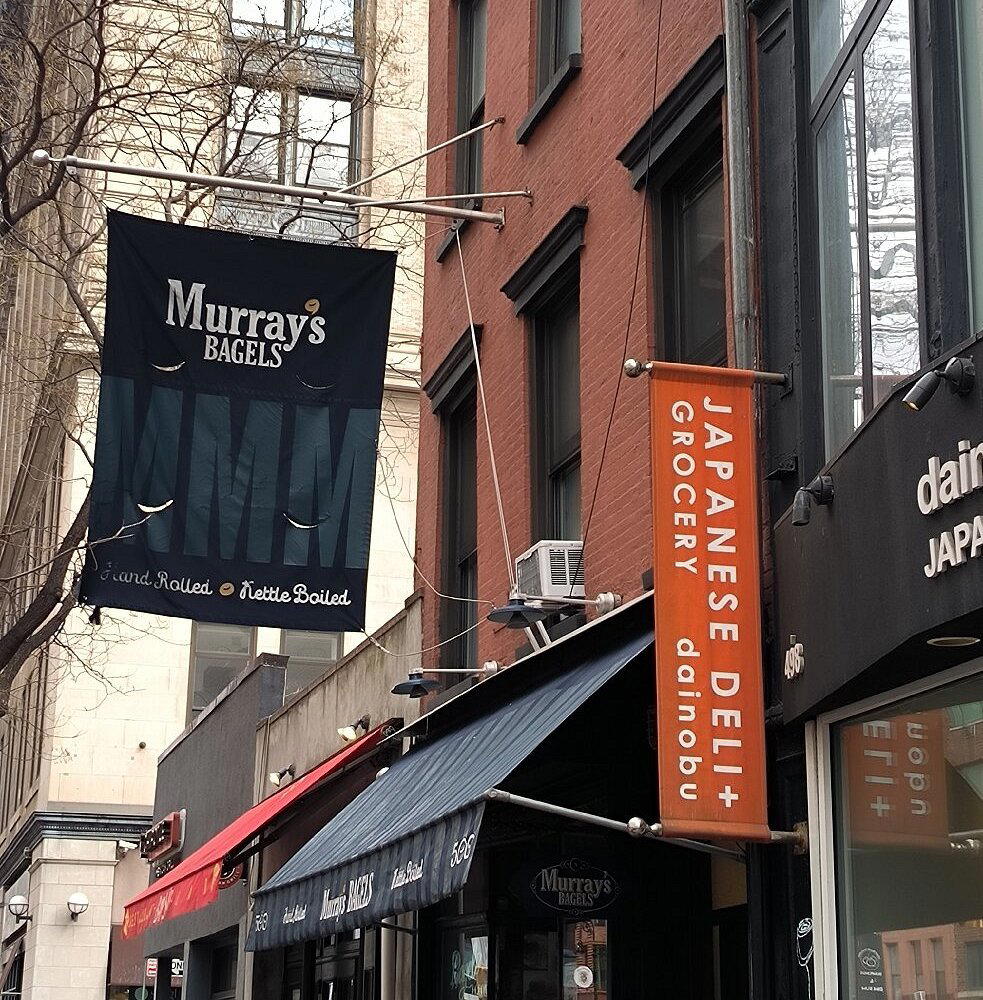
The Counter, the Queue, and the Standard
On 6th Avenue in Greenwich Village, the bagel counter functions as a kind of civic institution. There are no reservations, no tasting menus, and no ambient music chosen to signal a mood. What you get at Murray's Bagels is a queue, a counter, and a product that has kept a specific standard in a category where New York's reputation and the reality on the plate are often miles apart.
The physical experience is calibrated to function rather than atmosphere in the designed sense: fluorescent light, glass cases, a counter staff that moves efficiently. This is not a failing of ambition. In New York's bagel shops, the absence of hospitality theatre is itself the style. The product is the performance. If you have spent time at the fine-dining end of the New York spectrum, where front-of-house choreography at places like Le Bernardin or the multi-hour progression of Eleven Madison Park constitute the full experience, the stripped-back format at Murray's offers a sharper contrast.
Where Hand-Rolled Sits in the City's Food Hierarchy
New York's bagel debate has two fault lines: kettle-boiled versus not, and hand-rolled versus machine-produced. Murray's occupies the hand-rolled, kettle-boiled position, which is the traditional method and the one that produces the chew-to-crust ratio the format depends on. The interior crumb should be dense but not gummy; the crust should have enough resistance to register before giving way. These are textural arguments, not sentimental ones, and they explain why the shop has maintained a consistent following among people who eat bagels as a regular rather than occasional choice.
The no-toasting rule, which Murray's has enforced as a point of product integrity, is worth understanding in context. A freshly made, properly boiled bagel does not require toasting; toasting compensates for staleness or for a product that lacked sufficient crust development in the first place. The policy functions as a quality signal, not an inconvenience. It is the equivalent of a serious ramen shop refusing to adjust the broth sodium level on request: the constraint is part of the standard.
New York's premium dining circuit has expanded its geographic and conceptual range considerably. Tasting menus at Atomix or Per Se and the omakase pricing at Masa represent one end of the city's food spend. Murray's Bagels represents a different but equally serious category: the benchmark casual counter, where the standard is set by repetition and consistency rather than by seasonal creativity. Both ends of that spectrum matter to understanding what New York actually eats.
The Team Dynamic Behind a Counter Operation
In fine-dining contexts, the interplay between kitchen, floor, and drinks programs is a visible part of the experience. The sommelier's pairing logic, the front-of-house pacing, the chef's sequencing: these are legible to the guest. At a high-volume counter like Murray's, the equivalent dynamic is less visible but no less consequential. The counter staff controls the pace of the line, the accuracy of orders, and the speed at which a busy morning service remains functional. A bagel counter at volume is a logistics problem as much as a food problem, and the teams that run them well do so through a kind of practised shorthand that takes time to develop.
This is a different register of hospitality from what you find at Blue Hill at Stone Barns or the service model at The French Laundry. The ability to move a weekend queue efficiently, to manage the gap between in-store and takeaway orders, and to maintain product quality under sustained demand is a specific operational competence. Murray's has sustained this over a period long enough that regulars have built the shop into their weekly rhythms, which is as reliable a signal of consistent execution as any formal award.
Placing Murray's in New York's Wider Food Map
For visitors building a New York food itinerary, the question of where Murray's fits depends on how you structure a day. The Greenwich Village location puts it within reach of a significant cluster of the city's serious eating. The shop functions well as an early anchor before an afternoon of neighbourhood exploration. If your New York trip is weighted toward the fine-dining circuit, Murray's offers a useful recalibration: a reminder that the city's food identity is not only defined by its Michelin tier but by the everyday counters that have outlasted most of the destinations around them.
Readers interested in how other American cities approach the relationship between casual institution and fine-dining anchor will find useful comparisons in Lazy Bear in San Francisco, Smyth in Chicago, and Emeril's in New Orleans. The point of comparison is not cuisine but the way a city's food culture depends on institutions at multiple levels operating with serious attention to their own standard.
Internationally, the same principle applies. The precision of service and product at Dal Pescatore in Runate or the sourcing discipline at Atelier Moessmer Norbert Niederkofler in Brunico are expressions of institutional seriousness at the fine-dining tier. Murray's operates at the opposite price point but with a comparable clarity of purpose. Additional American comparisons worth noting: Addison in San Diego, Providence in Los Angeles, Single Thread Farm in Healdsburg, Frasca Food and Wine in Boulder, and The Inn at Little Washington all demonstrate, in their respective categories, the same principle: consistency over time is the hardest standard to maintain.
Planning Your Visit
Murray's Bagels is located at 500 6th Avenue, New York, NY 10011, in Greenwich Village. The shop operates on a walk-in basis with no reservations. Weekend mornings generate the longest queues; mid-week visits tend to move faster. No toasting is available. Hours: Mon to Fri 6 AM to 5 PM, Sat and Sun 7 AM to 4 PM.
Price and Recognition
Comparable venues nearby, for context on price, style, and recognition.
| Venue | Cuisine | Price | Notes |
|---|---|---|---|
| Murray's BagelsThis venue — the venue you are viewing | Not listed | $ | Not listed |
| The Commodore | Not listed | $ | Williamsburg, American Comfort Food & Fried Chicken |
| Skylight Diner | Not listed | $ | Chelsea-Hudson Yards, Classic American Diner |
| Culture Espresso | Not listed | $ | Midtown-Times Square, Specialty Coffee & Cookies |
| Dean Fryer | American Diner | $ | Not listed |
| Culture | Park Slope, Cafe | $ | Not listed |
Continue exploring
More in New York City
Restaurants in New York City
Browse all →
Bars in New York City
Browse all →
Hotels in New York City
Browse all →



Wineries in New York City
Browse all →


At a Glance
- Cozy
- Classic
- Well Known
- Casual Hangout
- Brunch
- Standalone
Current opening hours
- Monday
- 6 AM–5 PM
- Tuesday
- 6 AM–5 PM
- Wednesday
- 6 AM–5 PM
- Thursday
- 6 AM–5 PM
- Friday
- 6 AM–5 PM
- Saturday
- 7 AM–4 PM
- Sunday
- 7 AM–4 PM
Hours can change for holidays and private events. Last verified .
Sweet, cozy deli-style spot with chalkboard menus and a charming, casual atmosphere.