Our verdict
On Bergmannstraße in Kreuzberg, Munchies occupies a stretch of street that has long defined the neighbourhood's appetite for casual eating done with conviction. The address places it inside one of Berlin's most food-attentive districts, where sourcing habits and regional produce have shaped menus long before such things became talking points elsewhere in the city.

Pearl is the En Primeur Club membership app, where members save venues, book tables and use the concierge.

The menu
What to order
- Birria Tacos
- Nashville Hot Chicken Sandwich
- Smash Burger
- Beyond Burger
Bergmannstraße and the Kreuzberg Eating Tradition
Kreuzberg has been feeding Berlin honestly for decades. The neighbourhood's food culture was never built on ceremony: it developed through market proximity, migrant kitchen traditions, and a practical relationship with produce that kept cooking grounded when other parts of the city were chasing spectacle. Bergmannstraße sits at the centre of that continuity, a street dense with independent food businesses that reflect the district's preference for substance over staging. Munchies, at number 19, operates inside that tradition rather than against it.
The address itself is instructive. Kreuzberg's Bergmannkiez sits within easy reach of the Marheineke Markthalle, one of Berlin's covered market halls, which has supplied the neighbourhood's kitchens with regional dairy, bread, and seasonal produce for generations. Restaurants and cafés along this stretch have always had shorter supply lines than their counterparts in Mitte or Prenzlauer Berg, and that proximity to direct sourcing tends to show in what ends up on the plate. Ingredients arrive faster, turn over more quickly, and carry less of the refrigerated distance that flattens flavour in higher-volume supply chains.
What Ingredient Sourcing Means in This Part of Berlin
The sourcing conversation in Berlin fine dining has shifted considerably over the past decade. At the Michelin-starred tier, venues like Nobelhart & Schmutzig have made regional provenance a structural commitment, naming producers on the menu and refusing ingredients that cannot be traced to a specific Brandenburg or Mecklenburg farm. Rutz has built its wine and food philosophy around German-speaking terroir. Even the dessert counter at CODA Dessert Dining treats ingredient origin as a core design principle rather than a footnote.
At the neighbourhood level, the dynamic operates differently. Sourcing is less likely to be a declared philosophy and more likely to be a practical habit: what is available nearby, what the market stall is selling this week, what the seasonal rhythm of the German agricultural calendar actually allows. A venue on Bergmannstraße is closer to that second mode of sourcing than to the curated producer-list model of the starred kitchen. That distinction is not a hierarchy. It reflects two genuinely different relationships with the supply chain, both of which can produce cooking that is honest and well-grounded.
Germany's broader produce calendar gives any kitchen in this district a strong seasonal skeleton to work with. Spring brings white asparagus from the Spreewald and Brandenburg lowlands, a vegetable so embedded in German culinary habit that it briefly reorganises entire menus across the country. Summer pushes stone fruit from Saxony and Thuringia into markets. Autumn delivers wild mushrooms, game from the surrounding forests, and root vegetables that dominate larders through the colder months. A kitchen that pays attention to this calendar rather than papering over it with year-round imports will produce food that changes noticeably with the seasons.
Kreuzberg's Place in Berlin's Wider Dining Map
Berlin's restaurant scene has never consolidated around a single neighbourhood the way London's has around Mayfair or Tokyo's around Ginza. The city remains geographically spread, with credible cooking distributed across Mitte, Prenzlauer Berg, Charlottenburg, and the two Kreuzberg postcodes. This dispersion means that neighbourhood character still shapes what a restaurant chooses to be, rather than proximity to a fixed prestige address determining the format.
Kreuzberg SO36 and Kreuzberg 61, which straddles the Bergmannkiez, have historically attracted kitchens that prioritise accessibility and directness over tablecloth formality. The neighbourhood's demographic mix has produced a food culture that is genuinely pluralist: Turkish, Middle Eastern, and Southern European cooking traditions sit alongside German-inflected kitchens and newer casual formats without the competitive hierarchy that organises dining in more homogenous districts. Munchies occupies a street where that plurality is visible at the street level.
For readers mapping Berlin by dining ambition, the comparison set at the upper end of the city's offer includes FACIL in Mitte, Restaurant Tim Raue in Kreuzberg itself, and the newer wave of tasting-menu formats that have found Berlin a more hospitable city for experimentation than its European peers. Munchies does not compete at that tier, nor does Bergmannstraße position it to.
Germany's fine dining elsewhere provides useful contrast. In Wolfsburg, Aqua and in Munich, JAN operate with the kind of formal structure that Kreuzberg's food culture has largely resisted. The Black Forest, home to Schwarzwaldstube, represents Germany's most trophy-dense dining corridor. Kreuzberg's identity is built on the opposite of that concentration: accessible, neighbourhood-scaled eating without the architecture of ceremony around it.
Internationally, the contrast is equally clear. Where Le Bernardin in New York City or Atomix represent the high-ceremony, high-documentation end of the dining spectrum, Bergmannstraße's food culture sits at the opposite pole: legible, direct, and rooted in neighbourhood routine rather than destination occasion.
Know Before You Go
Address: Bergmannstraße 19, 10965 Berlin, Germany
Neighbourhood: Kreuzberg (Bergmannkiez), Berlin
Transport: U-Bahn Gneisenaustraße (U7) or Mehringdamm (U6/U7); the street is walkable from both stops
Phone: Not listed
Website: Not listed
Booking: Not listed, walk-in recommended as a first approach given the neighbourhood format
Hours: Not listed, confirm locally before visiting
Price range: Not listed
Nearby context: Marheineke Markthalle is within a short walk and worth combining with a visit for market context
For a broader map of where Munchies sits within Berlin's eating offer, see our full Berlin restaurants guide.
Frequently asked questions
Is Munchies suitable for visitors who want to eat the way Kreuzberg locals do?
Bergmannstraße is one of the most genuinely local-facing streets in Kreuzberg for food, and an address at number 19 places Munchies inside that everyday eating culture rather than on the tourist-facing edge of the district. The proximity to the Marheineke Markthalle reinforces the neighbourhood's market-to-table rhythm that defines how this part of Berlin actually eats, as opposed to how it performs eating for an outside audience. For visitors wanting to understand Berlin through its neighbourhood kitchens rather than its destination restaurants, the EP Club Berlin guide maps the full spread from this street-level register through to venues like FACIL and Restaurant Tim Raue at the top of the city's offer.
Booking and Cost Snapshot
Comparable venues nearby, for context on price, style, and recognition.
| Venue | Cuisine | Price | Notes |
|---|---|---|---|
| MunchiesThis venue (the venue you are viewing) | American Comfort Food & Mexican Tacos | $10–20 | Not listed |
| Burgermeister | Classic American Burgers | $10–20 | Kreuzberg, Classic American Burgers |
| Burger Joint | Classic American Burgers | $10–20 | Mitte, Classic American Burgers |
| Play Off Marzahn im Le Prom | American Diner | $10–20 | Marzahn, American Diner |
| Magic John's | New York-Style Pizza & Detroit Deep Dish | $10–20 | Mitte, New York-Style Pizza & Detroit Deep Dish |
| House of Burgerz | Casual Burgers & Sides | $10–20 | Mitte, Casual Burgers & Sides |
Continue exploring
More in Berlin
Restaurants in Berlin
All restaurants in Berlin →
Bars in Berlin
All bars in Berlin →

Details
- Lively
- Trendy
- Cozy
- Casual Hangout
- Late Night
- Group Dining
- Standalone
- Open Kitchen
- A La Carte
- Counter Dining
- Halal
- Vegetarian Friendly
- Vegan Options
Current opening hours
- Monday
- 12–11 PM
- Tuesday
- 12–11 PM
- Wednesday
- 12–11 PM
- Thursday
- 12–11 PM
- Friday
- 12 PM–12 AM
- Saturday
- 12 PM–12 AM
- Sunday
- 12–11 PM
Hours can change for holidays and private events. Hours as of .
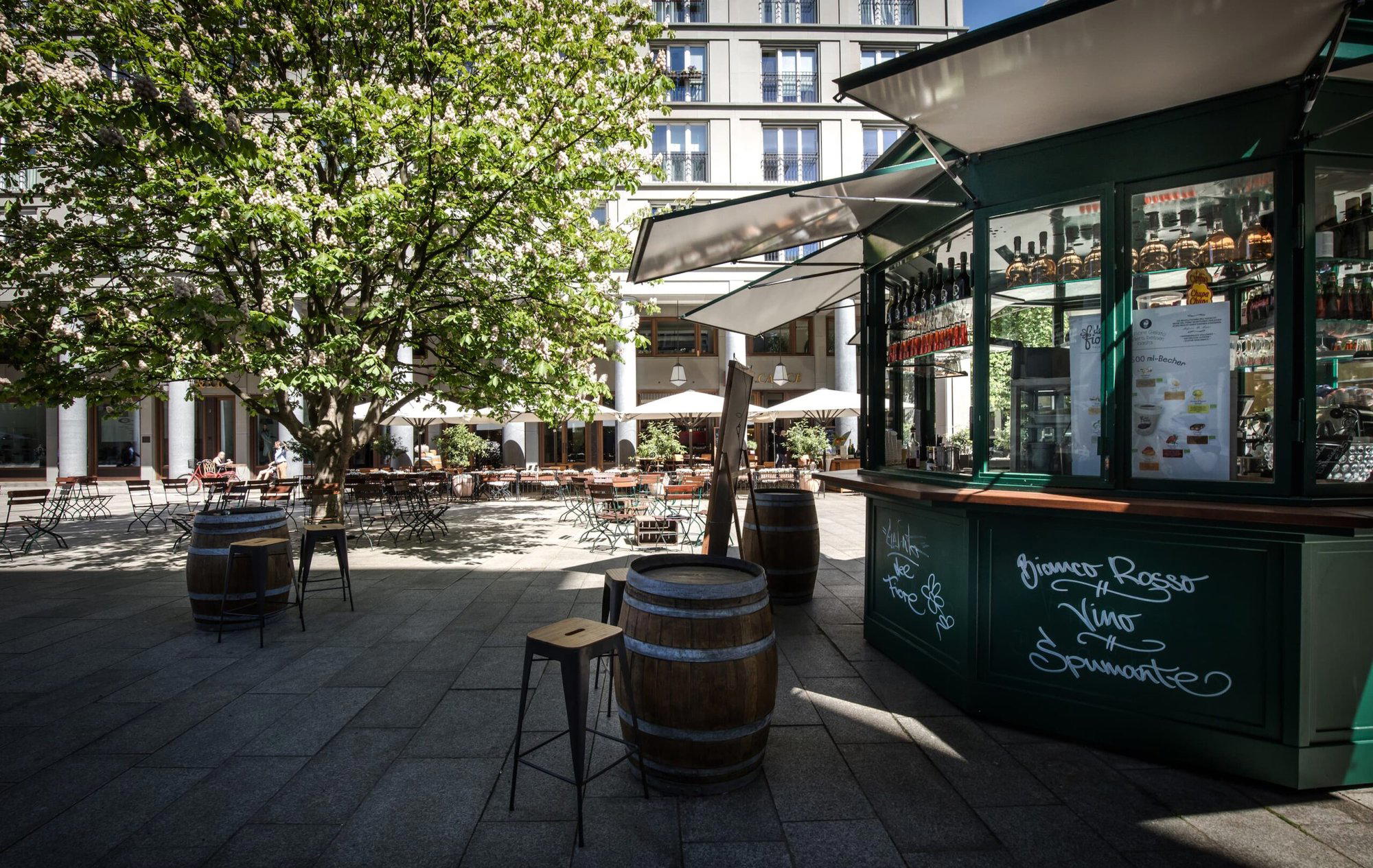
Casual, lively street food atmosphere with cozy outdoor seating in a trendy Berlin neighborhood.