
Tabelog 100 #56
Our verdict
A 12-seat counter near Tsuruhashi Station, Men to Niku Daitsuru Tsuruhashi ten belongs to Osaka’s fast, solo-friendly ramen culture rather than the city’s longer sit-down dining rhythm. Its 2025 Tabelog 100 Ramen Osaka selection places it in a competitive local field where abura-soba and maze-soba sit alongside soup ramen as serious, specialist formats.

Pearl is the En Primeur Club membership app, where members save venues, book tables and use the concierge.
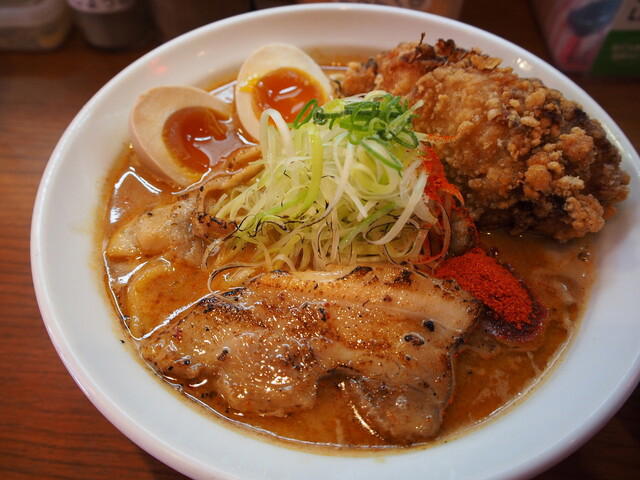
The menu
What to order
- Horumon Mazesoba (offal mixed noodles)
- Grilled pork belly mazesoba
- Spicy abura-soba / maze-soba
Approaching a ramen shop in Osaka is rarely a slow entrance. The city moves by rail lines, market traffic, barbecue smoke, and quick meals built around one seat, one bowl, and little ceremony beyond the order itself. Men to Niku Daitsuru Tsuruhashi ten fits that Osaka rhythm: direct, noodle-led, and closer to a dining ritual of speed and concentration than to the reservation theatre that defines much of premium Japan dining.
Osaka's counter culture rewards focus over ceremony
Osaka’s reputation often leans on takoyaki, okonomiyaki, kushikatsu, and the city’s habit of treating appetite as a civic language. Ramen belongs to a different register. It is less about the group table and more about a disciplined solo format: enter, choose, sit, eat while the noodles hold their texture, and leave without turning the meal into a drawn-out social event. That tempo is not a lesser experience; it is the point.
Osaka sharpens that logic. The city is one of Japan’s more kinetic food environments, better known to many visitors for casual abundance and quick decisions, but its eating culture also makes room for compact specialists. In that context, ramen, abura-soba, and maze-soba operate as formats for diners who want intensity without a long sitting. The etiquette is practical: minimal lingering, attention on the bowl rather than the room, and respect for the pace of the meal.
Men to Niku Daitsuru Tsuruhashi ten was selected for Tabelog 100 Ramen Osaka 2025, a useful signal in a city where casual pricing does not mean casual scrutiny. Tabelog’s ramen lists tend to reward places that regular diners return to and compare closely, and in Osaka that puts a shop into a demanding peer group. The distinction matters because ramen excellence in Japan is often argued through small technical differences rather than luxury markers.
Ramen, abura-soba, and maze-soba sit in the same serious register here
The listed categories, ramen, abura-soba, and maze-soba, place the shop in a broader Japanese noodle tradition that has moved beyond soup alone. Abura-soba and maze-soba change the mechanics of the meal: sauce, fat, seasoning, and toppings are mixed through the noodles by the diner, making texture and timing more visible. The ritual is practical and physical, not decorative. Stir thoroughly, eat promptly, and treat condiments as adjustments rather than distractions.
That matters in Osaka, where noodle meals often compete with other quick-format specialists. Compared with Sora Tsuruhashi souhonten, this shop occupies its own ramen lane. Ramen Shuki, Yaoyasu, Okonomiyaki Ajikuraya, and Udon Jojo show how varied the casual field can be: noodle shops, flour-based cooking, and efficient meals all answer different versions of the same question, namely how much time and appetite a diner wants to spend in Osaka.
The absence of a chef-led public narrative is not a weakness in this category. Many strong ramen shops are judged less by biography than by repeatability: whether the noodles, seasoning, and pacing hold up across the day. The format reinforces that standard. There is little need for a soft-focus dining room story; the experience is close-range and operational. In a city with serious formal dining, that directness is part of ramen’s appeal.
For visitors building a wider Osaka eating route, this is the kind of stop that works as a counterpoint to longer meals. A day might move from bakery culture or cafe pacing, through street-level Osaka staples, then into a more deliberate dinner elsewhere in the city. The ramen counter changes the cadence: shorter, sharper, and less dependent on occasion.
How to read the meal in a city built for appetite
The useful way to judge this kind of shop is not by asking whether it behaves like a destination restaurant. It does not need to. The better question is whether it clarifies a local habit: Osaka diners are comfortable giving serious attention to inexpensive, high-turnover meals. A Tabelog 100 Ramen Osaka 2025 selection and a listed focus on ramen, abura-soba, and maze-soba combine into a clear editorial picture. This is a specialist noodle stop for diners who understand that speed can carry discipline.
Payment and seating conventions in small ramen shops also shape the experience. Cash readiness remains sensible in this category, and compact noodle shops are poor fits for sprawling luggage, long conversations, or improvised large groups. The dining code is simple: arrive prepared, order decisively, eat while the noodles are at their intended texture, and give the seat back when the meal is done. That etiquette is not stiffness; it is how the format stays affordable and efficient.
Readers comparing Japanese casual formats beyond Osaka can also look to other dining rooms and casual specialists across Japan and abroad, while keeping Men to Niku Daitsuru Tsuruhashi ten in mind as an Osaka example of how a short noodle meal can still carry serious intent.
Accolades, Compared
Comparable venues in the metro at similar price points.
| Venue | Cuisine | Price | Awards | Notes |
|---|---|---|---|---|
| Men to Niku Daitsuru Tsuruhashi tenThis venue (the venue you are viewing) | Spicy Osaka Horumon Mazesoba & Ramen | $10–20 | Tabelog 100 #56 | Not listed |
| Honneri Kwashi Suiren isshin | Japanese traditional sweets (wagashi) & cafe | Not listed | Tabelog 100 #96 | Chūō |
| Curry & Nice Katool | Japanese spice curry stand | $1–10 | Tabelog 100 #34 | Chūō |
| Tori Soba Zagin Honten | Chicken ramen (tori paitan soba) counter | $10–20 | Tabelog 100 #97 | Nishi |
| Osaka Mentetsu | Osaka-style ramen counter | $10–20 | Tabelog 100 #91 | Kita |
| Kamaage Udon Raku | Kamaage udon and tempura shop | $10–20 | Tabelog 100 #97 | Nishinari |
Recognition history
Dated appearances from independent guides and award organizations, with the underlying list record or original source where available.
Tabelog 100 #56 · No. 56
Tabelog · Tabelog 100 - Ramen - OSAKA - 2025
Continue exploring
More in Osaka
Restaurants in Osaka
All restaurants in Osaka →



Bars in Osaka
All bars in Osaka →
Hotels in Osaka
All hotels in Osaka →




Wineries in Osaka
Browse all →
Details
- Lively
- Energetic
- Trendy
- Solo
- Casual Hangout
- Late Night
- After Work
- Standalone
- A La Carte
- Counter Dining
Current opening hours
- Monday
- 11 AM–10 PM
- Tuesday
- 11 AM–10 PM
- Wednesday
- 11 AM–10 PM
- Thursday
- 11 AM–10 PM
- Friday
- 11 AM–10 PM
- Saturday
- 11 AM–10 PM
- Sunday
- 11 AM–10 PM
Hours can change for holidays and private events. Hours as of .
A compact, ramen-focused shop near Tsuruhashi Station with a casual, energetic atmosphere; customers come primarily for the bold, spicy mazesoba rather than a long sit-down experience.