Megenagna
Our verdict
Megenagna brings Ethiopian dining to Aurora's South Ironton Street corridor, a stretch that has become one of the Denver metro's more quietly consistent addresses for immigrant-community cooking. The name itself references a major intersection in Addis Ababa, signaling where the kitchen's allegiances lie. For the Aurora dining circuit, it fills a specific gap in East African representation.

Pearl is the En Primeur Club membership app, where members save venues, book tables and use the concierge.
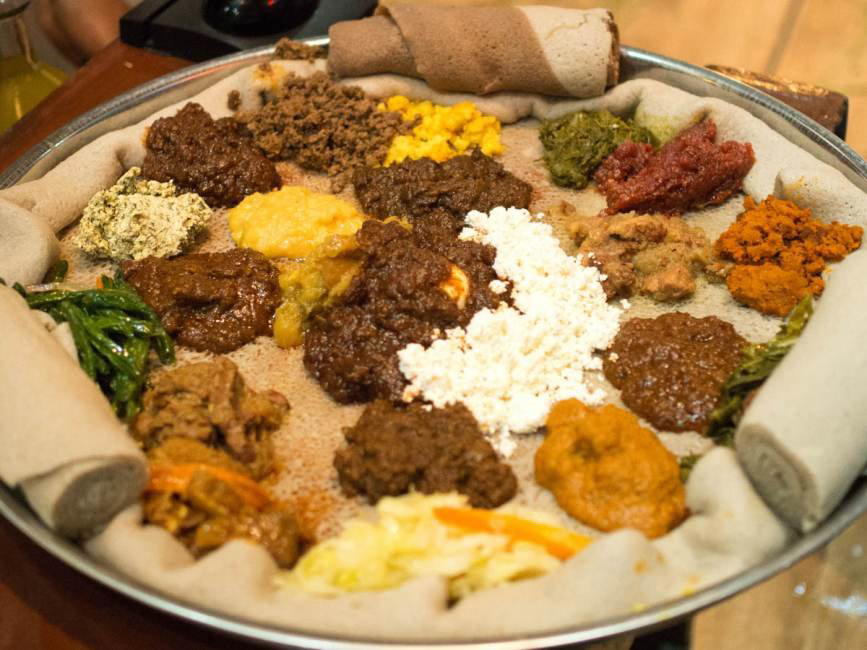
The menu
What to order
- Megenagna Special Kitfo
- Derek Tibs
Aurora's East African Table
Ethiopian restaurants rarely announce themselves loudly. The genre tends to operate through word of mouth within diaspora communities first, then gradually surface to a broader audience through reputation alone. Megenagna, at 306 S Ironton St in Aurora, fits that pattern. The address places it in a stretch of Aurora that has developed as one of the Denver metro's more concentrated corridors for immigrant-community dining, where places like Alice's Corner Bolivian Cuisine and La Machaca De Mi Ama operate alongside ramen counters and pan-Asian spots such as Mikaku Ramen & Temaki. This is not a dining district built around any single cuisine or aesthetic program. It is a practical, community-facing strip, and Megenagna belongs to it authentically.
The name itself carries weight. Megenagna is a major intersection in Addis Ababa, a roundabout that functions as both a geographic and social reference point in the Ethiopian capital. Naming a restaurant after a specific Addis neighborhood landmark rather than a generic Ethiopian word or phrase is a deliberate signal: the kitchen is not positioning itself as an introduction to Ethiopian food for the uninitiated. It is speaking to people who already know the reference.
The Cuisine and What It Represents
Ethiopian cooking is one of the few culinary traditions that has maintained structural continuity across its diaspora. The injera-and-sharing format, the spice logic of berbere and mitmita, the fasting-day distinctions between meat-based and vegan preparations, the communal plate rather than individual portions, these are not just aesthetic choices. They reflect a specific culture of eating in which the table is a social contract, not just a transaction. In the United States, Ethiopian restaurants have historically concentrated in Washington D.C. which hosts the largest Ethiopian diaspora population in the country, along with strong secondary clusters in Minneapolis, Los Angeles, and the Denver-Aurora metro.
Colorado's Ethiopian dining scene is smaller than those coastal concentrations but has been present long enough to have its own internal variation. Aurora, with its significant East African population, has been a center of that activity. Within the city's broader dining mix, which runs from the more dressed-up operators you'd find in comparable urban-adjacent metro corridors to casual community spots like Tasty Chef and The Cabin, Megenagna occupies the East African niche without much direct competition at its immediate address.
The injera itself is the clearest differentiator between Ethiopian restaurants operating as cultural institutions and those that have softened the format for broader palatability. Injera fermented correctly has a pronounced sourness and a slight sponginess that functions both as plate and as eating utensil. When a kitchen gets that right, the rest of the meal has a foundation. When it doesn't, the whole meal shifts toward approximation. Restaurants with strong diaspora customer bases tend to maintain that standard because their regulars know what the benchmark is.
Where Megenagna Sits in the Broader Dining Context
To be clear about what Megenagna is not: it does not operate in the same tier as the Michelin-tracked, formally plated American restaurants featured elsewhere in EP Club's coverage. Le Bernardin in New York City, Alinea in Chicago, The French Laundry in Napa, or Lazy Bear in San Francisco operate in an entirely different framework of formality, price, and tasting-menu structure. The same applies to farm-to-table destinations like Blue Hill at Stone Barns in Tarrytown and Single Thread Farm in Healdsburg, or the Korean fine-dining precision of Atomix in New York City.
But that comparison is itself the point. The EP Club remit covers the full spectrum of meaningful dining, from destination tasting counters like Providence in Los Angeles and Addison in San Diego to community-anchored neighborhood operators that serve a specific cultural function in their cities. The Inn at Little Washington in Washington and 8 1/2 Otto e Mezzo Bombana in Hong Kong make the case for destination dining at one end. Megenagna makes a different case: that Aurora's East African community has produced a restaurant with genuine cultural grounding at a price point and in a format that the neighborhood actually uses. That is a different kind of value, but it is a documented kind. See our full Aurora restaurants guide for how Megenagna fits within the city's wider dining patterns alongside Bolivian, Mexican, Japanese, and pan-Asian operators.
For comparison, Emeril's in New Orleans built its reputation partly by formalizing a regional cuisine that already had deep community roots. The tension between accessibility and formalization is one Ethiopian restaurants across the U.S. manage constantly. Megenagna, based on its address and community positioning in Aurora, appears to resolve that tension in favor of community access.
Planning a Visit
Megenagna is located at 306 S Ironton St, Unit C, Aurora, CO 80012. The Unit C designation places it in a multi-tenant commercial building, which is typical of the corridor's format. Price range and booking requirements are similarly unconfirmed, but Ethiopian restaurants in comparable community-facing positions across the Denver metro typically operate at accessible price points without advance reservations, accepting walk-ins during service hours.
Parking in this section of South Ironton is generally available at street level or in shared commercial lots. The corridor is not heavily pedestrian in character, so driving or rideshare is the practical approach from most of the metro. For visitors coming specifically to explore Aurora's immigrant-community dining in a single trip, combining Megenagna with nearby addresses across Bolivian, Mexican, and pan-Asian cuisines makes geographic sense given the concentration of those operators along the same stretch.
Frequently asked questions
Is Megenagna okay with children?
Ethiopian dining in the injera-and-sharing format is structurally family-friendly, food arrives at the center of the table and everyone eats together, which suits younger diners well. Megenagna's address in a multi-tenant commercial building on S Ironton St in Aurora suggests a relaxed, neighborhood-oriented setting rather than a formal dining room. Nothing in the venue's profile indicates any age restriction or adults-only policy.
Is Megenagna formal or casual?
Ethiopian restaurants operating within diaspora communities in cities like Aurora typically run casual, with the focus on the food and the communal format rather than dress codes or white-tablecloth service. Megenagna's location in a commercial unit on S Ironton St reinforces that positioning. Come comfortable, the format here is built around shared plates and conversation, not ceremony.
Does Megenagna serve vegetarian or vegan options suitable for dietary restrictions?
Ethiopian cuisine is one of the few culinary traditions with a deep, structurally built-in vegetarian repertoire, rooted in Orthodox Christian fasting practices that prohibit animal products on roughly 200 days of the year. This means vegetable-only dishes are not afterthoughts but central preparations with their own techniques and spice logic.
What's the must-try dish at Megenagna?
What can be said with confidence is that Ethiopian restaurants in this tradition anchor their offering around injera, the sourdough flatbread that functions as both plate and utensil, served with a spread of stews and vegetable preparations. First-time visitors to this cuisine would do well to order a combination platter, which is the standard vehicle for exploring the full range.
Budget Reality Check
Comparable venues nearby, for context on price, style, and recognition.
| Venue | Cuisine | Price | Awards | Notes |
|---|---|---|---|---|
| MegenagnaThis venue (the venue you are viewing) | Authentic Ethiopian | $20–30 | Not listed | Not listed |
| Yo Mommas Cantina | Mexican Fusion Taqueria | $20–30 | Not listed | Highpoint, Mexican Fusion Taqueria |
| Mikaku Ramen & Temaki | Japanese Ramen & Temaki | $20–30 | Not listed | Not listed |
| Traveling Mercies | Seafood Raw Bar & Cocktails | Not listed | James Beard Award Semi Finalist | Stanley Marketplace, Seafood Raw Bar & Cocktails |
| La Machaca De Mi Ama | Authentic Mexican Machaca | $10–20 | Not listed | Aurora, Authentic Mexican Machaca |
| Tofu House | Korean Tofu House & BBQ | $20–30 | Not listed | Koreatown, Korean Tofu House & BBQ |
Continue exploring
More in Aurora
Restaurants in Aurora
All restaurants in Aurora →
Bars in Aurora
All bars in Aurora →

Details
- Cozy
- Rustic
- Group Dining
- Casual Hangout
- Historic Building
- Family Style
- Vegetarian Friendly
Current opening hours
- Monday
- 9 AM–8 PM
- Tuesday
- 9 AM–8 PM
- Wednesday
- 9 AM–8 PM
- Thursday
- 9 AM–8 PM
- Friday
- 9 AM–8 PM
- Saturday
- 9 AM–8 PM
- Sunday
- 9 AM–8 PM
Hours can change for holidays and private events. Hours as of .
Thatched table covers, aromatic coffee and spices, warm welcoming atmosphere with desirable decor.