Michelin Plate
Our verdict
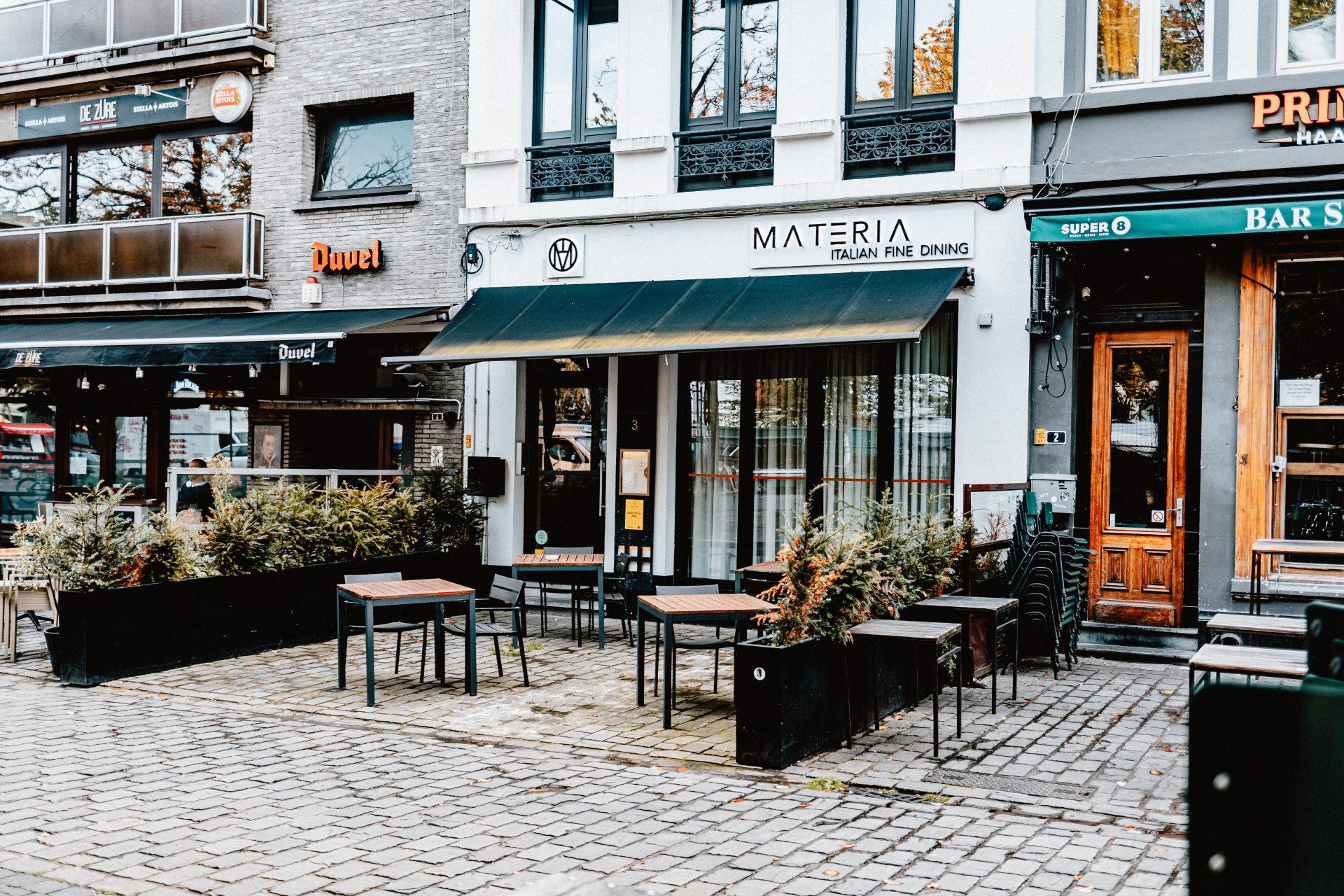
On Dageraadplaats, one of Antwerp's most characterful squares, Materia positions itself within the city's growing wave of ingredient-led, ecologically conscious dining. The name signals intent: the kitchen's relationship with raw material is the point of departure for everything on the plate. For those tracking where serious Antwerp cooking is heading, Materia is a practical reference point.

Pearl is the En Primeur Club membership app, where members save venues, book tables and use the concierge.
The menu
What to order
- Granchio burro nocciola carote
- Tarbot Franciacorta
- Kwartel mela cotogna pure chocolade
Dageraadplaats and the Shift Toward Material Honesty
Dageraadplaats sits in the Zurenborg district, one of the few corners of Antwerp where the neighbourhood still belongs to locals. The square draws a morning market crowd, a late-afternoon terrace culture, and an evening restaurant scene that operates at a remove from the tourist circuits around Grote Markt. It is precisely the kind of address where a kitchen committed to ethical sourcing and ingredient transparency finds its footing: the surrounding food culture already values provenance, and the clientele tends to engage with what they're eating rather than simply consuming it.
Materia, at Dageraadplaats 3, is part of a broader shift visible across serious Belgian cooking over the past decade. Where the previous generation of ambitious Flemish kitchens built identity around technical elaboration, intricate reductions, luxury proteins, classical architecture on the plate, a newer wave has reoriented around the question of what the ingredient actually is, where it came from, and what the kitchen owes it. This is not a philosophical flourish. It is a structural change in how menus are conceived, how supplier relationships are managed, and how waste is treated as a measure of culinary seriousness rather than an operational afterthought.
The Sustainability Turn in Flemish Fine Dining
Belgium's high-end dining circuit has been wrestling with ecological accountability in a way that has produced genuinely different approaches across the country. At one end, kitchens like Willem Hiele in Oudenburg have built entire identities around coastal foraging and hyper-local sourcing that reads as both environmental stance and culinary programme. At another, estates like Hof van Cleve in Kruishoutem operate within a agricultural context that makes farm-to-table less a marketing position and more a logistical reality. Boury in Roeselare and Bartholomeus in Heist each reflect local geography in ways that impose a natural discipline on sourcing.
What connects these kitchens is not a shared aesthetic but a shared accountability to material. The name Materia positions the Antwerp address squarely within that conversation. In a city where Zilte anchors the creative fine-dining end of the market and Hertog Jan at Botanic brings a Modern Flemish sensibility to a botanical setting, Materia's apparent emphasis on ingredient primacy gives it a distinct positioning rather than placing it in direct competition with either.
Across Belgium, the restaurants taking ecological sourcing most seriously tend to operate with shorter menus, seasonal cadences that shift more frequently than their classical counterparts, and supplier lists that function as part of the venue's identity. L'air du temps in Liernu represents perhaps the most developed version of this in Wallonia, where the kitchen's garden provides a structural backbone for the entire menu. Castor in Beveren and De Jonkman in Sint-Kruis each demonstrate how Flemish kitchens can build coherent seasonal programmes without defaulting to the Scandinavian template that dominated the conversation for much of the 2010s.
Antwerp's Ingredient-Led Dining Tier
Within Antwerp specifically, the dining market has stratified in ways that make ingredient-led kitchens legible as a category. The city's classical benchmark, 't Fornuis, operates in a register of European-Flemish classicism where product quality has always been the argument. The newer generation, represented across addresses from the Zurenborg to the Eilandje, tends to make that argument more explicitly: sourcing credentials appear on menus, supplier names are cited, and waste reduction is treated as a signal of kitchen discipline rather than a concession to fashion.
This matters for how a venue like Materia should be read. It is not an isolated gesture toward sustainability; it reflects a citywide recalibration of what serious cooking is expected to look like. The same pressure is visible in Bistrot du Nord's approach to traditional French material and in DIM Dining's Japanese sourcing discipline, where the procurement logic is as considered as the technique applied to it.
For context beyond the city, the Belgian model of ethical sourcing connects to a wider European conversation. Kitchens like Bozar Restaurant in Brussels have demonstrated how ingredient-led programmes can operate at scale in institutional settings, while internationally, the sourcing rigour at addresses like Le Bernardin in New York City shows how material-first thinking translates across different culinary traditions. Atomix, also in New York, applies a similar accountability to Korean ingredients and their provenance.
Planning a Visit to Materia
Materia sits at Dageraadplaats 3 in the 2018 postal zone, placing it in the Zurenborg quarter and within direct reach of Antwerp-Berchem station. The square itself is a practical landmark: the Saturday market brings a density of food producers and foragers that reinforces the neighbourhood's relationship with seasonal supply, making the walk to the restaurant a useful orientation. For those arriving by tram, lines serving Dageraadplaats from the city centre run frequently throughout the day and evening. Given the limited published booking and operational data available at time of writing, visiting the restaurant directly or checking current contact information locally is advisable before making specific plans around opening hours or reservation requirements.
For a broader sense of where Materia sits within the city's dining offer, the full Antwerp restaurants guide maps the competitive field across cuisine types, price tiers, and neighbourhood clusters. Those also tracking Belgium's wider ethical-sourcing movement will find useful reference points in addresses including La Durée in Izegem and d'Eugénie à Emilie in Baudour, both of which operate with sourcing philosophies that parallel the direction Materia's name implies.
Frequently asked questions
What part of town is Materia in?
Materia is located at Dageraadplaats 3, 2018 Antwerpen, Belgium, Antwerp.
Is Materia in Antwerp suitable for a vegetable-focused or plant-forward meal?
Materia's placement in Antwerp's ingredient-led dining tier, centred on Dageraadplaats in Zurenborg, suggests a kitchen attentive to primary produce rather than protein-anchored menus. Belgium's sustainability-oriented fine dining shift has produced a number of kitchens where vegetables and fermented or foraged components take structural roles in the menu rather than supporting ones. Confirming the current menu direction directly with the restaurant is advisable before visiting.
What's the signature dish at Materia?
The restaurant's address in Zurenborg, one of Antwerp's more locally rooted neighbourhoods, aligns with an approach that prioritises what's available over what's repeatable. Expect the menu to shift accordingly.
Should I book Materia in advance?
Materia occupies Dageraadplaats 3 in Antwerp's Zurenborg quarter, a square with genuine neighbourhood footfall rather than tourist traffic, which tends to mean tables fill through local repeat custom rather than online hype. No public booking window is documented, but ingredient-led restaurants at this address tier in Antwerp typically warrant a reservation several days to a week ahead, particularly for weekend service.
What's the standout thing about Materia?
The positioning within Dageraadplaats is itself a signal: Zurenborg has resisted the commercial drift that has reshaped much of central Antwerp, and restaurants that open here tend to be oriented toward the neighbourhood rather than the city's broader dining circuit. Within Belgium's current sustainability-conscious dining conversation, Materia represents the Antwerp iteration of a kitchen philosophy that foregrounds raw material over technique showmanship.
How does Materia handle allergies?
No allergy policy is published in available venue records for Materia. As with most ingredient-led kitchens where menus shift with supply, the most reliable approach is to check the venue's official channels before booking to confirm what accommodations are possible for a given service date.
Cuisine and Credentials
Comparable venues nearby, for context on price, style, and recognition.
| Venue | Cuisine | Price | Awards | Notes |
|---|---|---|---|---|
| MateriaThis venue (the venue you are viewing) | Modern Italian Fine Dining | $100–150 | Michelin Plate | Not listed |
| ARTE | Modern Italian with Sardinian Influences | $30–50 | Not listed | Historic Center |
| Four | Modern Italian-American | $50–100 | Not listed | Antwerp |
| ArriKiiati | Sicilian Seasonal Bistro | $50–100 | Not listed | Schipperskwartier |
| Danieli Il Divino | Italian Fine Dining | $50–100 | Star Wine List · Wine Spectator Best of Award of Excellence | Park den Brandt |
| Matty | Modern French-Belgian Fine Dining | $50–100 | Not listed | Zuidkwartier |
Recognition history
Dated appearances from independent guides and award organizations, with the underlying list record or original source where available.
Michelin Plate
Michelin