
Kurume’s ramen culture is built on tonkotsu, roadside utility, and bowls priced for regular use rather than ceremony. Maruboshi Ramen belongs to that older register: a Route 3 institution linked to classic pork-bone ramen, oden, counter seating, take-out, and repeated Tabelog Ramen WEST “Tabelog 100” selections from 2023 to 2025.
Pearl is the En Primeur Club membership app — saves, bookings, and concierge access live there. Same editors, same standards.
- Address
- 2 Chome-7-27 Takano, Kurume, Fukuoka 830-0002, Japan
- Phone
- +81 942-33-6440
- Website
- instagram.com
- Directions
- Get directions
 Saves & bookings on Pearl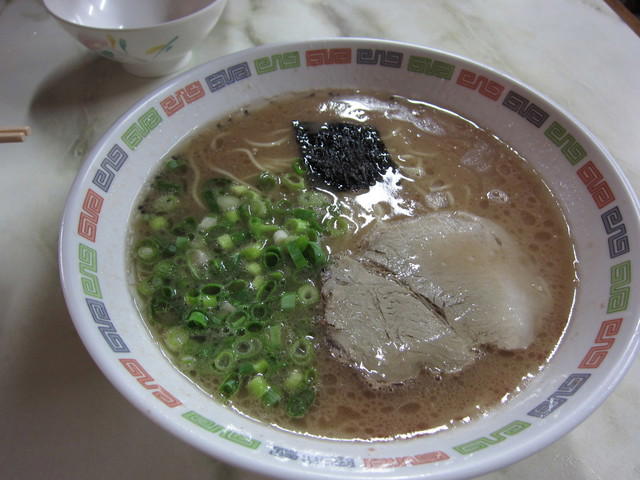
Approaching a Kurume ramen shop on National Route 3 means entering a food culture shaped as much by traffic as by appetite. The city’s tonkotsu tradition did not grow out of tasting-menu logic; it grew around steam, speed, pork bones, and the needs of workers, drivers, families, and solo diners who wanted a bowl without ceremony. Maruboshi Ramen sits inside that older grammar, where the point is not refinement for its own sake but continuity: a classic pork-bone style served in a room built for turnover, counter eating, and repeat local use.
Kurume matters in Japanese ramen history because tonkotsu here reads differently from the polished Hakata style many travellers know first. The local version is tied to longer simmering, deeper pork-bone identity, and a less decorative idea of ramen as everyday infrastructure. That distinction is why a low-priced bowl in Kurume can carry more cultural weight than a technically elaborate ramen counter elsewhere. The sourcing story is not about rare produce or luxury ingredients; it is about the sustained centrality of pork bone broth in a city where the base ingredient defines the category.
Kurume tonkotsu as roadside food, not dining theatre
Maruboshi Ramen’s public identity is unusually direct: ramen and oden, classic tonkotsu, a house-restaurant setting, and a long-running association with truck drivers moving along Route 3. That combination explains the room better than any soft-focus description could. The format favours function. Counter seating, take-out, non-smoking service, and a broad family-and-solo appeal place it in the working ramen tradition rather than the boutique ramen tier that now dominates parts of Tokyo, Osaka, and Fukuoka city.
The Tabelog Ramen WEST “Tabelog 100” selections in 2023, 2024, and 2025 give the shop a useful credential without changing what kind of place this is. Recognition in that list puts Maruboshi Ramen into a regional conversation about ramen merit across western Japan, but the restaurant’s appeal remains grounded in a narrow proposition: classic tonkotsu at everyday pricing. In Kurume, that matters. A bowl under the JPY 999 bracket is not an entry-level compromise; it is part of the city’s food logic, where ramen has to remain accessible enough to be eaten as habit.
Ingredient sourcing, in this context, should be read through broth rather than boutique provenance. Tonkotsu is a cuisine of extraction: bones, heat, time, and repetition. Kurume’s contribution to the ramen canon is the insistence that pork bone is not merely a base but the defining structure of the meal. The presence of oden alongside ramen also speaks to a practical, old-school Japanese counter rhythm, where simmered items can sit within a quick-service meal without turning the experience into a multi-course format.
How it fits into Kurume's everyday restaurant map
Kurume’s dining scene is compact enough that category choices become meaningful. A traveller can read the city through casual formats: ramen, gyoza, izakaya-style stands, and small neighbourhood counters. For a broader view, Our full Kurume restaurants guide is the useful starting point, while the city’s non-restaurant planning sits separately in Our full Kurume hotels guide, Our full Kurume bars guide, Our full Kurume wineries guide, and Our full Kurume experiences guide.
Within that restaurant map, price and purpose separate the meal types. Goju Ban and Mitsuya Stand sit in a higher casual bracket at JPY 1,000 to JPY 1,999, while Hitokuchi Gyoza Tenya moves into a fuller evening-spend band at JPY 3,000 to JPY 3,999. Against those reference points, the restaurant occupies the stripped-down end of the spectrum: ramen first, low spend, fast rhythm, broad usability. Readers comparing local options can also look at Goju Ban, Mitsuya Stand, Hitokuchi Gyoza Tenya, Gyoza Nyannyan, and Dharmasagara for different versions of casual dining in the city.
The smarter editorial read is not to treat the ramen shop as a destination detached from its setting. It is better understood as a benchmark for Kurume’s low-cost tonkotsu culture: a place whose repeated recognition confirms the durability of an old format rather than a place chasing novelty. Travellers who build a day around regional food should see it as the pork-bone anchor, then use gyoza counters, stands, and other casual rooms to understand how Kurume eats when the meal is not ramen.
Planning the meal around pace, payment, and appetite
The practical character is part of the critical assessment. Reservations are unavailable, private rooms are unavailable, and the seating count is listed at 50, so this is a walk-in, shared-room proposition rather than a controlled dining appointment. Payment is cash-oriented: credit cards, electronic money, and QR code payments are not accepted. The transportation notes are similarly workaday, with Miyanojin Station listed as the nearest station and parking available, including space associated with large trucks. Those details are not footnotes; they explain the restaurant’s place in the city’s ramen ecology.
For travellers moving through Japan beyond Fukuoka, the contrast with other casual formats is useful. A rice-ball specialist such as Onigiri Time in Pasadena, a sake-led room like Jōdo Saké Bar in Los Angeles, or a specialist curry shop such as [Curry Senmon Ten] Maruyama Kyoju. in Sapporo each shows how a narrow category can become a full meal identity. In Japan, similar specificity appears across formats, from -Grilled beef Sukiyaki- KAMAKURA TANUKIAN 鎌倉 たぬき庵 in Kamakura to. 鮪と炭火焼き うお炭 秋葉原店 in Tokyo.cafe in Osaka.know in Kumamoto, and (Shoku) Vietnam in Kawasaki.
The verdict is simple: the restaurant is for readers who want Kurume tonkotsu in its utilitarian form, not a polished reinterpretation. Its value lies in the alignment between city, broth tradition, price band, and operating style. The repeated Tabelog Ramen WEST “Tabelog 100” selections add external validation, but the stronger reason to care is more fundamental: Kurume’s ramen culture is still legible here as food built for regular life.
At-a-Glance Comparison
Comparable venues by cuisine and price in the same metro.
| Venue | Cuisine | Price | Notes |
|---|---|---|---|
| Maruboshi Ramen | Kurume-style tonkotsu ramen | $ | / Kurume |
| Mitsuya Stand | Japanese tachinomi standing bar | $ | Higashimachi, Kurume |
| Tachibana Udon | Traditional Kurume udon shop | $ | Higashi Aikawa / near Kurume Interchange |
| Gyoza Nyannyan | Traditional Japanese gyoza shop | $ | Mutsumonmachi |
| Goju Ban | Classic gyoza & dumpling house | $ | Higashimachi |
| Dharmasagara | Authentic South Indian Restaurant | $$ | Tanushimaru-machi |
Recognition history
Dated appearances from independent guides and award organizations, with the underlying list record or original source where available.
Tabelog 100 #90 · No. 90
Tabelog · Tabelog 100 - Ramen - WEST - 2025
At a Glance
- Lively
- Classic
- Cozy
- Solo
- Casual Hangout
- After Work
- Late Night
- Family
- Group Dining
- Standalone
- Beer Program
Current opening hours
- Monday
- 9 AM–9 PM
- Tuesday
- 9 AM–9 PM
- Wednesday
- 9 AM–9 PM
- Thursday
- 9 AM–9 PM
- Friday
- 9 AM–9 PM
- Saturday
- 8 AM–9 PM
- Sunday
- 8 AM–9 PM
Hours can change for holidays and private events. Last verified .