Marrakech Moroccan Restaurant
On a block of the Tenderloin where San Francisco's immigrant food traditions run deep, Marrakech Moroccan Restaurant at 419 O'Farrell Street brings North African dining to a city more accustomed to omakase counters and farm-to-table tasting menus. The restaurant occupies a distinct tier in the local dining map, offering a cuisine largely absent from the premium end of the San Francisco market and drawing regulars who treat it as a reliable counterpoint to the city's California-centric dining orthodoxy.
Pearl is the En Primeur Club membership app — saves, bookings, and concierge access live there. Same editors, same standards.
- Address
- 419 O'Farrell St, San Francisco, CA 94102
- Phone
- +14157766717
- Website
- marrakechsf.com
- Directions
- Get directions
 Saves & bookings on Pearl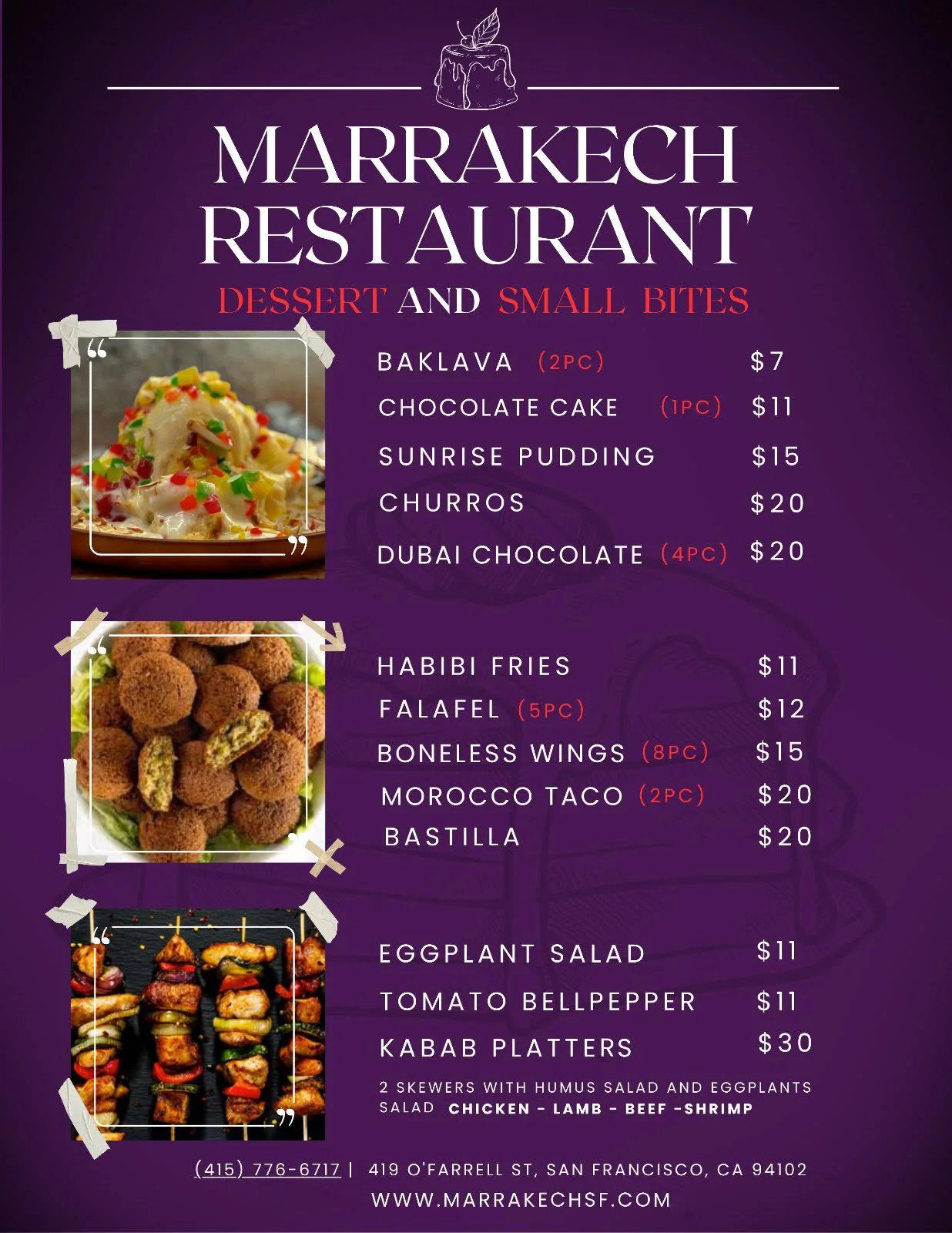
Where North African Tradition Meets the San Francisco Dining Map
San Francisco's premium dining tier is dense with Michelin-decorated tasting menus. Marrakech Moroccan Restaurant is a traditional Moroccan restaurant at 419 O'Farrell St in San Francisco, priced at about $35 per person. Lazy Bear, Atelier Crenn, Benu, Quince, and Saison collectively define the city's leading bracket, each working within a broadly European or Californian tradition. Moroccan cooking occupies a different corner of the market entirely, and that separation is part of what makes Marrakech Moroccan Restaurant at 419 O'Farrell Street worth understanding on its own terms. The cuisine it represents, built around slow-braised tagines, layered spice blends, and the communal logic of shared plates, belongs to a culinary tradition with no meaningful equivalent in the city's fine-dining mainstream.
The address places it in the Tenderloin, a neighbourhood that functions less as a dining destination and more as a working-class residential grid where immigrant-run restaurants have historically operated outside the attention of the city's food press. That context matters. Moroccan restaurants in American cities tend to concentrate in these kinds of districts, where rent structures allow the long hours and high labour of traditional preparation to remain economically viable. What the neighbourhood lacks in foot traffic from the Marina or the Financial District, it compensates for with the kind of regularity that sustains a dining room across years rather than seasons.
The Logic of Moroccan Service and Why It Travels Well
Moroccan restaurant culture, even in its exported form, carries a distinctive service philosophy. The meal is designed to move slowly. Bread arrives early. Appetisers are shared. A tagine or bastilla is a main event that rewards patience rather than pace. In cities where dining rooms are optimised for table turns and minimal dwell time, a Moroccan format creates a different kind of evening, one structured around conversation and accumulation rather than the sequenced reveal of a tasting menu.
That dynamic puts the front-of-house team in an unusual position. The service rhythm needs to match the food's natural tempo, which means staff judgment about pacing, about when to bring the next course, about how to read a table's appetite, carries more weight than in formats where the kitchen controls sequencing entirely. When service and kitchen operate in alignment at a Moroccan restaurant, the experience feels generous and unhurried. When that alignment breaks, courses arrive in the wrong order or bread runs out before the tagine lands, the whole structure suffers. It is a format that rewards a coherent team dynamic over individual performance.
San Francisco and the Broader Context of North African Dining in American Cities
Across the United States, Moroccan restaurants have occupied a curious position: beloved by regulars, rarely discussed in the critical press, and consistently underrepresented at the awards level. Cities with strong North African immigrant communities, New York, Chicago, Los Angeles, have Moroccan dining options that range from neighbourhood staples to more ambitious modern interpretations, but the cuisine has never developed the institutional critical apparatus that has followed Japanese or French traditions. Le Bernardin in New York City and Alinea in Chicago anchor their respective cities' fine-dining conversations; Moroccan restaurants in those same cities rarely enter that frame at all.
That absence is not a comment on quality. It reflects how American food criticism has historically oriented itself toward Western European lineages and, more recently, toward East and Southeast Asian traditions gaining mainstream recognition. North African cooking, with its Berber, Arab, and Andalusian layers, has not yet been taken seriously in the way that, say, the kaiseki tradition has been taken seriously on the coasts. Atomix in New York City and 8½ Otto e Mezzo Bombana in Hong Kong demonstrate what happens when cuisines from outside the French-American mainstream receive sustained critical attention. Moroccan cooking is still waiting for that moment at the upper end of the American market.
How Marrakech Moroccan Restaurant Sits in the City
Within San Francisco's dining map, the restaurant addresses a segment of demand that the city's headline restaurants do not touch. While properties like Single Thread Farm in Healdsburg and The French Laundry in Napa operate at the extreme upper end of the Bay Area's experiential dining tier, and while Southern California's Providence in Los Angeles and Addison in San Diego define that region's upper-tier offering, O'Farrell Street represents something categorically different: a neighbourhood restaurant where the cuisine itself is the primary draw, not the format, not the awards, not the tasting menu architecture.
That positioning comes with its own kind of appeal. Diners who want a long, slow evening built around sharing dishes, who are interested in Moroccan spice traditions and the particular comfort of a slow-cooked braise, are unlikely to find a comparable option anywhere within a few blocks. The nearest culinary competitors, in cuisine type rather than geography, would likely be across the Bay or in the Mission's broader immigrant food corridor. Regionally, restaurants like Bacchanalia in Atlanta, Emeril's in New Orleans, Blue Hill at Stone Barns in Tarrytown, and The Inn at Little Washington each occupy distinct niches in their cities, but none address the specific gap that a Moroccan dining room fills in a market dominated by European-lineage and Californian formats.
Know Before You Go
| Address | 419 O'Farrell St, San Francisco, CA 94102 |
| Neighbourhood | Tenderloin |
| Cuisine | Moroccan |
| Phone | Not listed in the record |
| Website | Not listed in the record |
| Hours | Confirm directly with the restaurant before visiting |
| Price Range | About $35 per person |
| Reservations | Reservations are recommended |
Cuisine-First Comparison
Comparable venues nearby, for context on price, style, and recognition.
| Venue | Cuisine | Price | Notes |
|---|---|---|---|
| Marrakech Moroccan RestaurantThis venue — the venue you are viewing | Traditional Moroccan | $$ | Not listed |
| Beit Rima | Palestinian & Jordanian Comfort Food | $$ | Castro/Upper Market |
| Savor Cafe | Modern Arabic Vegetarian | $$ | Inner Sunset |
| Se7enbuds | Afghan & Persian | $$ | Nob Hill |
| Frenchie Wine Bar | Dining | Not listed | San Francisco |
| 'āina | Modern Hawaiian | $$ | Dogpatch |
Continue exploring
More in San Francisco
Restaurants in San Francisco
Browse all →
Bars in San Francisco
Browse all →
Hotels in San Francisco
Browse all →
At a Glance
- Cozy
- Intimate
- Romantic
- Date Night
- Special Occasion
- Live Music
Current opening hours
- Monday
- Closed
- Tuesday
- Closed
- Wednesday
- Closed
- Thursday
- 5 PM–12 AM
- Friday
- 5 PM–2 AM
- Saturday
- 5 PM–2 AM
- Sunday
- 5 PM–12 AM
Hours can change for holidays and private events. Last verified .
Cozy atmosphere with low couches, ornate pillows, and tapestries covering walls and ceilings creating comfort and leisure.