Our verdict
Ranked among Europe's top cheap eats by Opinionated About Dining in both 2024 and 2025, Manteigaria on Rua do Loreto is Lisbon's reference point for the pastel de nata. Open daily from 8am to midnight, it operates in the tight-margin, high-craft tradition of the city's serious pastry counters, where Portuguese egg custard tart production is treated as a discipline rather than a convenience.

Pearl is the En Primeur Club membership app, where members save venues, book tables and use the concierge.
The Counter, the Queue, and the Custard
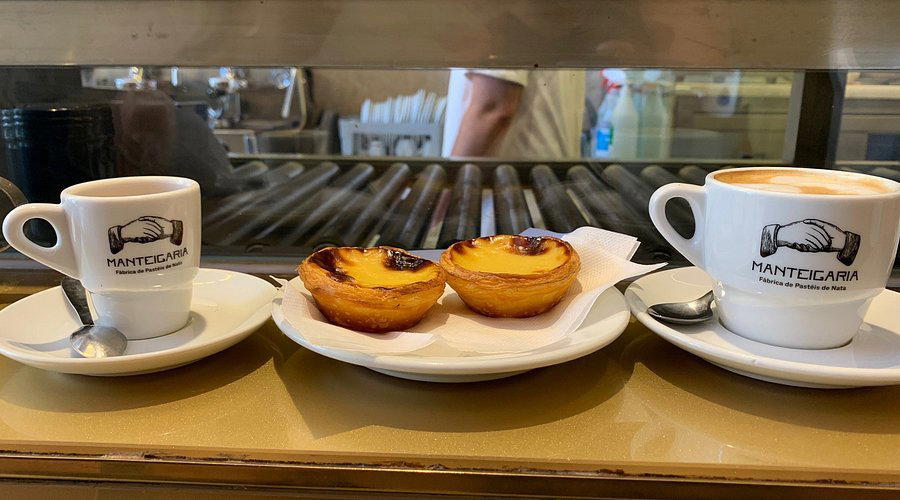
On Rua do Loreto, just below the Chiado, a warm, faintly caramelised smell meets you before you reach the door. Inside Manteigaria, the production is visible through a glass partition: a rotating cast of bakers working at pace, filling fluted tins with custard, loading trays into high-heat ovens, pulling finished natas to cool on racks. This is not theatre for visitors. It is a working pastry operation, and the fact that you can watch it is incidental to the fact that it never stops.
That visibility matters for a reason that goes beyond charm. Lisbon's pastel de nata culture has always been shaped by the tension between tradition and reproduction. The original recipe, attributed to the monks of Mosteiro dos Jerónimos in Belém, has been widely replicated across the city and, by extension, much of the world. What separates the serious counters from the tourist-facing copies is not secrecy but execution: oven temperature, custard ratio, lamination quality, and the pace at which a finished nata is consumed relative to when it left the heat.
A Tart With an Argument Behind It
The pastel de nata is one of the few cases in European pastry where a single product carries the full weight of a national culinary identity. Portugal's relationship with egg yolks, sugar, and puff pastry runs deep, rooted in centuries of convent cooking in which egg whites were used to starch ecclesiastical clothing, leaving large quantities of yolks to be incorporated into sweets. The nata emerged from that tradition, refined through the nineteenth century and standardised, loosely, into the form recognised today: a short, fluted pastry shell filled with a baked egg custard that chars slightly at the surface under intense direct heat.
The technique is not complicated in principle. It is difficult in practice. The custard must set without curdling, the base must remain crisp rather than soggy, and the char must read as caramelisation, not burn. Achieving this consistently across thousands of units daily, Manteigaria's output is high, in line with a serious counter operation, requires process discipline that places it closer to a production kitchen than a neighbourhood bakery.
That distinction is reflected in how the Opinionated About Dining Cheap Eats in Europe list has assessed it: ranked 14th in 2024 and 12th in 2025, it has moved in the right direction within a list that covers the full breadth of affordable eating across the continent. For a single-product counter operating on low unit prices, this kind of recognition signals that the product itself is being evaluated at the level of craft, not category.
Where It Fits in Lisbon's Eating Hierarchy
Lisbon's dining scene covers a wide range, from the kind of tasting-menu operations that occupy the same register as Belcanto or CURA at one end, to standing pastry counters at the other. The city also has 50 Seconds from Martin Berasategui, Eleven, and 2Monkeys for those moving through the premium tier. Manteigaria operates in an entirely different register, but the seriousness applied to the product is not different in kind from what drives quality at those higher price points.
This matters because Lisbon's most credible food culture has always been expressed in its simpler formats as much as its fine dining rooms. The nata counter, the tasca, the wine bar: these are the forms through which the city has historically communicated its culinary values, and they sit alongside the tasting-menu restaurants without hierarchy in terms of intent. Portugal's broader restaurant scene, from Vila Joya in Albufeira to Antiqvvm in Porto and Casa de Chá da Boa Nova in Leça da Palmeira, shares an underlying commitment to Portuguese product and technique. Manteigaria's particular form of that commitment is compressed into a single pastry.
For context beyond Portugal, Il Gallo d'Oro in Funchal, The Yeatman in Vila Nova de Gaia, and Ocean in Porches represent the formal end of Portuguese gastronomy across the country's distinct regions. Manteigaria represents its most distilled, democratic form in the capital.
The Technique Behind the Product
The editorial angle that makes Manteigaria interesting beyond its address is the question of method. The pastel de nata is a product formed by local ingredients processed through a technique that developed within Portuguese convent kitchens, but which shares structural logic with French pâtisserie, particularly in its laminated pastry base, where the folding of fat into dough creates the layered, slightly crisp shell that characterises a well-made nata. This is not borrowed technique; it developed in parallel and in response to the same European pastry traditions that shaped croissant lamination and Portuguese egg custard production simultaneously from different starting points.
What Manteigaria's operation illustrates is how that technique stabilises into a craft standard when applied at volume with rigorous consistency. High-heat baking, the specific hydration of the custard filling, and the geometry of the fluted tin are all calibrated variables, not inherited accidents. The OAD recognition, advancing year-on-year, suggests the calibration is holding.
Planning a Visit
Manteigaria sits at Rua do Loreto 2 in Lisbon's Chiado district, accessible on foot from the Baixa or via the Largo do Chiado tram stop. It operates daily from 8am to midnight, which means it covers breakfast, post-lunch, late afternoon, and the stretch after dinner when most of the city's serious restaurants have closed. For visitors working through Lisbon's higher-end dining options, it functions as both a morning opening and a late-night close: a nata with a small coffee before a tasting menu is a reasonable use of the schedule, and a nata after midnight is an equally reasonable ending.
The format requires no reservation and no significant time commitment. Ordering is done at the counter, the product is consumed standing or at a small shelf, and the experience runs to minutes.
For further reading on eating and drinking in the city, EP Club's guides cover Lisbon restaurants, Lisbon hotels, Lisbon bars, Lisbon wineries, and Lisbon experiences in full.
Frequently asked questions
Does Manteigaria have a Michelin star or similar recognition?
Manteigaria has received recognition including: Opinionated About Dining Cheap Eats in Europe Ranked #12 (2025); Opinionated About Dining Cheap Eats in Europe Ranked #14 (2024).
Who runs the kitchen at Manteigaria?
The chef associated with Manteigaria is Various.
What should I eat at Manteigaria?
The pastel de nata is the only option: Manteigaria operates as a single-product counter with no menu beyond the custard tart. That focus is precisely why it ranked #12 on Opinionated About Dining's Cheap Eats in Europe list for 2025, up from #14 in 2024. Order as many as you intend to eat on the spot, since the tarts are made to be consumed warm at the counter or just outside on Rua do Loreto.
What kind of cuisine does Manteigaria serve?
When is Manteigaria open?
Hours at Manteigaria: Hours: Monday 8 am–12 am Tuesday 8 am–12 am Wednesday 8 am–12 am Thursday 8 am–12 am Friday 8 am–12 am Saturday 8 am–12 am Sunday 8 am–12 am.
What part of town is Manteigaria in?
Manteigaria is located at Rua do Loreto 2, 1200-108 Lisboa, Portugal, Lisbon.
Cuisine-First Comparison
| Venue | Cuisine | Price | Awards | Notes |
|---|---|---|---|---|
| ManteigariaThis venue (the venue you are viewing) | Portuguese Custard Tarts | $1–10 | Not listed | Not listed |
| Belcanto | Contemporary Portuguese Fine Dining | $200–300 | 2 Michelin Stars · World's 50 Best #42 | Modern Portugese, Creative |
| 50 seconds from Martin Berasategui | Avant-Garde Spanish Fine Dining | $200–300 | 2 Michelin Stars · La Liste Top Restaurants | Progressive Spanish |
| Eleven | Sophisticated Modern Mediterranean | $150–200 | 1 Michelin Star · Falstaff Restaurant - 93 Falstaff Points | Portugese, Creative |
| Feitoria | Modern Portuguese Fine Dining | $50–100 | 1 Michelin Star · La Liste Top Restaurants | Modern Cuisine |
| Grenache | Contemporary French Fine Dining | $150–200 | 1 Michelin Star | French Contemporary |
Recognition history
Dated appearances from independent guides and award organizations, with the underlying list record or original source where available.
Opinionated About Dining Cheap Eats in Europe Ranked #32
Opinionated About Dining
Full recognition history (3 entries)
Opinionated About Dining Cheap Eats in Europe Ranked #12
Opinionated About Dining
Opinionated About Dining Cheap Eats in Europe Ranked #14
Opinionated About Dining