
Tabelog 100 #12
Our verdict
Goku Chasou brings Yokohama’s Chinatown cafe culture into sharper focus: tea-house pacing, pork-bun familiarity, and a menu that reads as a pause between street snacks and sit-down Chinese dining. Its Tabelog Cafe EAST “Tabelog 100” 2025 selection, 30-seat scale, and accessible lunch-and-dinner budgets place it in a useful middle tier for visitors mapping the city’s casual food circuits.

Pearl is the En Primeur Club membership app, where members save venues, book tables and use the concierge.
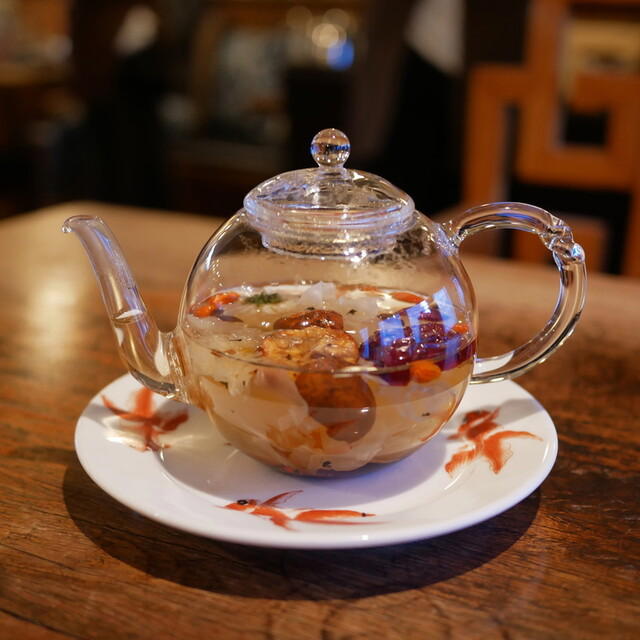
The menu
What to order
- Tofu soy milk tantanmen (とうにゅうたんたんめん)
- Cold green bean shiratama dessert (冷 緑豆白玉汁粉)
- Goku jasmine fruit tea with aiyu jelly (悟空 愛玉水果茉莉花茶)
- Dunhuang dessert (敦煌デザート)
- Lotus-wrapped sticky rice with Chinese sausage (腸詰入り蓮包おこわ)
Yokohama is often read through its larger dining rooms and take-away counters, but its quieter cafe layer tells a different story. Cafes can work as buffers: places to sit down without committing to a full multi-course meal, to order around a compact snack rather than a chef’s tasting sequence, and to let the city slow from sightseeing pace to neighbourhood rhythm. Goku Chasou belongs to that smaller category, where the room matters because the menu asks for time rather than speed.
The menu architecture is the point. In a city built on choice, a cafe-and-pork-bun format narrows the decision without flattening it. The useful distinction is not between casual and serious dining, but between two Yokohama modes: quick snack eating at one end, larger restaurant meals at the other. A cafe menu sits between them, making space for conversation and a snack-led meal that can stretch or contract depending on the day. That middle ground helps explain why the format remains so useful in Yokohama.
Tea-house pacing inside Yokohama's snack-and-meal corridor
Yokohama’s dining scene has long traded on range: larger restaurants, crowd-friendly menus, and everyday places that suit groups moving through the city. Cafes operate by a different logic. They use smaller decisions, repeatable orders, and a softer rhythm, which is why a pork bun can carry as much cultural weight as a larger meal in the right setting. At Goku Chasou, the public categories are simple, cafe and pork bun, but that simplicity is editorially useful. It signals a venue built around a narrower appetite: warm snacks, light eating, and a pause in a dense city.
The Tabelog Hyakumeiten 2025 recognition gives the address a clear trust signal in a category where international travellers can struggle to separate serious local favourites from passing traffic. The listed score, 3.71, adds a useful data point without turning the venue into a ranking exercise. Cafe recognition in Japan tends to reward consistency, not spectacle. For Yokohama, that places the venue in a local cafe conversation rather than in the city’s more formal restaurant hierarchy.
Price also frames the decision. Lunch sits in the JPY 1,000 to JPY 1,999 range, with dinner in the JPY 2,000 to JPY 2,999 range, keeping the experience closer to a planned stop than a splurge. Nearby comparison points show how tight this casual Yokohama band can be: Aichun and Kinryo sit in the same broad casual conversation, while Keitokuchin can be read as another useful reference point. That spread is useful for reading the city. Yokohama is not one price category; it is a stack of snack counters, everyday restaurants, and slower cafe-led rooms.
A compact menu tells visitors how to use the room
Menu structure can teach more than menu size. A cafe that also anchors itself around pork buns gives visitors a practical script: sit, order something warm and compact, and avoid the paralysis that can come with long menus in a high-traffic city. The format suits travellers who want Yokohama texture without turning lunch into a scheduling problem. It also suits flexible groups, because a snack-led table can accommodate uneven appetites better than a formal set meal.
The scale implied by the format reinforces that reading. This is not a grand dining room designed for ceremonial pacing, nor a pure grab-and-go counter where the street is the real dining room. It sits in the more useful middle: specific enough to feel intentional, structured enough to absorb visitors who want a seated break. The cafe-and-pork-bun pairing keeps the operation connected to Yokohama’s casual eating culture while still giving it a clear reason to be chosen over a generic stop.
The Yokohama setting places it in a city where food is inseparable from movement. Visitors often arrive with several possible stops in mind, and the cafe format works well after the first pass through the day’s main plan. The better use is not to treat it as the day’s grand meal, but as a calibrated stop: enough structure to reset the afternoon, enough informality to keep plans loose.
For a broader Yokohama eating map, contrast this cafe rhythm with other unnamed Yokohama dining rooms, the casual price band around Aichun, and the everyday appeal of other local restaurants. Together they show why Yokohama rewards category-specific planning rather than a single dining checklist.
Where it fits in a Yokohama itinerary
Goku Chasou is strongest as a daytime or early-evening pause in Yokohama, especially when the aim is to understand the city beyond a single big meal. Its cafe-and-pork-bun identity argues for treating the stop as part of the day’s route rather than as a long, open-ended meal. The price range also supports that role: substantial enough to plan around, modest enough to leave room for the rest of the itinerary.
Travellers building a fuller city plan should separate food, drink, lodging, and culture rather than forcing one stop to carry the entire itinerary. Start with a full Yokohama restaurants guide, then pair it with broader Yokohama hotels, bars, wineries, and experiences research. For wider Japan context, compare how casual formats travel across cities through unnamed dining in other destinations. Across the Pacific, similar casual Japanese formats can become more specialized when removed from their home context.
Frequently asked questions
Is Goku Chasou suitable for children?
Goku Chasou’s cafe-and-pork-bun format makes it a practical casual stop in Yokohama.
Is Goku Chasou formal or casual?
It reads as casual rather than formal: the public categories are cafe and pork bun, and the setting is better suited to an unhurried snack or cafe break than a dressed-up meal.
What's the price range at Goku Chasou?
Pricing at Goku Chasou is listed as dinner JPY 2,000 - JPY 2,999 and lunch JPY 1,000 - JPY 1,999.
What's Goku Chasou's location?
Yokohama.
Should I book Goku Chasou in advance?
Advance planning helps for any popular Yokohama cafe, especially around busy periods. Confirm current booking options directly with the venue before going.
What makes Goku Chasou worth seeking out?
Its credibility is plain: it has Tabelog Hyakumeiten recognition for 2025, a listed score of 3.71, and clear public categories of cafe and pork bun. That makes it a practical Yokohama stop rather than a generic cafe.
City Peers
Comparable venues for orientation by cuisine and category.
| Venue | Cuisine | Price | Awards | Notes |
|---|---|---|---|---|
| Goku ChasouThis venue (the venue you are viewing) | Traditional Chinese Teahouse & Cafe | $10–20 | Tabelog 100 #12 | Not listed |
| Kinryo | Traditional Cantonese roast meats | $10–20 | Tabelog 100 #21 | JPY 1,000 - JPY 1,999 JPY 1,000 - JPY 1,999 |
| Aichun | Traditional Cantonese in Yokohama Chinatown | $10–20 | Tabelog 100 #82 | JPY 1,000 - JPY 1,999 JPY 1,000 - JPY 1,999 |
| Keitokuchin | Traditional Sichuan Chinese | $20–30 | Tabelog 100 #14 | JPY 3,000 - JPY 3,999 - JPY 999 |
| Juraku | Traditional Chinese sweets and bakery | $1–10 | Tabelog 100 #58 | JPY 999 - JPY 999 |
| Kyo Chubo | Traditional Taiwanese-style Chinese in Yokohama Chinatown | $10–20 | Tabelog 100 #89 | JPY 1,000 - JPY 1,999 - JPY 999 |
Recognition history
Dated appearances from independent guides and award organizations, with the underlying list record or original source where available.
Tabelog 100 #12 · No. 12
Tabelog · Tabelog 100 - Cafe - EAST - 2025
Continue exploring
More in Yokohama
Restaurants in Yokohama
All restaurants in Yokohama →



Bars in Yokohama
Browse all →








Details
- Cozy
- Classic
- Quiet
- Well Known
- Casual Hangout
- Solo
- Group Dining
- After Work
- Family
- Brunch
- Live Music
- Historic Building
- Standalone
- Design Destination
- Zero Proof
- Street Scene
- A La Carte
- Set Menu
- Tea
- Non Alcoholic Specialty
A calm, retro-Shanghai style Chinese teahouse with a quiet, relaxing atmosphere where guests linger over Chinese tea, light meals, and desserts away from the bustle of Yokohama Chinatown.