LIU Xiaomian Marylebone
Tucked into Weymouth Mews off Marylebone High Street, LIU Xiaomian brings the fiery, numbing register of Chongqing noodle cuisine to one of London's quietest residential pockets. The menu is built around xiaomian, the workhorse street noodle of southwest China, served at The Jackalope in a format that sits somewhere between casual canteen and considered dining room. For London's growing appetite for regional Chinese specificity, this address matters.
Pearl is the En Primeur Club membership app — saves, bookings, and concierge access live there. Same editors, same standards.
- Address
- The Jackalope, 43 Weymouth Mews, London W1G 7EQ, United Kingdom
- Website
- liu-xiaomian.com
- Directions
- Get directions
 Saves & bookings on Pearl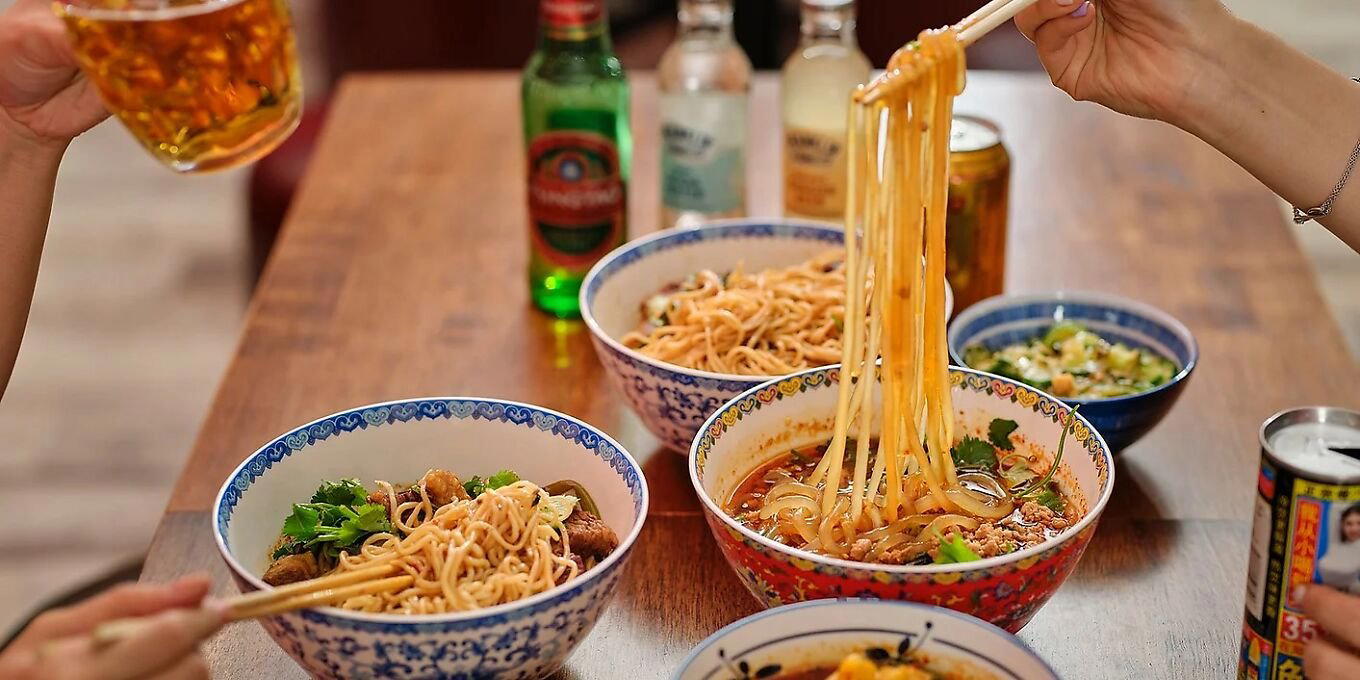
A Mews Address and a Menu Built for Precision
Weymouth Mews is a quiet address in Marylebone. The cobbled lane sits a short walk from Marylebone High Street but operates at a completely different register: quieter, residential, unmarked. Arriving at The Jackalope, the pub-adjacent setting that houses LIU Xiaomian, you are confronted immediately with a productive tension, the surroundings suggest a neighbourhood local, but the menu that follows belongs to a much more specific culinary tradition.
That tradition is Chongqing xiaomian, the spiced noodle format that functions as the everyday fuel of southwest China's largest city. In London, regional Chinese specificity has historically been flattened into a generic Cantonese or pan-Asian shorthand. The past decade has seen that change, with Sichuan-focused operators and regional specialists beginning to hold distinct positions in the market. LIU Xiaomian sits inside that shift, placing a single regional format at the centre of its menu rather than hedging toward a broader, more accessible Chinese repertoire.
What the Menu Architecture Reveals
The editorial interest of any xiaomian-focused menu lies in what the format demands of the kitchen. Xiaomian is not a canvas for elaborate plating or imported luxury ingredients. It is a study in condiment architecture: the ratio of chilli oil to sesame paste, the depth of the broth, the texture of the alkaline noodle, the balance between Sichuan peppercorn numbness (ma) and chilli heat (la). A menu built around this format is, by definition, an argument about those proportions, and the kitchen's position on that argument is legible in every bowl served.
This is markedly different from the approach taken by London's established formal Chinese dining rooms, where the menu tends toward breadth and banquet logic. It is also distinct from the capital's Sichuan operators who use the cuisine's heat as one element within a larger dim sum or sharing-plate structure. A xiaomian-centric menu narrows the frame deliberately. The kitchen is committing to depth over range, and the guest is expected to read that commitment correctly.
For context, London's £££-plus tier across other cuisines, venues like CORE by Clare Smyth, Sketch, The Lecture Room and Library, or The Ledbury, is built on multi-course tasting logic where menu length signals ambition. The xiaomian format inverts that: fewer dishes, tighter focus, and a demand that the core product be executed with consistency rather than variety. It is a harder editorial position to hold in a city that rewards novelty.
Marylebone as Context
The neighbourhood placement is worth reading carefully. Marylebone has consolidated over the past fifteen years as one of London's more interesting mid-tier dining destinations, distinct from the Michelin density of Mayfair or the trend-chasing pace of Shoreditch. The area's dining character leans toward considered independents and quality-conscious operators rather than destination fine dining or high-volume casual. Weymouth Mews, specifically, is the quieter end of that quieter neighbourhood, a location that signals some confidence in the product's ability to draw visitors rather than relying on footfall.
That confidence is consistent with how regional Chinese specialists tend to position themselves in London. The venues that have made the strongest case for Chinese regional cuisine, whether Hunanese, Sichuan, or Yunnanese, have rarely needed high-street visibility to build a following. The audience for this kind of specificity travels for it.
How This Fits London's Broader Chinese Dining Story
London's relationship with Chinese cuisine has been slowly rewiring. For most of the twentieth century, the city's Chinese dining was anchored in Gerrard Street and its surroundings, with a menu logic shaped by diaspora practicality and mass-market expectation. The emergence of regional specialists, in Bayswater, in the suburbs, and increasingly in central neighbourhoods, represents a structural shift in what London's Chinese dining can be.
Internationally, the benchmark for that shift has been set in cities like New York, where venues such as Atomix have demonstrated that Asian regional cooking, positioned with precision and editorial intent, can hold a serious place in a competitive fine-dining market. In London, the equivalent argument is still being made, and it is being made largely by operators willing to plant a flag in a single regional tradition rather than trying to represent the breadth of Chinese cuisine in one menu.
LIU Xiaomian's Marylebone address puts it in a peer conversation not with Chinatown's established operators but with the newer wave of regional specialists across the capital. For readers interested in the full range of London dining, that terrain includes venues like Restaurant Gordon Ramsay, Dinner by Heston Blumenthal, and the broader field of UK destination dining at Waterside Inn, Le Manoir aux Quat'Saisons, L'Enclume, Moor Hall, Gidleigh Park, Hand and Flowers, hide and fox, Midsummer House, Opheem, and Restaurant Andrew Fairlie.
Planning Your Visit
LIU Xiaomian Marylebone is located at The Jackalope, 43 Weymouth Mews, London W1G 7EQ. The mews address is most easily reached from Marylebone High Street or via Bond Street and Baker Street underground stations.
The format and location suggest an accessible, informal register rather than a jacket-required dining room, consistent with the xiaomian tradition, which originates in the street-food stalls of Chongqing rather than any banquet context. Visitors arriving from the formal end of the London dining spectrum, or from comparable international addresses such as Le Bernardin in New York, should calibrate expectations accordingly: the value here is in craft and regional specificity, not ceremony.
Quick reference: 43 Weymouth Mews, London W1G 7EQ. Located within The Jackalope. Nearest stations: Bond Street, Baker Street.
Accolades, Compared
Comparable venues nearby, for context on price, style, and recognition.
| Venue | Cuisine | Price | Notes |
|---|---|---|---|
| LIU Xiaomian MaryleboneThis venue — the venue you are viewing | Chongqing Spicy Noodles | $ | Not listed |
| Wong Kei | Cantonese | $ | Chinatown |
| Hong Kong restaurant | Halal Cantonese Dim Sum | $$ | Canonbury |
| Master Wei Hammersmith | Authentic Xi'an Noodles | $$ | Hammersmith Broadway |
| Jia | Cantonese Dim Sum | $$ | Earl's Court |
| BaoziInn | Modern Chinese Dim Sum & Baozi | $$ | Soho |
Continue exploring
More in London
Restaurants in London
Browse all →
Bars in London
Browse all →
Hotels in London
Browse all →

At a Glance
- Cozy
- Trendy
- Casual Hangout
Current opening hours
- Monday
- Closed
- Tuesday
- 12–2:30 PM, 6–9 PM
- Wednesday
- 12–2:30 PM, 6–9 PM
- Thursday
- 12–2:30 PM, 6–9 PM
- Friday
- 12–2:30 PM, 6–9 PM
- Saturday
- 12–2:30 PM, 6–9 PM
- Sunday
- Closed
Hours can change for holidays and private events. Last verified .
Buzzy, dimly lit basement space with simple counter service and aromatic spicy scents.