Little Beet
Little Beet at 111 W 40th St occupies a corner of Midtown Manhattan where fast-casual health-forward dining meets the lunch rhythms of office towers and Bryant Park visitors. Relative to the tasting-menu tier represented by venues like Le Bernardin or Per Se, it operates at a different register entirely, accessible, grain- and vegetable-led, and suited to the daytime crowd that defines this stretch of Sixth Avenue.
Pearl is the En Primeur Club membership app — saves, bookings, and concierge access live there. Same editors, same standards.
- Address
- 111 W 40th St, New York, NY 10018
- Phone
- +1 917 338 7111
- Website
- thelittlebeet.com
- Directions
- Get directions
 Saves & bookings on Pearl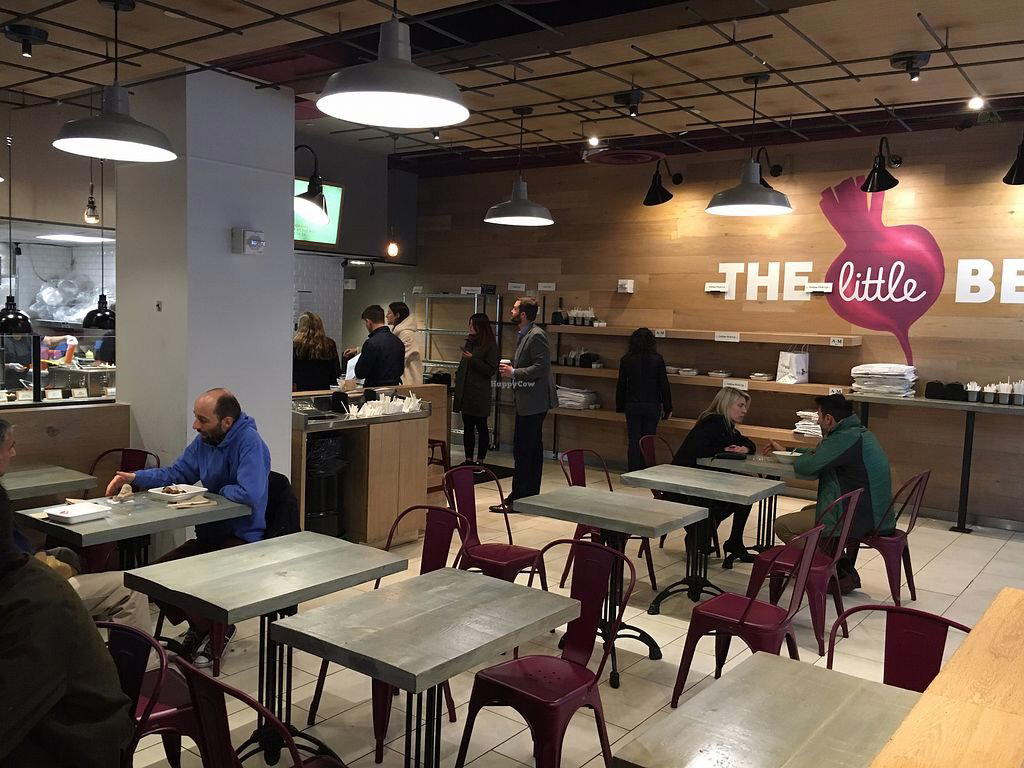
Midtown's Daytime Dining Register
Little Beet is a casual, fast-casual restaurant in Midtown Manhattan at 111 W 40th St, New York, NY 10018, with a price around $15 per person. Office density, hotel foot traffic, and the proximity of the public library and several major media headquarters create a daytime crowd that differs considerably from the evening-out visitor who books weeks ahead at Le Bernardin or Per Se. This is a corridor where fast-casual formats with some nutritional intentionality have found their steadiest audience, people who eat out five days a week and want something that performs better than a deli counter without requiring a reservation or a long table-service window.
Little Beet at 111 W 40th St sits inside that pattern. The address places it squarely in the commercial core of Midtown, within walking distance of Times Square to the north and the Garment District to the south. At street level, the format reads as accessible and daytime-focused rather than destination dining in the tasting-menu sense that Atomix or Eleven Madison Park occupy.
The Fast-Casual Health Format in New York Context
New York's health-forward fast-casual category expanded substantially through the 2010s, and the Midtown office corridor absorbed a significant portion of that growth. The model, grain bowls, roasted vegetables, lean proteins assembled to order, proved well-matched to the lunch habits of a workforce that values speed and some degree of nutritional transparency. What distinguishes operators within this format is less the individual ingredient and more the coherence of the sourcing story and the consistency of execution across a high-volume service window.
Vegetables and grains anchoring a menu, rather than appearing as sides to a protein, represents a structural shift from the plate-centre protein model that defined American casual dining for generations. In cities like San Francisco, where Lazy Bear represents the fine-dining pole, and New Orleans, where Emeril's built its reputation on a protein-forward Louisiana tradition, the vegetable-forward format remains a smaller niche. In Midtown Manhattan, it operates at scale.
Team Coordination at Volume
The editorial angle worth applying to any fast-casual operation at this address is not the individual chef or the single signature dish, it is how the floor team and kitchen team coordinate across a compressed service window. In a tasting-menu environment like The French Laundry in Napa or Smyth in Chicago, the collaboration between a sommelier, a chef de cuisine, and a front-of-house manager operates over two or three unhurried hours per cover. The staff-to-guest ratio is high and the pacing is controlled.
At a Midtown fast-casual counter, the dynamic inverts. The kitchen team needs to execute assembly with speed and accuracy across a lunch rush that may compress most of its daily covers into ninety minutes. The front-of-house role shifts from hospitality orchestration toward queue management and order clarity. Both models require real team discipline, the pressures are simply different in kind. Operators like Single Thread Farm in Healdsburg and Blue Hill at Stone Barns have built reputations on the former model. The latter, executed well at volume, is its own form of operational competence.
Positioning Within New York's Broader Restaurant Map
Understanding where Little Beet sits within New York's dining spectrum requires acknowledging the width of that spectrum. At one end, Masa represents the highest per-cover price point in the American sushi category, with an omakase format that operates on scarcity and craft. At the other, the city's fast-casual sector competes on accessibility, throughput, and the ability to hold quality at high volume. Both ends of that range require genuine operational seriousness to sustain, they just express it differently.
The restaurant occupies the accessible end. That is not a diminishment. For a reader who is eating near Bryant Park on a weekday, the relevant comparable set is not Providence in Los Angeles or Addison in San Diego. It is the other options within a ten-minute walk, and within that comparison, a format that centres whole grains and vegetables with some transparency about sourcing has a real point of difference from the deli and fast-food alternatives that dominate the immediate blocks.
Situating the Gluten-Free Format
One structural detail that places the restaurant in a specific niche within the fast-casual category is its gluten-free orientation. Entirely gluten-free menus in a restaurant setting, rather than a single gluten-free section within a broader menu, remain relatively rare, and that specificity creates a defined audience that goes beyond general health-consciousness. Diners with coeliac disease or a medical requirement for gluten avoidance have a narrower field of options in any city, and a Midtown Manhattan location that can serve that need at lunch pace represents a genuine gap being filled. The format is also of interest to venues internationally; the farm-to-table discipline at places like Frasca Food and Wine in Boulder or the ingredient-sourcing rigour at Atelier Moessmer Norbert Niederkofler in Brunico operates through a different lens, seasonality, terroir, but the underlying discipline of building a menu around clear constraints shares some structural logic.
The Italian tradition of cooking within strict regional and seasonal parameters, visible also at Dal Pescatore in Runate and echoed in how The Inn at Little Washington approaches its sourcing, suggests that constraint-led menus can produce coherence rather than limitation. A gluten-free fast-casual format is a different kind of constraint, but the operational discipline required to maintain it across high volume is not trivial.
Planning Your Visit
The restaurant is located at Address: 111 W 40th St, New York, NY 10018, placing it between Sixth Avenue and Bryant Park. Reservations: The fast-casual counter format means walk-in is the standard approach, with the lunch rush typically falling between noon and 2 pm on weekdays. Budget: The price tier sits well below the tasting-menu venues in Midtown; expect a daytime meal to fall into the lower fast-casual range for New York. Dress: No dress code; the format suits business casual and casual equally. Timing:
The Essentials
Comparable venues nearby, for context on price, style, and recognition.
| Venue | Cuisine | Price | Notes |
|---|---|---|---|
| Little BeetThis venue — the venue you are viewing | Not listed | $$ | Not listed |
| Junior's Restaurant & Bakery | Not listed | $$ | Midtown-Times Square, Classic American Diner & Cheesecake |
| Dishes | Midtown-Times Square, American Deli | $$ | Not listed |
| Ambassador Grill | Not listed | $$ | East Midtown-Turtle Bay, American Steakhouse with Global Influences |
| Dig Inn | Not listed | $$ | Midtown South-Flatiron-Union Square, Farm-to-Table American Bowls |
| Forty Carrots | Not listed | $$ | Upper East Side-Carnegie Hill, American Cafe with Frozen Yogurt |
Continue exploring
More in New York City
Restaurants in New York City
Browse all →
Bars in New York City
Browse all →

Hotels in New York City
Browse all →





At a Glance
- Modern
- Trendy
- Casual Hangout
- After Work
- Open Kitchen
Current opening hours
- Monday
- 10 AM–9 PM
- Tuesday
- 10 AM–9 PM
- Wednesday
- 10 AM–9 PM
- Thursday
- 10 AM–9 PM
- Friday
- 10 AM–9 PM
- Saturday
- 11 AM–9 PM
- Sunday
- 11 AM–9 PM
Hours can change for holidays and private events. Last verified .
Bright, bustling fast-casual atmosphere in busy food halls like Penn Station and Grand Central, with a focus on fresh, healthy eats amid urban hustle.