
Michelin Plate
Our verdict
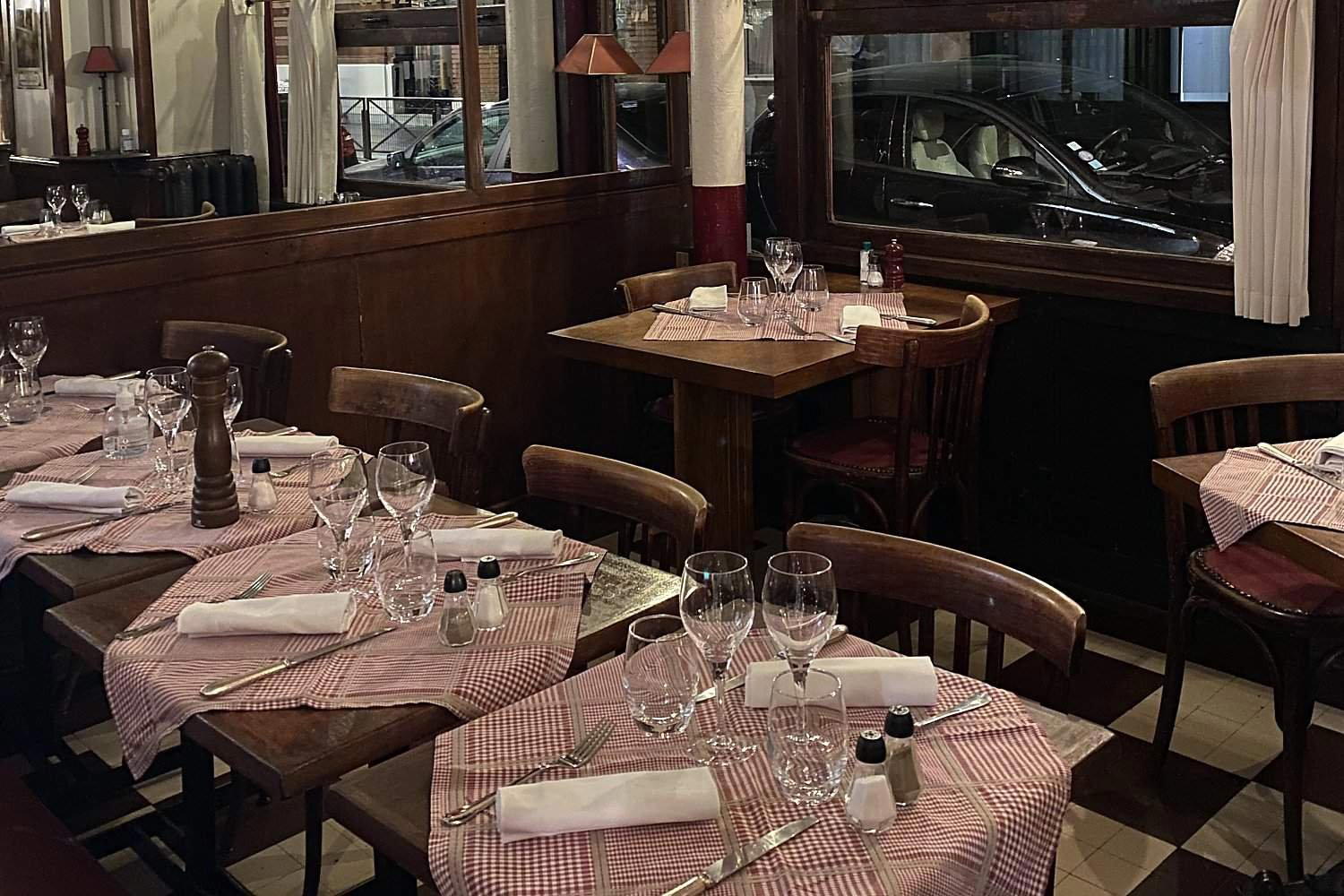
À L'Improviste on rue Médéric operates in the tradition of the classic Parisian bistro, where the menu changes daily and the room rewards regulars with napkin ring holders at their usual tables. Chef Jean-Marc Notelet, formerly of Caïus, brings considered technique to straightforward cooking: beef cheek in red wine, rice pudding with salted butter caramel. The aesthetic is unambiguously old-school, and deliberately so.

Pearl is the En Primeur Club membership app, where members save venues, book tables and use the concierge.
The menu
What to order
- Baba au rhum
- Tarte Tatin
- Terrine de campagne
The Bistro as It Was Meant to Be
There is a particular register of Parisian dining room that no amount of renovation can replicate convincingly: wooden chairs worn smooth by decades of use, enamel signs fixed to walls that have absorbed the smell of slow-braised meat and good red wine, red checked napkins folded just so. À L'Improviste on rue Médéric occupies that register without affectation. The room does not perform nostalgia, it simply has not abandoned it. Napkin ring holders sit on the tables for regulars, a detail that separates a working neighbourhood bistro from one that is merely dressed to look like one.
Paris has no shortage of restaurants selling the idea of the traditional bistro. Far fewer can claim the actual fabric of it: the physical patina, the daily-changing slate, the sense that lunch on a Tuesday and dinner on a Friday will produce different things because the market and the week dictate it. This is the environment À L'Improviste creates, and it is the reason the address registers differently from the grand dining rooms of the 8th arrondissement, where places like Le Cinq at the Four Seasons Hôtel George V and Alléno Paris au Pavillon Ledoyen operate at a completely different pitch of ambition and formality.
What the Room Tells You Before You Order
The sensory cues at À L'Improviste do real editorial work. The wooden furniture and enamel signage signal that the kitchen is not trying to reinvent anything. The checked napkins in their rings tell you the house expects you to come back. This is not a room designed for a single occasion, it is designed for a relationship, the kind of local-restaurant loyalty that Parisian neighbourhood dining has built over generations.
That aesthetic logic extends to the menu format. A daily-changing slate imposes a discipline on the kitchen that fixed menus do not: the cook must respond to what is available and what is good, not what was printed last season. In practice, this means dishes like pâté des copains with hazelnuts, beef cheek braised in red wine until it yields completely, and rice pudding finished with salted butter caramel, the kind of cooking that requires patience and proportion rather than invention. These are the benchmarks of the traditional French kitchen, and they travel well across the comparison set. The three-Michelin-starred rooms at L'Ambroisie or the Franco-Japanese precision of Kei operate on entirely different logic, technique as spectacle, tasting menus as event. À L'Improviste answers a different question: what does a well-cooked bistro plate taste like when the cook is serious and the brief is simple?
Chef Notelet and the Tradition He Carries
The broader French culinary conversation has long been pulled between grand classicism and creative modernism. Houses like Arpège redefined what a three-star kitchen could do with vegetables; places like Mirazur in Menton absorbed Mediterranean influence at altitude; Troisgros in Ouches has been rewriting its own legacy across generations. The regional anchors, Auberge de l'Ill in Alsace, Bras in the Aveyron, Paul Bocuse in Collonges, each represent a kind of monument to a particular idea of what French cooking is.
À L'Improviste sits outside that monument-making impulse entirely. Chef Jean-Marc Notelet came to rue Médéric from Caïus, a respected address in the 17th, and the transition tracks a coherent line: considered, ingredient-led cooking expressed without theatrical framing. The tribute here is to the bistro form itself, to the idea that a daily pâté, a proper braise, and a well-made pudding, executed with care, constitute a complete and honest meal. That is not a modest ambition. It is a specific and demanding one.
How It Fits Into Paris Now
The 17th arrondissement does not have the dining density of the Marais or the Left Bank, and rue Médéric in particular is not a street you are likely to arrive at accidentally. That relative obscurity is part of the address's character. The regulars with their napkin rings are neighbourhood diners, not tourists triangulating between landmarks. The daily menu format reinforces this, a visitor who arrives expecting a fixed reference point will need to adapt to what the kitchen has decided today, which is part of the experience rather than a drawback.
For readers who want the wider Paris picture, our full Paris restaurants guide maps the city's dining scene across price points and arrondissements. Our Paris hotels guide, bars guide, and experiences guide round out the planning picture. For those interested in French wine to accompany a meal at this register, the Paris wineries guide is a useful reference point, and further afield, Flocons de Sel in Megève represents the Alpine end of the French culinary range, a useful counterpoint when thinking about how regional and seasonal specificity operates across different contexts.
Outside France, the bistro register has been translated with varying fidelity. Le Bernardin in New York operates at the high-formality end of French-trained cooking in America; Emeril's in New Orleans takes French technique into a completely different culinary vernacular. Neither is trying to do what À L'Improviste does, which underlines how specific the traditional Paris bistro format remains to its own context.
Planning Your Visit
À L'Improviste is at 21 rue Médéric in the 17th arrondissement. The daily-changing menu means there is no fixed reference point to preview in advance, arriving with flexibility is part of the contract. Given the neighbourhood positioning and the regulars-first atmosphere, booking ahead is advisable, particularly for dinner and weekend lunch. The bistro format and pricing will sit well below the €€€€ tier occupied by the city's grand tables, placing it in the accessible range for most visitors who are not anchoring their trip around tasting-menu dining. Nearest metro access is via Courcelles or Monceau on line 2.
Frequently asked questions
Where exactly is À L'Improviste?
À L'Improviste is located at 21 rue Médéric, Paris.
Has À L'Improviste won any awards?
À L'Improviste has received recognition including: Chef Jean-Marc Notelet (formerly at Caïus) pays a heartfelt tribute to traditional cuisine and the simple pleasures of the bistro. The space has retained its original charm and old-school bistro aesthetic – wooden furniture, enamel signs, r….
What's the must-try dish at À L'Improviste?
The menu changes daily, which means no single dish is guaranteed on any given visit. The kitchen's documented repertoire includes pâté des copains with hazelnuts, braised beef cheek in red wine sauce, and rice pudding with salted butter caramel, the kind of slow-cooked, produce-led cooking that defines what Chef Jean-Marc Notelet (formerly of Caïus) is building here. Arriving without a fixed expectation is part of the format.
Should I book À L'Improviste in advance?
Yes. The bistro at 21 rue Médéric draws a loyal local following, and the daily-changing menu gives regulars, some of whom have named napkin rings reserved for them, strong reason to return repeatedly. A compact room plus that kind of repeat clientele means walk-in tables are not reliable. Book ahead, particularly for dinner and weekend services.
Nearby-ish Comparables
Comparable venues nearby, for context on price, style, and recognition.
| Venue | Cuisine | Price | Awards | Notes |
|---|---|---|---|---|
| À L'ImprovisteThis venue (the venue you are viewing) | Traditional French Bistro | $50–100 | Michelin Plate | Not listed |
| L'Esquisse | Modern French Bistronomic | $30–50 | Michelin Plate | 18th arrondissement (Montmartre) |
| Richer | Modern French Bistro | $30–50 | Michelin Plate | 9th arrondissement |
| La Grande Ourse | Modern French Bistro | $30–50 | Michelin Plate | 14th Arr. |
| Anecdote | Homemade French Bistro | Not listed | Michelin Plate · Relais Chateaux Award | Bastille |
| Quedubon | Traditional French Bistro | $30–50 | Michelin Plate | 19th arrondissement |
Recognition history
Dated appearances from independent guides and award organizations, with the underlying list record or original source where available.
Michelin Plate
Michelin · 2026 Michelin Plate
Full recognition history (2 entries)
Michelin Bib Gourmand
Michelin
Continue exploring
More in Paris
Restaurants in Paris
All restaurants in Paris →

Bars in Paris
All bars in Paris →



Details
- Cozy
- Classic
- Intimate
- Date Night
- Casual Hangout
- Family
- Historic Building
- Extensive Wine List
- A La Carte
- Wine
Current opening hours
- Monday
- 12–2 PM, 7:30–10 PM
- Tuesday
- 12–2 PM, 7:30–10 PM
- Wednesday
- 12–2 PM, 7:30–10 PM
- Thursday
- 12–2 PM, 7:30–10 PM
- Friday
- 12–2 PM, 7:30–10 PM
- Saturday
- Closed
- Sunday
- Closed
Hours can change for holidays and private events. Hours as of .
Cozy and inviting with wood paneling, gingham tablecloths, and original decor preserving its vintage bistro charm.