Our verdict
Le Rempart occupies a place in Ciney's dining scene that reflects the broader character of Wallonian provincial dining: rooted in place, unhurried in pace, and operating at a remove from the award-circuit noise of Brussels or Bruges. Concrete details on format, pricing, and chef remain limited, making a direct booking inquiry the most reliable first step for visitors to this part of the Namur province.

Pearl is the En Primeur Club membership app, where members save venues, book tables and use the concierge.

Provincial Wallonia at the Table: What Ciney's Dining Scene Tells You
The town of Ciney sits in the Condroz plateau of the Namur province, a stretch of Belgian countryside defined by cattle farming, gentle limestone ridges, and a food culture that has never needed to perform for outside audiences. Unlike the Flemish dining corridor that runs through Ghent, Bruges, and Antwerp, where restaurants like Zilte in Antwerp and Boury in Roeselare operate inside an internationally legible prestige system, Wallonian provincial towns tend to support a different kind of establishment: places where the cooking is anchored to local produce and tradition rather than to a global fine-dining grammar. Le Rempart fits inside that context. It is a Ciney address, in a town whose dining identity is shaped more by the agricultural rhythms of the Condroz than by the competitive pressures of Belgium's starred circuit.
That distinction matters when you are deciding how to spend a meal in this part of the country. The restaurants that draw the most sustained critical attention in Wallonia tend to cluster along specific corridors or in destinations with established tourism infrastructure. L'air du temps in Liernu is the region's most prominent example of a Wallonian restaurant operating at international reference level. Ciney, by contrast, supports a dining scene built around local regulars and the occasional visitor passing through on the way to the Ardennes. That is not a criticism; it is a structural fact about how provincial restaurant culture works, and it sets the right expectations before you sit down.
The Cultural Logic of Wallonian Restaurant Dining
Belgian cuisine in its Wallonian expression is distinct from its Flemish counterpart in ways that go beyond language. The cooking traditions of Namur and its surrounding provinces draw on a larder shaped by cattle breeding, game, freshwater fish from the Meuse and its tributaries, and a deep familiarity with slow, fat-enriched preparations that predate the nouvelle cuisine era. Dishes built around Blanc Bleu Belge beef, lapin à la Liégeoise, or civet de sanglier are not nostalgic gestures in this part of the country; they are the baseline, the thing against which more contemporary departures are measured.
This cultural grounding is why restaurants in towns like Ciney often resist the kind of clean categorization that urban dining guides rely on. They may not declare a cuisine type, maintain a consistent tasting menu format, or position themselves explicitly within a price tier the way that Bozar Restaurant in Brussels or a reference counter like Le Bernardin in New York City would. The format is often closer to a traditional Belgian restaurant: a printed menu with multiple courses, a wine list weighted toward France and the southern Belgian producers, and a dining room that expects you to take your time. Le Rempart carries the name of the medieval fortifications that once defined Ciney's urban boundary, a naming choice that locates it within the town's historical identity rather than positioning it as a departure from it.
Le Rempart in the Context of Ciney's Options
Ciney's restaurant offering is compact by the standards of any provincial Belgian town with a comparable population. The addresses worth knowing sit across a narrow range of formats and price points. RectoVerso represents the French Contemporary end of that range, operating at the €€ tier and providing a more clearly delineated modern dining experience. Auberge du Château de Leignon introduces a different register entirely, anchored in the kind of château-adjacent hospitality that Namur province does with some consistency. Chocolaterie du Château de Leignon serves a different function again, as does Sigoji, which extends the town's options into a separate culinary register. 97 Rue Piervenne rounds out the picture as another local address operating in the town's mid-range.
Le Rempart does not sit at the experimental end of this set. Its name and position within the town suggest a more rooted, traditional orientation, the kind of Belgian provincial restaurant where the cooking speaks to accumulated local knowledge rather than to a contemporary fine-dining idiom. For a fuller picture of how these addresses relate to one another, the full Ciney restaurants guide maps the town's options across formats and price points.
What to Know Before You Go
Le Rempart's public data is thin. In smaller Belgian towns, this kind of information gap is often a signal that the restaurant operates primarily for a local clientele rather than for visitors who arrive through digital channels. That pattern is common across provincial Wallonia, and it is not necessarily a barrier: showing up at a town address during standard Belgian lunch or dinner service windows (typically noon to two-thirty and seven to nine-thirty) is often how locals have always made these discoveries.
For context on the broader Belgian dining tradition that informs restaurants at this level and in this region, the Flemish circuit provides a useful reference frame: Hof van Cleve in Kruishoutem, Willem Hiele in Oudenburg, Bartholomeus in Heist, De Jonkman in Sint-Kruis, Castor in Beveren, and d'Eugénie à Emilie in Baudour all show what Belgian kitchens can do when operating with full critical visibility. Le Rempart occupies a quieter position in that national picture, but the provincial dining tradition it represents is no less grounded in what makes Belgian cooking worth seeking out. And for Korean-inflected fine dining at international reference level, Atomix in New York City illustrates how far the range extends at the other end of the spectrum.
Frequently asked questions
Can I bring kids to Le Rempart?
Le Rempart is a provincial Belgian restaurant in Ciney rather than a tasting-menu-only fine dining address, which makes it a reasonable choice for families. Restaurants of this type in Namur province typically operate as traditional dining rooms where children are accommodated without issue.
What should I expect atmosphere-wise at Le Rempart?
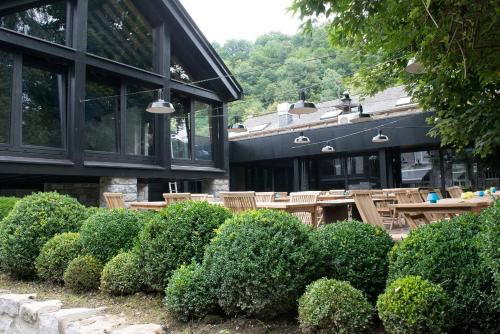
Ciney's dining addresses in this category tend toward traditional dining room formats: tablecloths, measured service pacing, and a room that reflects the agricultural character of the Condroz plateau rather than any urban-facing design trend. Le Rempart's name references the town's historic fortifications, which may inform the setting.
Is Le Rempart a practical stop for visitors travelling between Namur and the Ardennes?
Ciney sits on the Condroz plateau in Namur province, placing it along the natural corridor between the city of Namur and the deeper Ardennes to the east. For travellers covering that route, Le Rempart represents a locally rooted dining option rather than a destination detour.
What's the best thing to order at Le Rempart?
Restaurants of this type in the Namur province frequently draw on the region's cattle farming tradition, meaning beef preparations and locally sourced produce tend to anchor the kitchen's output.
Budget Reality Check
Comparable venues nearby, for context on price, style, and recognition.
| Venue | Cuisine | Price | Awards | Notes |
|---|---|---|---|---|
| Le RempartThis venue (the venue you are viewing) | French Gastronomic Fine Dining | $50–100 | Not listed | Not listed |
| Auberge du Château de Leignon | Refined French Market Cuisine | Not listed | Not listed | Leignon, Refined French Market Cuisine |
| RectoVerso | Contemporary French Seasonal | $50–100 | Michelin Plate | Ciney, Contemporary French Seasonal |
| Chocolaterie du Château de Leignon | Artisan Chocolaterie | Not listed | Not listed | Leignon, Artisan Chocolaterie |
| 97 Rue Piervenne | Franco-Belgian Bistro | Not listed | Not listed | Faubourg Piervenne, Franco-Belgian Bistro |
| Sigoji | Artisanal Belgian Chocolates | Not listed | Not listed | Ciney, Artisanal Belgian Chocolates |
Continue exploring
More in Ciney
Restaurants in Ciney
All restaurants in Ciney →
Bars in Ciney
Browse all →
Hotels in Ciney
Browse all →

Wineries in Ciney
Browse all →

Details
- Intimate
- Cozy
- Elegant
- Special Occasion
- Date Night
- Historic Building
- Extensive Wine List
- Local Sourcing
- Set Menu
Current opening hours
- Monday
- Closed
- Tuesday
- Closed
- Wednesday
- 12–2 PM, 7–9 PM
- Thursday
- 12–2 PM, 7–9 PM
- Friday
- 12–2 PM, 7–9 PM
- Saturday
- 7–9 PM
- Sunday
- Closed
Hours can change for holidays and private events. Hours as of .
Cozy and intimate atmosphere in a historic building with refined, welcoming service.